Management
Cosmic Principle No. 4
Don’t fall off the Cliff of Trust
Management
Cosmic Principle No. 4Don’t fall off the Cliff of Trust
Finance
The economics of the happy coupleA reminder of what you are looking for in a financial investment, and a warning against a common mistake
History
Are you related to Harry Kane?Yes, you are and so am I. And that is the true beauty of the World Cup.
Culture
MazawatteeTalented people should build things step by step, like an Indie band
Economics
Who should pay tax?Everyone, surely. But some of our compatriots are enjoying the greatest of all loopholes.
Technology
The alternative to a social media banI propose a new model based on the latest, on-demand technology and a regulatory construct which has worked for over a century in other industries
Management
Cosmic Principle No. 3Leave your top performers alone (they already know what to do)
Culture
Computer games are good for youAlthough, as a kid, I was always told the opposite
Politics
Vance is Gletkin.Revolutions are started by people who believe that something must change. But they are sustained by a second generation who do not ask questions, and use the revolution to advance their own positions.
Strategy
What exactly is an insight?A 2 minute read for anyone in a management role
Economics
How to blow your own foot offPick up the musket called 'tariff policy' and start yanking on the trigger
Technology
How to fix social mediaA good start would be for all users to say who they are
Politics
Common sense? Nonsense.The problem with 'common sense' is that it is a status quo concept and frequently antithetical to progress
Management
Cosmic Principle No. 2Something to think about as you finalise your New Year resolutions
Management
Cosmic Principle No. 1If we could each have an eponymous law, this would be mine
Business
The Bad Good IdeaWhat happens when corporate innovation goes wrong
Life
Life advice – from chessIf you don't have a master-plan, do what you can to build your position.
Probability
The House Always WinsBut do you know why?
Environment
Every cloud has a sulphur liningA look at the unexpected climate benefits of sulphur pollution
Economics
We only have 5 thingsAnd I am thinking about re-naming this newsletter after one of them.
Climate
Electric vehicles and the parable of the magic buttonA short contrarian read about the vehicle replacement cycle
Education
Advice for a college freshmanA 10 point plan for anyone you know who is heading off to university this year
Management
You're the decision maker nowCongrats – you earned it! But how will you know if you are doing a good job?
Finance
The most crowded trade in the cityA look at the perils, or potential, of TG61 – a very long duration bond.
Education
The College Essay is dead – Long Live the 'AI Viva'A simple solution to the problem everyone is talking about on campus
Finance
Everybody makes the same valuation mistakeThey forget to factor the fade.
Politics
The problem with 'common sense' is that it is a status quo concept and frequently antithetical to progress

In a competition for tired clichés, I could do worse than observe that we are living in an age of populism. There would be nothing at all novel in saying that.
However, if I went on to ask what exactly we take the term populism to mean, I doubt that we would all give the same answer - because populism as we know it comes in many different varieties and flavours.
And yet the basic recipe, if I am not mistaken, is relatively simple to pin down. Indeed it turns out that populism is a cake you can bake with just the following two, insidious ingredients:
To give these two dubious ingredients their correct labels, we might say that populism defines the problem as ‘the enemy within’, and the solution as ‘common sense’.
Which is, to cut a long story short, pretty much how I have arrived at the subject of this column.
Common Sense is, I accept, a useful philosophical razor. We can helpfully appeal to common sense when we see the risk of over-thinking things, and it is important that we do since experts are frequently wrong. If the first vice of the intellectual is to over-analyse the problem, the second is surely to over-engineer the solution.
Once you start looking for examples you see them everywhere. Often the policy architect has stumbled into an ever-more-detailed labyrinth of good intentions, imagining that the fluid complexity of human behaviour in the modern economy can be artfully channelled and managed through an ever more intricate system of intellectual dykes and levees. But as a rule, such approaches quickly boil down to pointless and unproductive complexity.
I encountered a memorable if minor example in my first real job after graduating, when I worked for a time in West Africa. In the country where I worked, the European Union had been running a project with the Ministry of Finance to establish a nomenclature budgétaire (a new set of budget expenditure codes) but it was taking years to reach any kind of conclusion. A glance online suggests that the task was finally completed in 2019, nearly two decades later. Common sense does seem to suggest that a simpler and faster solution could have been found.
More consequential examples are widely discussed. Health & Safety. Data Protection. Cookies. The proliferation of detailed financial regulations in the run up to the Global Financial Crisis in 2007/8, which did nothing to prevent a crash - and perhaps encouraged one. The development of detailed rules and processes for ESG investment in the asset management industry. The development of Social Justice Fundamentalism on US college campuses. The European Emissions Trading Scheme.1
In each of these areas, good intentions have morphed over time into counterproductive complexity, and a dose of common sense could indeed have been useful. Common sense can offer a sniff-test of sorts. It can be the antidote to over-thinking. It can allow us to step back for a moment and ask: do we really think this solution we have come up with is actually going to work?
But what about cases where the problem is under-thinking? Here the emotional or instinctive response is the problem, not the cure.
What do you think, for example, of the following scenario:
Witnesses are known to be reliable 99% of the time
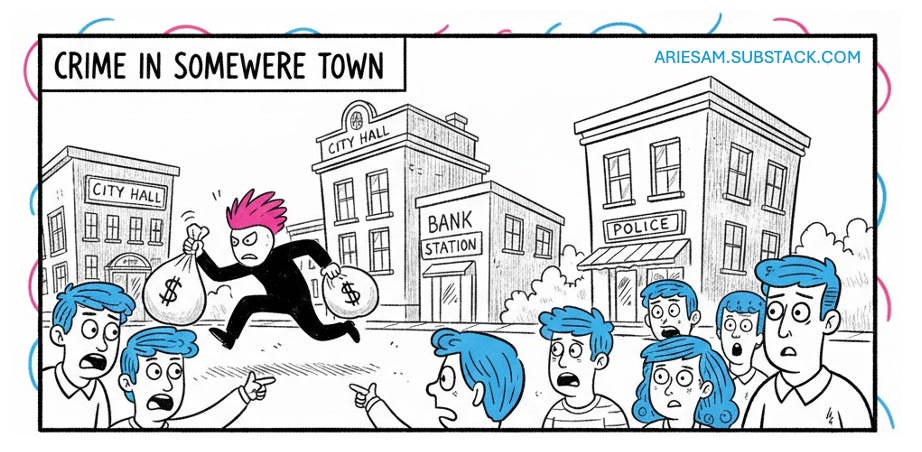
What does so-called ‘common sense’ tell you here? It tells you that the police should be searching for a pink-haired perp, since witnesses are highly reliable (and what the witness saw was so unusual). But this is, literally, the text book case of a misleading intuition.
The reality, as Bayesian analysis reveals, is that the perp is no more likely to have pink hair than blue. This follows because, without any further information, the chance that the witness has made a correct identification (99% accuracy x 1% of the population) is the same as the chance of an incorrect one (1% error rate x 99% of the population). Which means, if you think about it, that the police might as well be tossing a coin.2
Another recent example of under-thinking the problem is the idea that a country running a trade deficit is being ripped off by its trading partners - when in reality, the opposite is the case. If your country runs a trade deficit, it simply means that other nations are financing your consumption, by agreeing to hold your currency and very often also real assets in your country. Without this international support, your currency would depreciate, your citizens would have to consume less and, among other consequences, even well-known real estate developers would struggle to find international buyers.3
Another problem with common sense is that it clearly changes over time. It used to be common sense to many people that women should not work, or vote, or own property or do many other things which men were allowed to do. Or that certain races should be enslaved by other races. Thankfully these beliefs are no longer considered acceptable in most parts of the world, but the fact that what is thought of as ‘common sense’ can change so dramatically over time is a strong indicator that common sense itself is not an objective measure of anything.
And in the same way, what is considered ‘common sense’ also changes from one country to another: just look at how the minimum legal age varies for universal activities like driving a car, buying alcohol or getting married. This problem creates an issue in law (known as the Spanish bullfighter problem) if a citizen of one country does something in another country, which is legal there - but illegal back at home. 4
The point is that cultural and legal attitudes vary greatly around the world, and over historical time periods, and this highlights how subjective the supposed benchmark of common sense must be. What appears common sensical in one time or place may seem outrageous in another - which makes it very hard to see ‘common sense’ as something firm we can rely on.
A final concern is that common sense is frequently an expression of what people already believe in a given time and place, and so it is a concept which is fundamentally reflective of the status quo. It is therefore in some sense a backward looking ideal, based on everything we have learned and thought so far, in contrast to forward looking ideals (like innovation, discovery and progress) which are based on the idea that things can always get better.
In the end, we are left wondering how such a variable, elusive and backward-looking concept could ever have been offered up as a problem-solving tool.
Returning to our opening topic of populism, you will realise that I have not made any inroads into the concept of the enemy within. I am leaving it to you to decide if the difficulties we face in society are deliberately created by nefarious elites, or stubbornly persist despite our best efforts to solve them. And likewise I will leave it to you to decide what you think of the concept of some people being more ‘authentic’ than others, which is the part I find hardest to fathom.
But on the subject of the common sense solution, I think we can make some analytical progress. All we need to do is to recognise that for any given problem we face, the following will inevitably and always be true:
In that case, the possible combinations are going to be as follows:
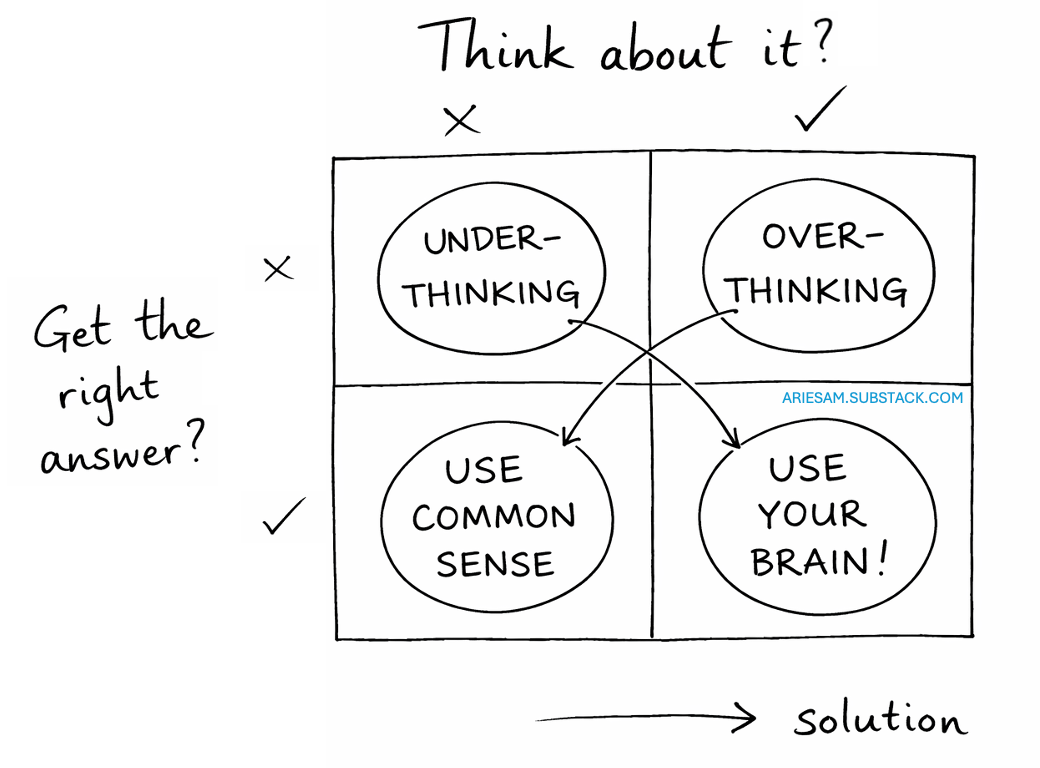
This matrix confirms what we have already noted, that there are two kinds of mistake we might make: over-thinking, and under-thinking. And it shows that the solution to over-thinking is to apply a dose of common sense, while the solution to under-thinking is to use your brain.
Now that we have all this mapped out, we just need to answer one last question: what kind of problems do we think we have today? Or to put it another way: are the biggest problems we face best understood as over-thinking problems, or as under-thinking problems?
The answer from the populists is that our problems today are over-thinking problems. But history, at least as I see it, suggests the opposite: that our worst mistakes have been due to under-thinking, and that in future our greatest leaps of progress will be achieved through more rational thought, rather than less.
And if you share that view, then you will conclude as I do that the mystical unicorn of a yardstick known as common sense is not nearly as helpful as it sounds. It may save us occasionally from complexity. It may prevent us from spending decades on a low value budget code. But it seems unlikely to resolve the greatest challenges of our times, which are for the most part complex conundra. Good solutions for those types of problems are more likely to be found if we switch on; think hard about the difficulties which confront us; and use our collective intelligence to find the best way forward.
For the avoidance of doubt, I consider myself an ardent environmentalist. And yet I have little regard for the European Emissions Trading Scheme, or carbon tax. The reasons why will have to wait for a column of their own.
This is an example of a broader point, that a test is only helpful when its error rate is lower than the incidence of the thing it is testing for. There was a good discussion of the dynamic in Thinking Fast & Slow. I would accept, I suppose, that there has still been an upgrade of information, in that without a witness (or any other info) you would have a 1% chance that the perp had pink hair. With the witness, the odds increase to 50/50.
This I find particularly ironic. The implication is that tariffs on US trade will turn out to be very damaging for the US real estate industry.
With bullfighting on the way out, this problem has more to do with selling marijuana these days. And whether that is considered money laundering, or not, depends more than anything else on where you are in the world.


