Management
Cosmic Principle No. 4
Don’t fall off the Cliff of Trust
Management
Cosmic Principle No. 4Don’t fall off the Cliff of Trust
Finance
The economics of the happy coupleA reminder of what you are looking for in a financial investment, and a warning against a common mistake
History
Are you related to Harry Kane?Yes, you are and so am I. And that is the true beauty of the World Cup.
Culture
MazawatteeTalented people should build things step by step, like an Indie band
Economics
Who should pay tax?Everyone, surely. But some of our compatriots are enjoying the greatest of all loopholes.
Technology
The alternative to a social media banI propose a new model based on the latest, on-demand technology and a regulatory construct which has worked for over a century in other industries
Management
Cosmic Principle No. 3Leave your top performers alone (they already know what to do)
Culture
Computer games are good for youAlthough, as a kid, I was always told the opposite
Politics
Vance is Gletkin.Revolutions are started by people who believe that something must change. But they are sustained by a second generation who do not ask questions, and use the revolution to advance their own positions.
Strategy
What exactly is an insight?A 2 minute read for anyone in a management role
Economics
How to blow your own foot offPick up the musket called 'tariff policy' and start yanking on the trigger
Technology
How to fix social mediaA good start would be for all users to say who they are
Politics
Common sense? Nonsense.The problem with 'common sense' is that it is a status quo concept and frequently antithetical to progress
Management
Cosmic Principle No. 2Something to think about as you finalise your New Year resolutions
Management
Cosmic Principle No. 1If we could each have an eponymous law, this would be mine
Business
The Bad Good IdeaWhat happens when corporate innovation goes wrong
Life
Life advice – from chessIf you don't have a master-plan, do what you can to build your position.
Probability
The House Always WinsBut do you know why?
Environment
Every cloud has a sulphur liningA look at the unexpected climate benefits of sulphur pollution
Economics
We only have 5 thingsAnd I am thinking about re-naming this newsletter after one of them.
Climate
Electric vehicles and the parable of the magic buttonA short contrarian read about the vehicle replacement cycle
Education
Advice for a college freshmanA 10 point plan for anyone you know who is heading off to university this year
Management
You're the decision maker nowCongrats – you earned it! But how will you know if you are doing a good job?
Finance
The most crowded trade in the cityA look at the perils, or potential, of TG61 – a very long duration bond.
Education
The College Essay is dead – Long Live the 'AI Viva'A simple solution to the problem everyone is talking about on campus
Finance
Everybody makes the same valuation mistakeThey forget to factor the fade.
History
Yes, you are and so am I. And that is the true beauty of the World Cup.
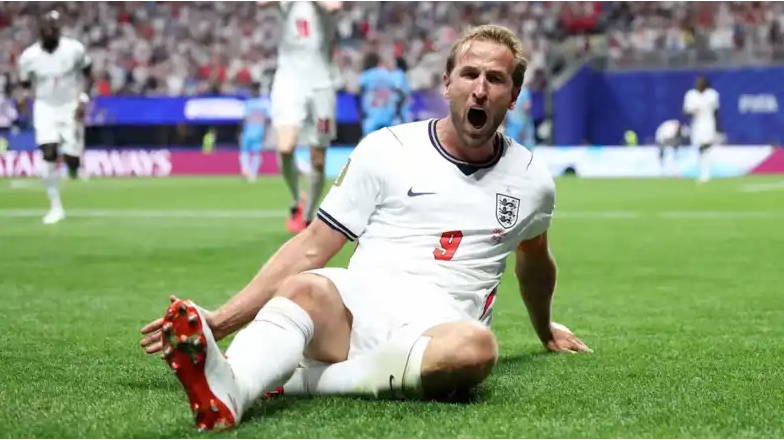
Hold your horses, I’m going to explain the title of this article in a minute. But first I need to say something important about gold rushes.
The story of the California gold rush of 1848 is already well known. What’s perhaps less well known around the world is that in 1851, the same thing happened again in Australia. Gold was discovered first in Ophir in New South Wales, and then in Victoria at Clunes, Buninyong, Castlemaine and Bendigo Creek. The quantities discovered were enormous1 and so was the immigration that followed: the Aussie population grew by a factor of four in only 20 years.
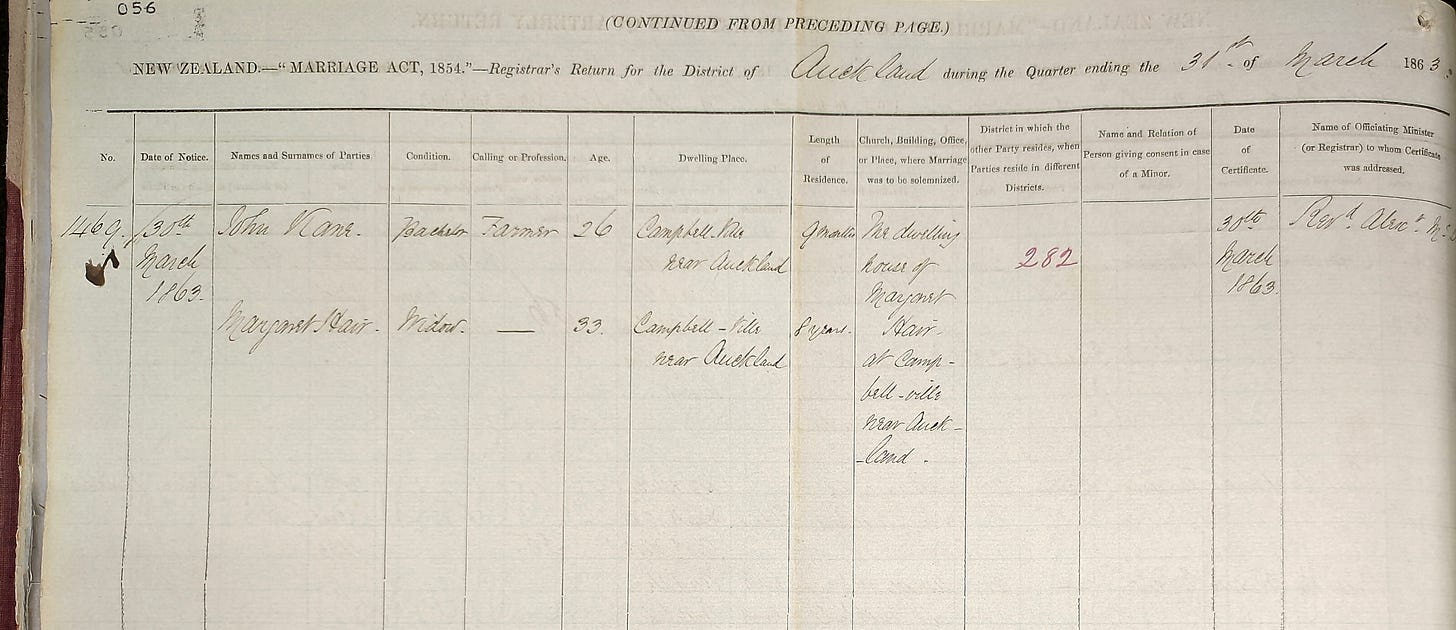
The vast majority of those Australian immigrants came from Britain and Ireland, including my great-great-grandfather, an Irishman by the name of John Kane. By the time he got there the easy discoveries were over, of course, and so John made a living for a while from the quieter industry of market gardening. When that line of work also ran dry, he upped and left for New Zealand where in the 1860s wages were high, land was cheap and a widow named Margaret Hair, an older woman with a smallholding outside Auckland, was prepared to make him an honest man. And 160 years later, that’s the reason for the silver fern on my passport of which I am so proud.
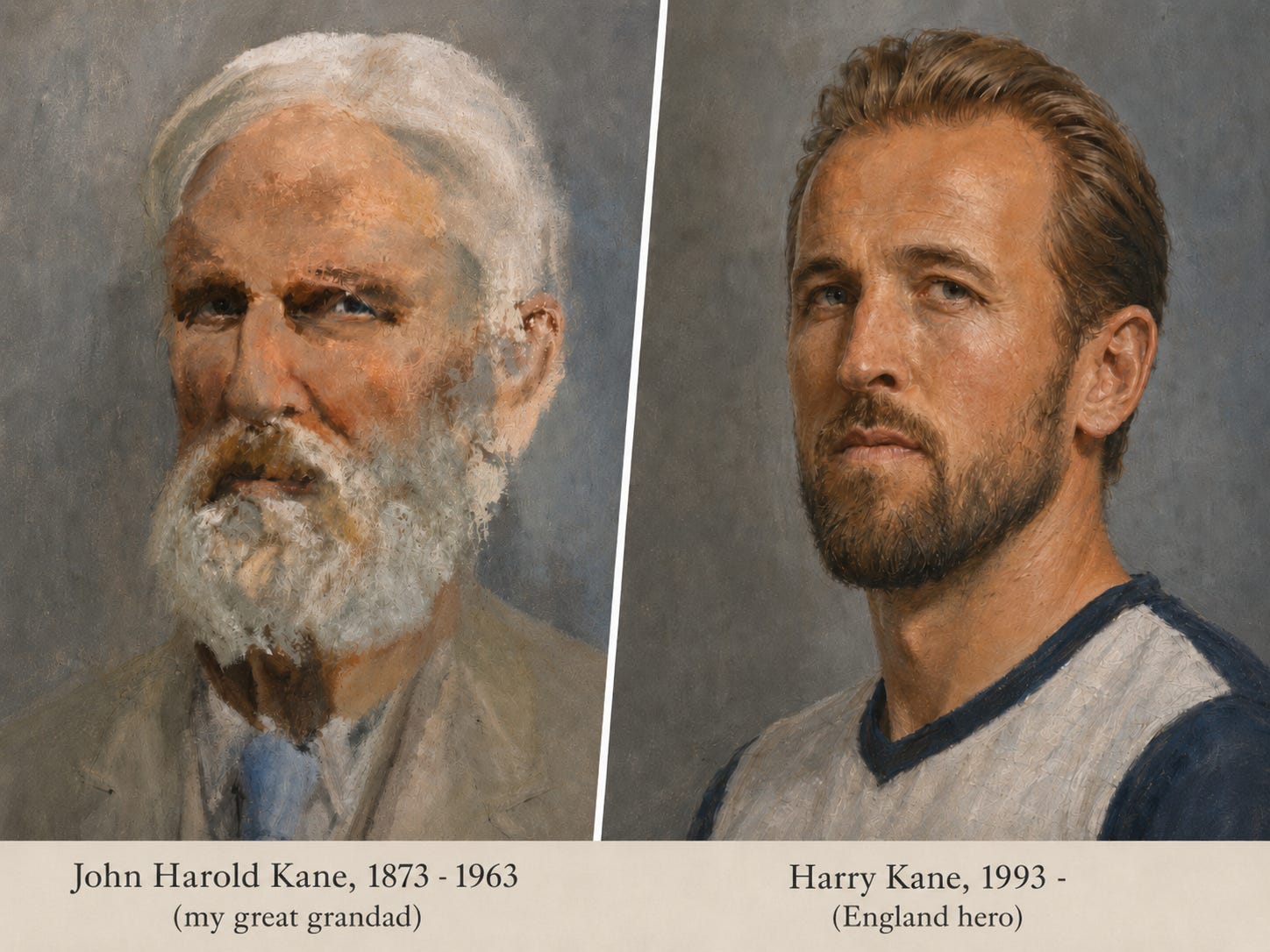
Now, back to my point: was my ancestor John Kane a relative of England hero Harry Kane? I’ll never know for sure, as there are many possible origin stories for the name our families have shared. In England, the name Cane (from the Latin canna, meaning a cane or reed) could be nothing more than a good name for a tall and skinny, reed-like guy. In Ireland or Scotland, the root is the Gaelic Ó Catháin, meaning “the son of Cathán”, the warrior. Now, I could tell you a good story about how either of those meanings would be a good fit for England’s tall and skinny football warrior… or I could point to Harry Kane’s Irish ancestors on his father’s side2… but the interesting point is that I don’t need to, because I already know that I’m related to him, and so are you.
Here’s how I know. Start by imagining your ancestors. You have two parents, four grandparents, eight great-grandparents, and so on. So the number of your ancestors rises exponentially as you go backwards in time. And now, think about how the human population has grown from the early days of Sapiens to around 8.3 billion of us alive today. Then you should have two images in your mind of growth curves more or less as below, producing an impossible concept:
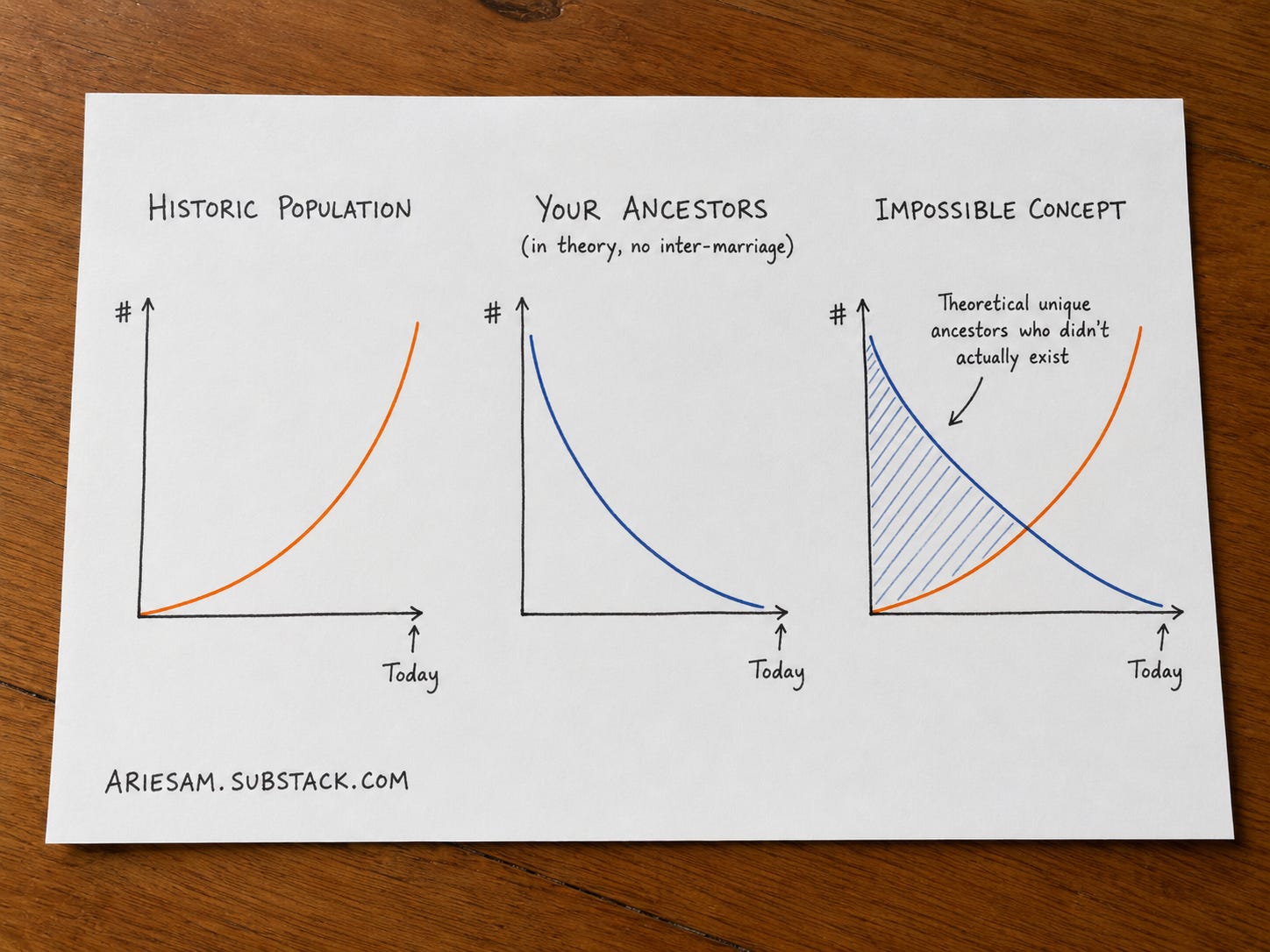
It should be obvious that the two charts cannot co-exist: there are not enough human ancestors to go around. Long before the arithmetic outruns the historical population, the same individuals must begin appearing in multiple branches of your family tree, a phenomenon known as pedigree collapse. Put simply, we can’t trace our heritage to an exponentially increasing set of ancestors through a historical population which is exponentially decreasing as we go back in time.3
Accordingly, we are wrong to imagine that our individual family trees are unique, when in fact the opposite is true: if you look across sufficient generations, our family trees overlap significantly and we share our ancestors. It turns out that we are all very obviously related to one another.
This line of thinking rewards us in two useful ways. First, we can estimate how long ago it must have been since our Most Recent Common Ancestor was alive, i.e. the most recent individual human who is an ancestor of every human alive today. And second, we can estimate the “identical ancestors” point (also known as the genetic isopoint) which is the most recent moment in time when every individual alive was either related to nobody at all in the modern world (because their genealogical line died out completely) or related to everybody alive in the modern world, because we have become completely intermixed.4
The details of course are a little tricky, because we need to take account not only of the number of people alive, but also of the “population substructures” which mean that inter-marriage is not random, but dictated by geography, language and other social networks and barriers. Yet in a fantastic Nature article from 2004, Douglas Rohde from MIT built the model, and it told us something genuinely remarkable.5
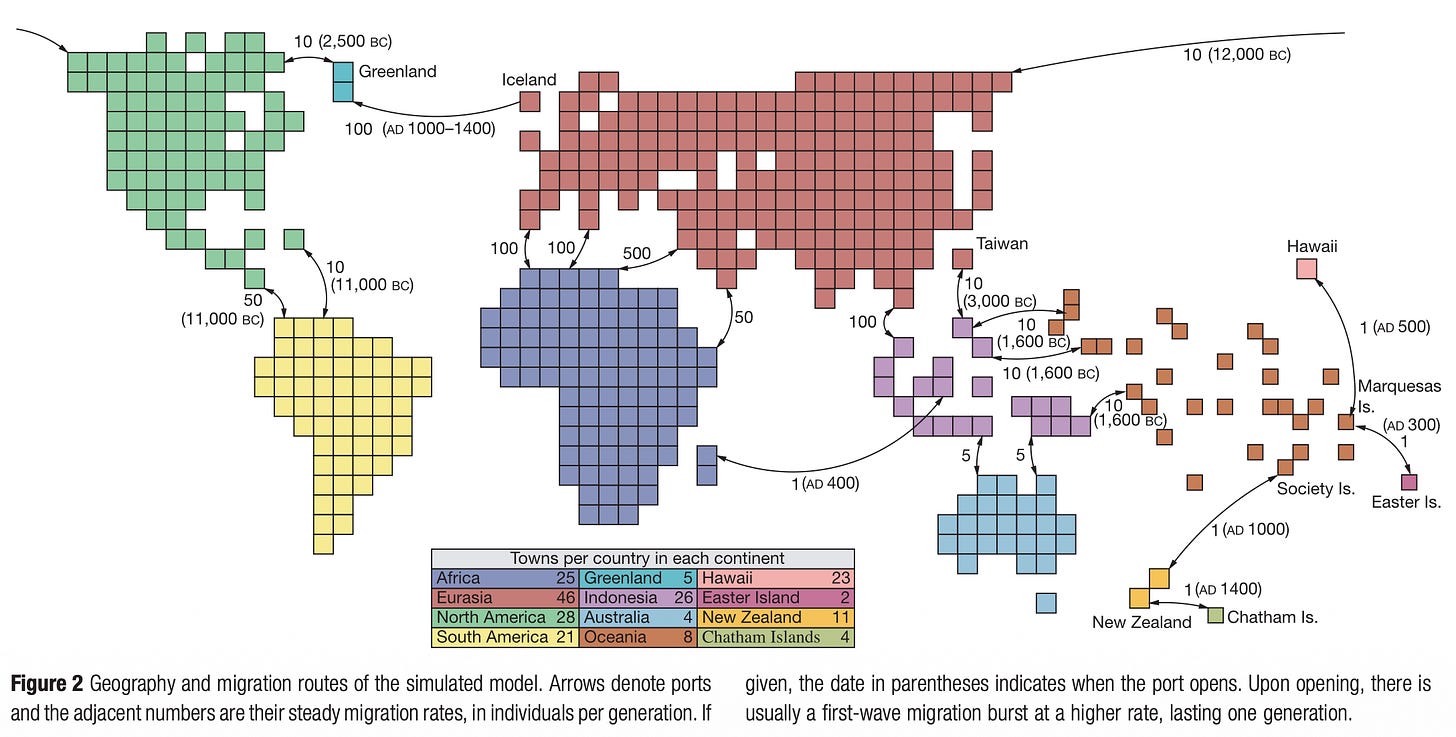
Rohde’s paper showed, astonishingly, that you only need to go back a few thousand years to find the last person we are all related to, and only a few thousand years beyond that to get to the identical ancestors point. In simple terms, it may only be about 5,000 years ago that everyone alive on the planet was an ancestor of everyone alive today (or of nobody alive today, if their lineage died out).6 This is such a counter-intuitive result it is worth quoting two passages from Rohde’s conclusion in full:
“… our results suggest that the most recent common ancestor for the world's current population lived in the relatively recent past—perhaps within the last few thousand years. And a few thousand years before that, although we have received genetic material in markedly different proportions from the people alive at the time, the ancestors of everyone on the Earth today were exactly the same.
… our findings suggest a remarkable proposition: no matter the languages we speak or the colour of our skin, we share ancestors who planted rice on the banks of the Yangtze, who first domesticated horses on the steppes of the Ukraine, who hunted giant sloths in the forests of North and South America, and who laboured to build the Great Pyramid of Khufu.”
Rohde, D. L. T., Olson, S. & Chang, J. T. “Modelling the recent common ancestry of all living humans.” Nature 431, 562–566 (2004).
So, yes, it does turn out that we are all related to England’s tall and skinny, warrior footballer, Harry Kane. And more wonderful still, we are all related to each other, and to all the other players, and we need only go back a handful of millennia to show that claim is universally true.
As someone who is, to be honest, not all that interested in football outside the big tournaments, I must say that this strikes me as the most brilliant thing about the FIFA World Cup. England heroes like Kane, Bellingham, Gordon and Spence are not just your cousins and mine, but equally also cousins of each other, and of Messi, Haaland, Mbappé and every other player or fan. They are even cousins of Giuliano Simeone, with all his dark arts.
So my advice is this: don’t lose too much sleep over last night’s result because whoever wins in the end, one thing is for sure: we’ll be keeping the trophy in the family.
“Lieutenant Governor La Trobe visited the area one month after the rush began and witnessed a team of five men dig out 136 ounces of gold in one day and another 120 ounces on the following day. The richness of these finds equated to around 10 years’ wages to an average Englishman. Forty miles north of Ballarat lay the Mt Alexander gold fields, richer still than Ballarat. The gold lay just under the surface. The shallowness meant that diggers could just scrape back soil to discover gold nuggets. In 7 months, the government escorts carried 2.4 million pounds of gold from Mount Alexander to Melbourne and Adelaide.” Source: Rush to Victoria, State Library of New South Wales.
Interestingly, pedigree collapse - also known as Ahnenschwund, Ahnenverlust or implex - is common among royal families which historically encouraged intermarriage with other royal families. A good example is Alfonso XII of Spain, El Pacificador, who had only four great-grandparents, rather than the usual eight.
Most Recent Common Ancestor condition: somebody alive then is related to everybody alive today. Genetic isopoint condition: everybody alive then is related to everybody alive today (unless their line ran out).
Rohde, D., Olson, S. & Chang, J. Modelling the recent common ancestry of all living humans. Nature 431, 562–566 (2004). https://doi.org/10.1038/nature02842
I have rounded to “about 5,000 years ago”. Rohde, Olson and Chang’s simulations suggested that the most recent common ancestor shared by everybody alive today may have lived only a few thousand years ago. Their estimates ranged from around AD 55 to 1415 BC, depending on the assumptions used. The identical-ancestors point came somewhat earlier—between roughly 2158 and 5353 BC. By then, anyone who left descendants alive today was an ancestor of everyone alive today; everyone else’s genealogical line had died out.


