Management
Cosmic Principle No. 4
Don’t fall off the Cliff of Trust
Management
Cosmic Principle No. 4Don’t fall off the Cliff of Trust
Finance
The economics of the happy coupleA reminder of what you are looking for in a financial investment, and a warning against a common mistake
History
Are you related to Harry Kane?Yes, you are and so am I. And that is the true beauty of the World Cup.
Culture
MazawatteeTalented people should build things step by step, like an Indie band
Economics
Who should pay tax?Everyone, surely. But some of our compatriots are enjoying the greatest of all loopholes.
Technology
The alternative to a social media banI propose a new model based on the latest, on-demand technology and a regulatory construct which has worked for over a century in other industries
Management
Cosmic Principle No. 3Leave your top performers alone (they already know what to do)
Culture
Computer games are good for youAlthough, as a kid, I was always told the opposite
Politics
Vance is Gletkin.Revolutions are started by people who believe that something must change. But they are sustained by a second generation who do not ask questions, and use the revolution to advance their own positions.
Strategy
What exactly is an insight?A 2 minute read for anyone in a management role
Economics
How to blow your own foot offPick up the musket called 'tariff policy' and start yanking on the trigger
Technology
How to fix social mediaA good start would be for all users to say who they are
Politics
Common sense? Nonsense.The problem with 'common sense' is that it is a status quo concept and frequently antithetical to progress
Management
Cosmic Principle No. 2Something to think about as you finalise your New Year resolutions
Management
Cosmic Principle No. 1If we could each have an eponymous law, this would be mine
Business
The Bad Good IdeaWhat happens when corporate innovation goes wrong
Life
Life advice – from chessIf you don't have a master-plan, do what you can to build your position.
Probability
The House Always WinsBut do you know why?
Environment
Every cloud has a sulphur liningA look at the unexpected climate benefits of sulphur pollution
Economics
We only have 5 thingsAnd I am thinking about re-naming this newsletter after one of them.
Climate
Electric vehicles and the parable of the magic buttonA short contrarian read about the vehicle replacement cycle
Education
Advice for a college freshmanA 10 point plan for anyone you know who is heading off to university this year
Management
You're the decision maker nowCongrats – you earned it! But how will you know if you are doing a good job?
Finance
The most crowded trade in the cityA look at the perils, or potential, of TG61 – a very long duration bond.
Education
The College Essay is dead – Long Live the 'AI Viva'A simple solution to the problem everyone is talking about on campus
Finance
Everybody makes the same valuation mistakeThey forget to factor the fade.
Economics
Everyone, surely. But some of our compatriots are enjoying the greatest of all loopholes.
The central tension at the heart of a modern democracy is tax.
We citizens, quite frankly, do not enjoy paying it.
But we also want good schools, hospitals, universities, policing, defence, pensions, a justice system, a welfare system, effective public administration, the right to come and go as we please, and all the potholes filling in.
Against this backdrop, elections are only superficially about ideology: the bottom line is that parties compete to offer us the best tradeoff between lower taxes and all the other things we want. There is a Laffer Curve of sorts which could be drawn to illustrate this, as below. The original (scribbled on Dick Cheney’s napkin, now in the National Museum of American History1) linked the tax rate to the tax take, and suggested a theoretical optimum level though nobody knew where exactly it was. But you could replace the tax take on Laffer’s y-axis with “citizen satisfaction” and make a very similar point.
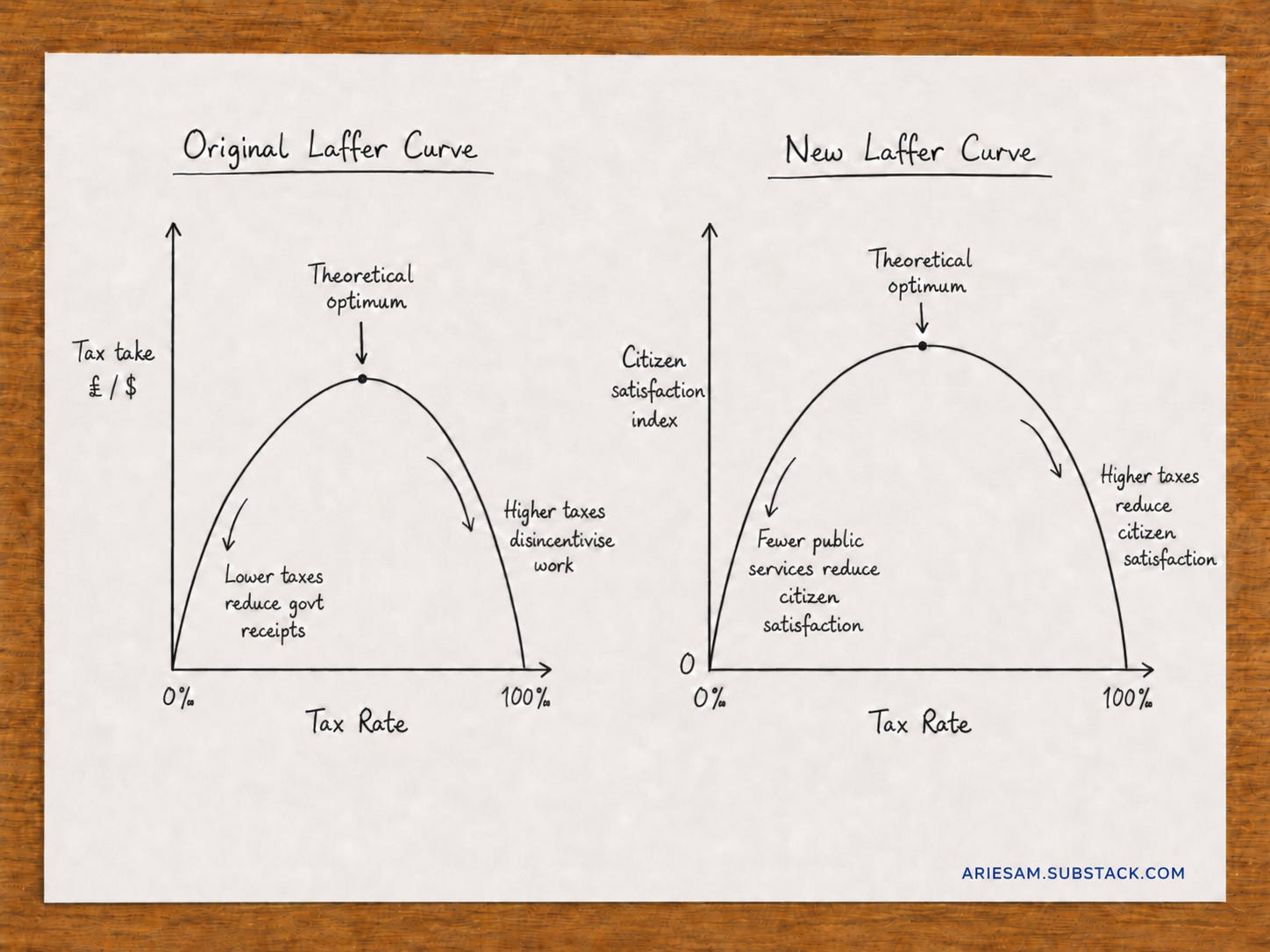
If you think about the maths behind this idea, we have no doubt arrived at the hump-shaped happiness function by adding together our Joy (when benefits are offered to us) with our Misery (when taxes are imposed). We derive joy from public services but only up to a point, beyond that they offer diminishing marginal benefits; and the misery caused by taxes is tolerable at a low level, but becomes exponentially painful as taxes begin to eat a majority of our income. The consequence of summing these reaction functions would be as below.
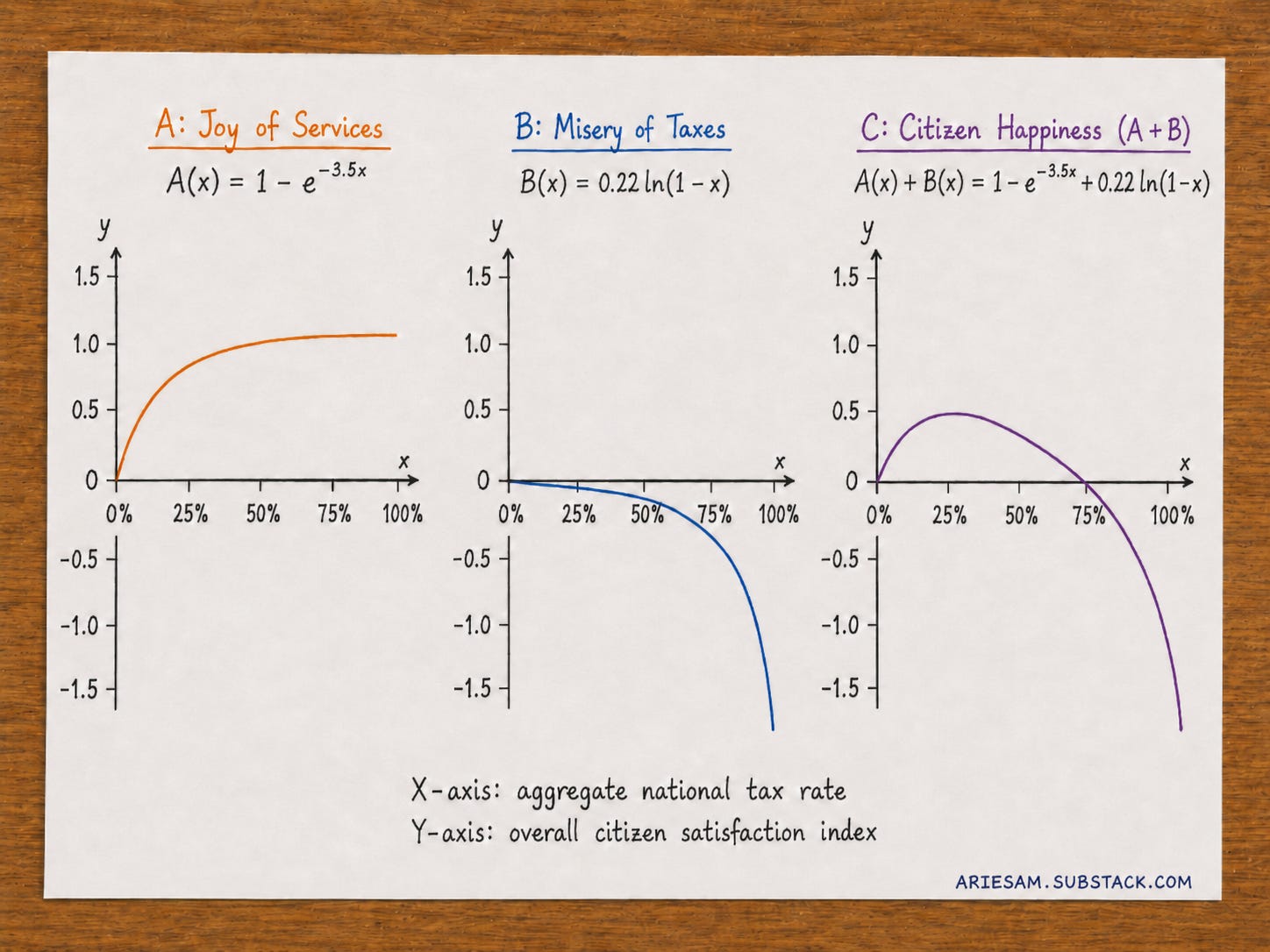
The conclusion - that aggregate citizen happiness is at its peak when taxes are around 25-50% of the economy - is probably no surprise. But what I hope is new here is to show how that result is derived: from finding the optimal blend of the Joy of Citizenship with the Misery of Taxes.
So, enough about how much tax we should pay, let’s move on to the thornier topic of who should actually pay it. A UK Minister was embarrassed this week for confessing that every conversation in government is about who can be taxed more, to pay benefits to others.
So let me make a direct contribution to that debate: how about … high earning expats?
This, to be clear, would be a departure from our recent thinking on cross-border taxation, where our most recent move was to dismantle the ‘non-dom’ tax break for foreigners living in the UK. This will raise a little money, but likely also discourages other foreigners from living here. What is more interesting, I think, is that we have not yet taken any action to discourage our own citizens from moving away.
To explain what we might do differently, let me use the US example where expat taxes for high earners work more or less as follows:
For many US expats going through this process, the result is that there is actually nothing to pay. This is because overseas tax rates are generally a bit higher than in the US, so you can often show that you have paid more to the country where you live than you would have owed to the US. But you still have to file, and if you are a high earner it is also true that, under this system, there is no way you are going to end up paying no tax to anyone.
And that, in a nutshell, is why I think that other countries should follow the same approach. Yes, there is some added complexity. But if nobody is going to end up paying no tax at all, then it becomes much harder for other countries to lure away your high earners with the promise of a 0% rate.
On that note, let’s talk about what Dubai is up to, favoured destination of my hedge fund friends and former clients. What made them all suddenly relocate to the Middle East, I wonder? A phone call with a client who made the move some years back called out the drama of the burgeoning skylines, the sense of energy and excitement, the great nightlife, low cost childcare and easy lifestyle. But the conversation soon moved to the other obvious reason: 0% tax.

Well, I don’t condemn anyone for taking advantage of a legal tax break. If you are a higher-rate taxpayer in the UK, and the system allows you to double your take home pay, more or less, by moving your tax residency to Dubai, then why not do that? You will accept some limits on how many days in the year you can return home, but if you are doing a stressful job, which you don’t want to do forever, this might be perfectly logical: you can roughly double your income, so you can cut in half the number of years it takes to get to your number. There are now apparently some 250,000 Brits in Dubai, taking advantage of this wheeze.
And how many Americans? Closer to 50,000. And the US population is five times larger, so the rate of brain-drain to Dubai is apparently 25 times higher for Brits. It may be even larger, if you factor that some of the non-UK citizens in Dubai may otherwise have chosen to work in London, so we have lost a lot of our foreign expats as well as our own high earning citizens. But even if we only count the 250,000 Brits, you can quickly identify a loss of tax receipts in the billions.3
Coming back to the high income Americans, no doubt some of them do just love the expat life in Dubai. Maybe they moved there for their own reasons? Perhaps they fell in love? But because of the way the US tax system works, one thing is for sure: they are not there for the money, because if they don’t pay their taxes in Dubai, then they will have to pay them in the US. The same unfortunately cannot be said for the Brits.
The obvious solution would be for all countries to adopt the US model. And just to be clear, this would not take choices away from anybody. Those moving to Dubai and who don’t want to file taxes at home could simply give up their citizenship. But it seems that nobody really wants to make that trade, because there is value in holding on to your citizenship of birth. At the minimum, holding on to your passport allows you to change your mind and go back home whenever you like. And in a crisis, that passport could get you onto a crucial emergency flight.
This is the option value which your citizenship carries, but under our current tax system the value of that option is simply not being priced by the State. To put it another way, we are allowing a large number of our compatriots to experience the Joy of Citizenship without the Misery of Taxes. That is both a fiscal and a social policy mistake. It should be corrected with some urgency.
Art Laffer apparently says the Smithsonian napkin is not the original one, which was tossed in the trash, but a reproduction he made for Jude Wanniski some years later.
You can claim a foreign tax credit if the US has a tax agreement with your host nation allowing you to do that. And you can also claim the Earned Foreign Income Exclusion currently around $130,000. So in practice you only end up paying US taxes, if you are a higher earning who is resident in a foreign country with lower taxes than the US. I am simplifying deliberately, but you get the point.
I don’t have data on the average salary of British ex pats in Dubai so I can’t do a proper calculation. It may be very high, given that the incentives to relocate to a zero tax jurisdiction are strongest for the highest earners. But then again, I also don’t know how many spouses and dependents may be included in the 250,000 figure. So I have deleted the calculation I originally drafted here, in case it is wildly wrong. In any case, we are not just talking about Dubai - the eventual calculation would need to add ex pats in other countries too.


