Management
Cosmic Principle No. 4
Don’t fall off the Cliff of Trust
Management
Cosmic Principle No. 4Don’t fall off the Cliff of Trust
Finance
The economics of the happy coupleA reminder of what you are looking for in a financial investment, and a warning against a common mistake
History
Are you related to Harry Kane?Yes, you are and so am I. And that is the true beauty of the World Cup.
Culture
MazawatteeTalented people should build things step by step, like an Indie band
Economics
Who should pay tax?Everyone, surely. But some of our compatriots are enjoying the greatest of all loopholes.
Technology
The alternative to a social media banI propose a new model based on the latest, on-demand technology and a regulatory construct which has worked for over a century in other industries
Management
Cosmic Principle No. 3Leave your top performers alone (they already know what to do)
Culture
Computer games are good for youAlthough, as a kid, I was always told the opposite
Politics
Vance is Gletkin.Revolutions are started by people who believe that something must change. But they are sustained by a second generation who do not ask questions, and use the revolution to advance their own positions.
Strategy
What exactly is an insight?A 2 minute read for anyone in a management role
Economics
How to blow your own foot offPick up the musket called 'tariff policy' and start yanking on the trigger
Technology
How to fix social mediaA good start would be for all users to say who they are
Politics
Common sense? Nonsense.The problem with 'common sense' is that it is a status quo concept and frequently antithetical to progress
Management
Cosmic Principle No. 2Something to think about as you finalise your New Year resolutions
Management
Cosmic Principle No. 1If we could each have an eponymous law, this would be mine
Business
The Bad Good IdeaWhat happens when corporate innovation goes wrong
Life
Life advice – from chessIf you don't have a master-plan, do what you can to build your position.
Probability
The House Always WinsBut do you know why?
Environment
Every cloud has a sulphur liningA look at the unexpected climate benefits of sulphur pollution
Economics
We only have 5 thingsAnd I am thinking about re-naming this newsletter after one of them.
Climate
Electric vehicles and the parable of the magic buttonA short contrarian read about the vehicle replacement cycle
Education
Advice for a college freshmanA 10 point plan for anyone you know who is heading off to university this year
Management
You're the decision maker nowCongrats – you earned it! But how will you know if you are doing a good job?
Finance
The most crowded trade in the cityA look at the perils, or potential, of TG61 – a very long duration bond.
Education
The College Essay is dead – Long Live the 'AI Viva'A simple solution to the problem everyone is talking about on campus
Finance
Everybody makes the same valuation mistakeThey forget to factor the fade.
Technology
A good start would be for all users to say who they are
The evidence is accumulating that social media has become a sewer.
The pipes and tunnels of the digital sewer are increasingly clogged with a caustic soup of harassment, misinformation, racism, misogyny, scams, deepfakes, bullying, shaming, flaming, doxxing, trolling, stalking, brigading, mobbing, dogpiling, catfishing, gaslighting, sea-lioning, astroturfing, phishing, grifting, rage-baiting, grooming and so many other bad behaviours that a whole new vocabulary is needed just to name them all. It’s not hard to see why parents want to keep their children as far away as possible from all of this.
The real world, fortunately, is not nearly so bad. No country is proposing laws to keep their children away from the real world until a certain age. But it is interesting to ask why not? Why are people more courteous and respectful in the real world than in the virtual world of social media? What is different about the real world that keeps our worst behaviour in check?
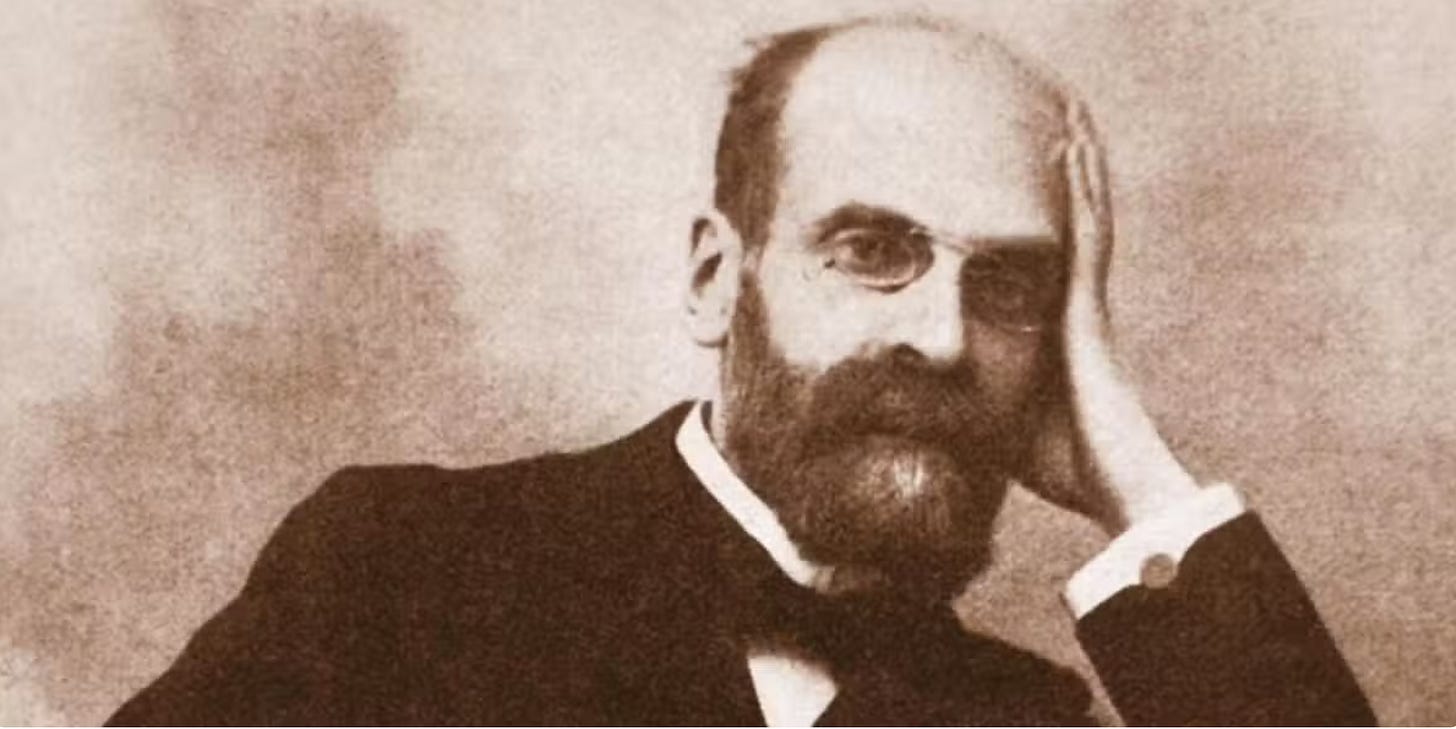
Perhaps the first to see the answer was the whiskery and bespectacled Victorian genius Emile Durkheim, who reasoned that society develops ways of acting which impose constraints on individual behaviour. He referred to these constraints as social facts, a concept which included laws and regulations but also culture and all the many and subtle social norms which contribute to our collective consciousness - a term he also coined, in French, in 1893.
The collective consciousness is important because it enables auto-moderation. Durkheim saw that this is how human societies have operated for millennia. In short, societies develop social norms (e.g. listening, being reasonable, and so on) and apply sanctions to those who deviate from them. The norms can evolve, but usually slowly. In the meantime, they provide a useful brake on extreme behaviour.1
To give a modern example: it might be OK to cuss and swear and voice outrageous views if you’re down the pub with a mate and blowing off steam. But not if you’re on a zoom meeting with colleagues or in class with your teacher. People who behave like that in public will quickly be sanctioned, and if they keep transgressing will eventually face more serious consequences. There are many forms of sanction, not least a difficulty building and maintaining relationships; achieving any kind of cooperative success; making progress in a career; or earning the support and endorsement of peers.
But Durkheim also noted that sometimes this system breaks down. In times of rapid social change, the absence of appropriate social facts can lead to anomie, a condition (sometimes known as normlessness) in which the social processes that regulate individual behaviour are weakened. And it is not in my opinion ridiculous to draw a line from Durkheim’s anomie to the contemporary libertarian concept of free speech, at least when it is defined - to give one recent example - to include the right of “Sir Doge of the Coin” to post AI-generated images of the UK Prime Minister in a bikini.
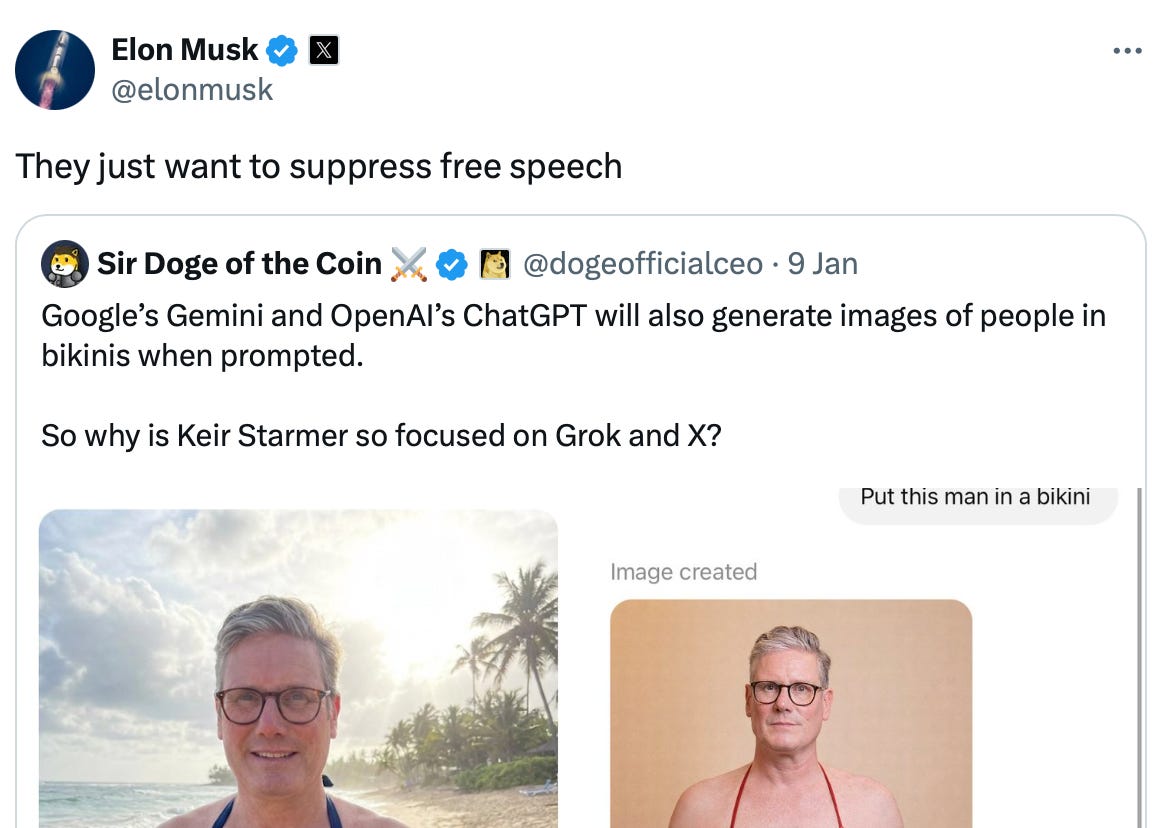
To be clear, it’s not so much the Prime Minister’s AI-bikini I am objecting to in this case, but the anonymity of the distributor.2 Musk himself has also posted an AI-bikini selfie and ballyhoo for him. We know who he is and he’s entitled to his opinion. But who on earth is Sir Doge of the Coin?3 The fact that most of us don’t know creates a problem, because if we don’t know who we’re talking to, we can’t even contribute to the weakest kind of social sanction: disapproval. There is no meaningful way to engage the collective consciousness if we don’t know who we’re engaging with.4
Anomie and anonymity, it turns out, are intimately connected. But the anonymity problem on social media could be quickly solved if all posters were obliged to identify themselves. The platforms could use a third party ID validation service, or users could simply be asked to make a card payment when signing up. A token payment of a single penny or cent would be enough to confirm your identity via the bank.
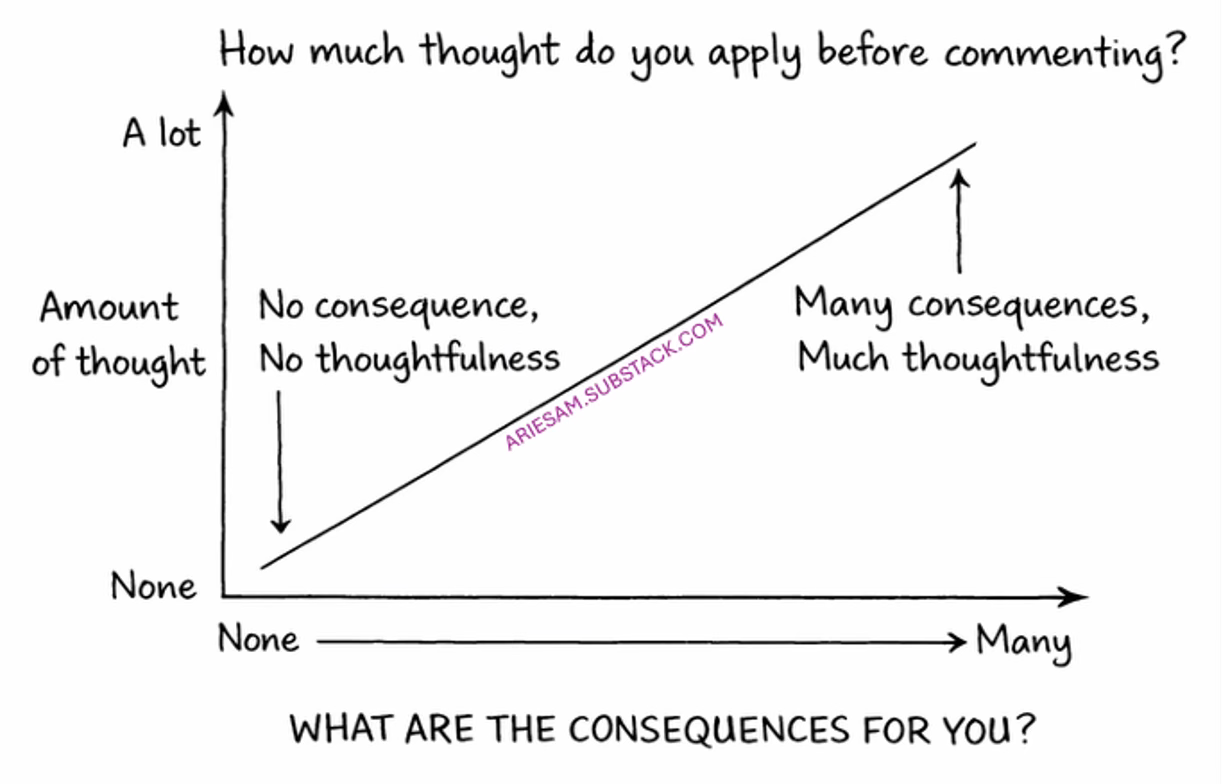
And my bet is that the quality of online behaviour would rapidly improve, because the amount of thought you put into a public comment is a function of the social consequences expressing that view may have for you. If you are anonymous, there are no consequences. But if you put your name to the view - then Durkheim’s collective consciousness will notice, and you will have to be ready to live with what you have said.
The example of the Euro 2020 football troll who sent racist emojis to England star Bukayo Saka is a case in point: here was a guy who was not regretful about his behaviour until journalists uncovered his identity. And then? Well, he was suddenly very sorry about it all.
The fundamental idea here is not to oppose free speech. Who would do that? It’s a subtler and hopefully more important assertion, that the right to speak freely goes with the responsibility to identify yourself when speaking. The assertion is in contrast to contemporary legal norms, which have often protected anonymity. It has more in common with Hannah Arendt’s idea that the arena of public speech requires a space of appearance “where I appear to others as others appear to me”.5
And this is not to say that self-identification would eliminate all examples of bad behaviour. There is nothing about the ‘space of appearance’ which dictates or entails perfection. The point is rather that identifying interlocutors in a public dialogue allows the social sanction process to kick in, on social media as it always has in real life. Bad behaviour would still occur, but it would be quickly recognised and sanctioned. It would not run amok, as it seems to do today on platforms like X - or even, dare I say, the hallowed FT comments section.
Of course, there could be some downsides. Some people would surely stop commenting online, so there might be fewer voices to be heard - which would mean less activity and fewer eyeballs to monetise for the platform owners. That is probably what they are afraid of and why they don’t already require commenters to identify themselves. But have they considered that the lower volume would be offset by a higher quality?
In other cases, some people might require anonymity, if they are political dissidents or corporate whistleblowers, for example, or other persons who might face repercussions for speaking out. But it wouldn’t be impossible to devise ways to speak anonymously online in these rare cases - again, just as we have devised such methods in real life.
Yet maybe the worst side effect would be how people behave differently when they identify themselves in public. If you want to know what I mean by that, just take a look at LinkedIn - which is obviously one of the few platforms where, by design, all of us have declared exactly who we are. We have all explained where we work, what we do, where we went to school and who our friends are. And what do we then do on Linked In? We show off. We all do. Even our four legged friends:
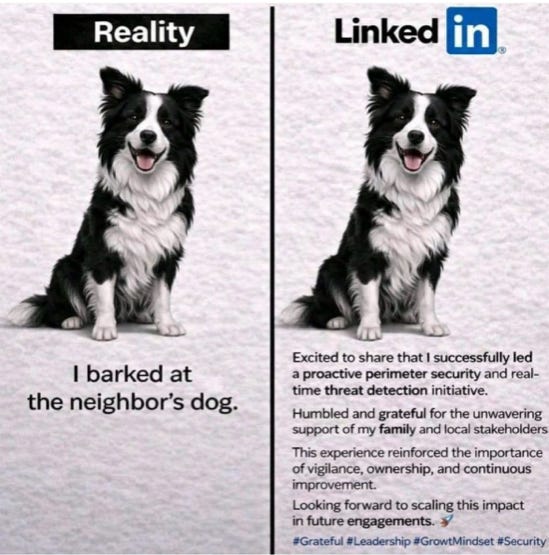
And yet, for all the showing off, flattery, humble-bragging and selfies - the quality of discourse on LinkedIn seems vastly better than on the anonymous platforms. Immodesty is tolerated, but deviation from other standards of community behaviour is quickly pointed out and policed by peers, and the platform overall is doing incredibly well. Along with Substack, LinkedIn seems to me a fairly reasonable and sensible place to exchange views with other people.
So if it’s a question of the lesser vices, I have decided to choose vanity and self-promotion (including my own) over misinformation, confrontation and the thesaurus of objectionable behaviour with which I began this article. And what that means specifically for me is that, not long ago, I decided not to post online any more except under my own name - and not to participate in discussion platforms anonymously.
Of course, I can and do frequently make mistakes, and identifying myself means that there is nowhere to hide when I do. But that is exactly the point. You know who I am and what I have said before, and if I get things wrong or make no sense or behave embarrassingly, I know that you will tell me straight away.
And that, above all, is why I’m here - and not on X.
In more recent times, Robert Ellickson from the Yale Law School showed empirically that this is indeed exactly how things work: communities enforce cooperation through informal sanctions tied to reputation.
Although I do also object to the AI-bikini pictures, which were obviously and deeply problematic as discussed in shocking detail in this article. I’m not endorsing them for a moment. I’m just focusing on a slightly different point, about the anonymity of the people who create and distribute them.
Conor Gallagher, the Crime & Security correspondent of the Irish Times has done a nice piece on this. He identifies ‘Sir Doge of the Coin’ as Barry O’Driscoll, one of several right-wing Irish voices who have captured the attention of Elon Musk. There is a nice podcast episode about all this on Spotify. But my point is not that we can’t figure out who these people are - it’s that they don’t volunteer the information.
I know that I should not end this sentence with ‘with’. Apologies for that. However the reformulation ‘with whom we are engaging’ appears way too pretentious these days, doesn’t it?
Hannah Arendt, The Human Condition (1958). See page 199 ff.


