Management
Cosmic Principle No. 4
Don’t fall off the Cliff of Trust
Management
Cosmic Principle No. 4Don’t fall off the Cliff of Trust
Finance
The economics of the happy coupleA reminder of what you are looking for in a financial investment, and a warning against a common mistake
History
Are you related to Harry Kane?Yes, you are and so am I. And that is the true beauty of the World Cup.
Culture
MazawatteeTalented people should build things step by step, like an Indie band
Economics
Who should pay tax?Everyone, surely. But some of our compatriots are enjoying the greatest of all loopholes.
Technology
The alternative to a social media banI propose a new model based on the latest, on-demand technology and a regulatory construct which has worked for over a century in other industries
Management
Cosmic Principle No. 3Leave your top performers alone (they already know what to do)
Culture
Computer games are good for youAlthough, as a kid, I was always told the opposite
Politics
Vance is Gletkin.Revolutions are started by people who believe that something must change. But they are sustained by a second generation who do not ask questions, and use the revolution to advance their own positions.
Strategy
What exactly is an insight?A 2 minute read for anyone in a management role
Economics
How to blow your own foot offPick up the musket called 'tariff policy' and start yanking on the trigger
Technology
How to fix social mediaA good start would be for all users to say who they are
Politics
Common sense? Nonsense.The problem with 'common sense' is that it is a status quo concept and frequently antithetical to progress
Management
Cosmic Principle No. 2Something to think about as you finalise your New Year resolutions
Management
Cosmic Principle No. 1If we could each have an eponymous law, this would be mine
Business
The Bad Good IdeaWhat happens when corporate innovation goes wrong
Life
Life advice – from chessIf you don't have a master-plan, do what you can to build your position.
Probability
The House Always WinsBut do you know why?
Environment
Every cloud has a sulphur liningA look at the unexpected climate benefits of sulphur pollution
Economics
We only have 5 thingsAnd I am thinking about re-naming this newsletter after one of them.
Climate
Electric vehicles and the parable of the magic buttonA short contrarian read about the vehicle replacement cycle
Education
Advice for a college freshmanA 10 point plan for anyone you know who is heading off to university this year
Management
You're the decision maker nowCongrats – you earned it! But how will you know if you are doing a good job?
Finance
The most crowded trade in the cityA look at the perils, or potential, of TG61 – a very long duration bond.
Education
The College Essay is dead – Long Live the 'AI Viva'A simple solution to the problem everyone is talking about on campus
Finance
Everybody makes the same valuation mistakeThey forget to factor the fade.
Culture
Talented people should build things step by step, like an Indie band

You don’t need to know, and I won’t bore you by explaining, how it came about that some time not long ago, late on a Friday evening, I found myself strolling down Little Clarendon Street in Oxford.1 What is more interesting to recount is that as I passed the Common Ground cafe I was swept up in a small crowd gathering to go inside. There was a band playing. Mazawattee. They sounded pretty good to me.
More on the Little Clarendon Street gig in a minute, but first — obviously — we need to talk about Andrew Yang, who ran for president in 2020.
Yang ran for the Democratic nomination, already flagging the threat of workplace automation (in a world before ChatGPT) and proposing, as his flagship policy, a universal basic income for every American adult of $1,000 a month. He secured a number of high-profile celebrity supporters, including Nicolas Cage and a number of big names from Silicon Valley. Implausible as it sounds today, both Elon Musk and Sam Altman were members of the ‘Yang Gang’.

Unfortunately, the dream did not last. While Yang made an impression in some of the primary debates, the votes weren’t there and eventually he threw in the towel. If you watch the speech in which he suspended his campaign, you’ll hear him say: ‘You know I am the math guy, and it is clear tonight from the numbers that we are not going to win this race.’ But you’ll also hear him say ‘this is not an ending - this is a beginning’, which leads me to the question for this article: what, if anything, was the legacy of Andrew Yang’s unsuccessful bid for the presidency?
Personally, I don’t think it will turn out to be the universal basic income idea, although I am sure we will continue to debate the proposal. Nor was it Venture for America, the non-profit which Yang modelled on the more famous Teach for America, to place recent graduates in tech startups around the US. Venture for America pledged to create 100,000 new jobs but never came close to that figure and was finally wound up, as the jobs and the funding ran out, in the summer of 2024.
So what else is left which could be considered a legacy? Perhaps one important idea, but to find it we have to go all the way back to 2014 and take a look at Yang’s book, the brilliantly titled Smart People Should Build Things. What Yang was arguing here, even before he started his bid for public office, was that the availability of good jobs in professional services was keeping young people away from the more serious business of building new things to add to the world.
Yang wondered what could happen if the young and eager minds of each new generation were channelled into more entrepreneurial activities, and it is hard not to have at least some sympathy with his concern. I mean, just look at the numbers: a decade later, it’s still true that some 40% of Harvard seniors go immediately into consulting or finance as a first job.
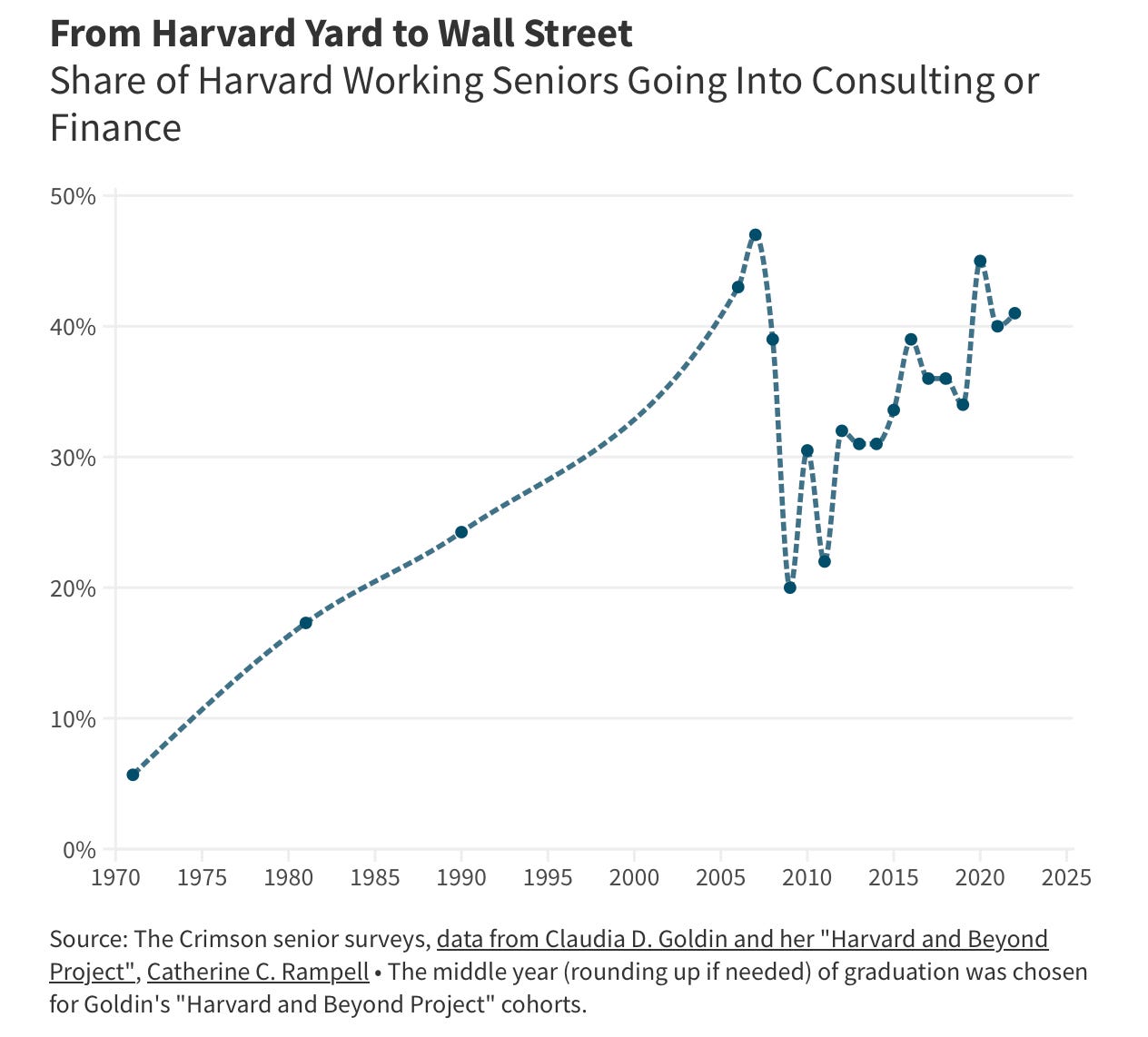
Yang himself was not a consultant or a banker, but he graduated from law school (like many Democratic candidates before, and since) and tried his hand for a while in a high-end New York law firm. But the experience, which he famously described as “like a pie-eating contest, where the prize was more pie”, was not for him. He left after five months and started a venture.
When it failed, he tried another one, and you get the idea from there. Eventually he got on board with Manhattan GMAT, a test prep business based on the idea that all the instructors would have a 99th percentile GMAT score themselves. Manhattan was eventually acquired by Kaplan, and Yang had made his first millions.
Of course, I spent my own career in professional services so I have some experience in the kind of work which Yang argues young people should not pursue. And I am careful not to throw too many stones: I learned a lot from my time in strategy consulting, and from another decade as a research analyst in a bank. And I also tried my hand in a startup years ago, which I can tell you cost me time, sweat, tears and treasure - but yielded little in return, except perhaps the modest lesson that creative success can be an elusive thing.
But still, I do think that somehow Andrew Yang has a point. The nature of many professional services jobs is that they are, somehow or other, premised on the world the way it already is. For all the talk in consulting of ‘transformation’, the bottom line is that professional services are expensive and clients must have funds to pay the fees. So for the most part, you are working for the businesses which have already established their success. At the margin there is creativity, but almost by definition everything is already underpinned by an existing cash flow. You are almost inescapably looking at the world through the eyes of an incumbent.
The premise of the entrepreneurial and creative industries, on the other hand, is novelty: to add something completely new, you must make a success out of something unexpected. You must build something which, in short, wasn’t there before. You are looking at the world through the eyes of a challenger.
At some level, which of these contrasting career paths you prefer may boil down to a question of personality. Do you want to work for a successful business and make it even better, or to start with a clean piece of paper and see what you can invent from scratch? At another level it’s also obviously a question of risk. Working for incumbents will tend to provide a salary, stability, apparent social status, regular bonuses to keep your jumbo mortgage under control, and an established career path with endless promotions to chase. On the other hand, starting something new comes with low pay, low status, poor recognition, high stress, high uncertainty, an improbable quantity of ramen noodles - but also the prospect of a life-changing payoff if against all odds, you can somehow make your project succeed.
You might think that in a perfectly working labour market, the expected value of the two very different career paths should more or less balance out, leading to some kind of balance in the flow of young people towards each track. But Yang’s book seems to be arguing that the playing field remains tilted in favour of the steady job, and a chat with the anxious parents of any recent graduate will quickly give you the same impression. As we know from Prospect Theory, we humans have a persistent bias in favour of the safe option - and in the context of career choices, it must follow that society is missing out on at least some good ideas as a result.
So what to do about this social organisation problem? I do agree with Andrew Yang that smart people should build things and my career spent mostly working with incumbents has left me fairly sure that our greatest problems will be solved by new ideas, rather than by further incremental optimisation of the old ideas.
But as a parent, would I advise my own children to turn their backs on the conventional career track and gamble everything on a new idea? Certainly not, because you only live once, and failed career bets are very expensive for the individual. Even if society would benefit in the aggregate from more risk-taking, the individuals whose bets do not work out pay a heavy price, as I learned myself. So there is a principal-agent problem of sorts here: society is the principal and would benefit from more risk-taking; but young people are the agents, fear the lifetime consequences of a risky decision which doesn’t work out, and they vote with their feet for predictable salaries instead.
What is the answer to this societal conundrum? I think it’s that you don’t have to take Yang’s lesson on board in a binary way. You don’t have to make a naked choice between building something and building your career. Instead, there are many ways to incubate a new idea without giving up the day job. John Legend, later to be the winner of 13 Grammys (and a Golden Globe and an Oscar for Glory) also worked for years at BCG, writing PowerPoint with the rest of us poor souls. But in the evenings he wrote songs and on the weekends he performed them, and he carried on until he could see that his music career was at a point that would sustain itself.

Now, back to my Little Clarendon Street gig. I’m pretty sure that Mazawattee are doing the same thing as John Legend. I don’t know, but I would guess that they are studying or have day jobs - because five talented people can’t live off gigs at the Common Ground cafe on Little Clarendon Street where the tickets are £10 each. But what those gigs can offer is a pathway to putting something new in the world which wasn’t there before, and to all the wonderful consequences which follow from that simple creative act.
To put it another way, if you know that you’re putting on a show this Friday evening, what will you do at lunchtime today? You will start to hum the melodies in your head and strum the guitar strings in your mind. All you will want to do, when you have five minutes free between meetings, is write another song. Before too long, perhaps you’ll have put together a very decent singles album in your spare time and who knows what happens after that? Maybe you’ll get a nice feature on local radio, and if you put your songs on Spotify then soon you’ll have a thousand monthly listeners. From there, if it doesn’t grow, you’ll know you need to change something. But if it does, well then —you’ll know the time has come to quit the day job, once and for all.
This, if you ask me, is a powerful way to build new things. Step by step and perfecting your product but without staking everything you have on a single idea until you can see if it has wings. That’s what I think the Mazawattee band is doing and I think it’s going to work out well for them.
Have a listen to some of their songs and see if you agree?
From Pliny’s letter to Avitus (II.6): longum est altius repetere nec refert, quemadmodum acciderit… I didn’t want to leave the classicists on my mailing list empty handed this week, I hope the gesture is appreciated.


