Management
Cosmic Principle No. 4
Don’t fall off the Cliff of Trust
Management
Cosmic Principle No. 4Don’t fall off the Cliff of Trust
Finance
The economics of the happy coupleA reminder of what you are looking for in a financial investment, and a warning against a common mistake
History
Are you related to Harry Kane?Yes, you are and so am I. And that is the true beauty of the World Cup.
Culture
MazawatteeTalented people should build things step by step, like an Indie band
Economics
Who should pay tax?Everyone, surely. But some of our compatriots are enjoying the greatest of all loopholes.
Technology
The alternative to a social media banI propose a new model based on the latest, on-demand technology and a regulatory construct which has worked for over a century in other industries
Management
Cosmic Principle No. 3Leave your top performers alone (they already know what to do)
Culture
Computer games are good for youAlthough, as a kid, I was always told the opposite
Politics
Vance is Gletkin.Revolutions are started by people who believe that something must change. But they are sustained by a second generation who do not ask questions, and use the revolution to advance their own positions.
Strategy
What exactly is an insight?A 2 minute read for anyone in a management role
Economics
How to blow your own foot offPick up the musket called 'tariff policy' and start yanking on the trigger
Technology
How to fix social mediaA good start would be for all users to say who they are
Politics
Common sense? Nonsense.The problem with 'common sense' is that it is a status quo concept and frequently antithetical to progress
Management
Cosmic Principle No. 2Something to think about as you finalise your New Year resolutions
Management
Cosmic Principle No. 1If we could each have an eponymous law, this would be mine
Business
The Bad Good IdeaWhat happens when corporate innovation goes wrong
Life
Life advice – from chessIf you don't have a master-plan, do what you can to build your position.
Probability
The House Always WinsBut do you know why?
Environment
Every cloud has a sulphur liningA look at the unexpected climate benefits of sulphur pollution
Economics
We only have 5 thingsAnd I am thinking about re-naming this newsletter after one of them.
Climate
Electric vehicles and the parable of the magic buttonA short contrarian read about the vehicle replacement cycle
Education
Advice for a college freshmanA 10 point plan for anyone you know who is heading off to university this year
Management
You're the decision maker nowCongrats – you earned it! But how will you know if you are doing a good job?
Finance
The most crowded trade in the cityA look at the perils, or potential, of TG61 – a very long duration bond.
Education
The College Essay is dead – Long Live the 'AI Viva'A simple solution to the problem everyone is talking about on campus
Finance
Everybody makes the same valuation mistakeThey forget to factor the fade.
Probability
But do you know why?
Roulette is the simplest game in the casino to learn. In the European version (played all over the world, actually, except the USA) it works like this:
Bets are placed while the ball spins, on a table that looks something like this:
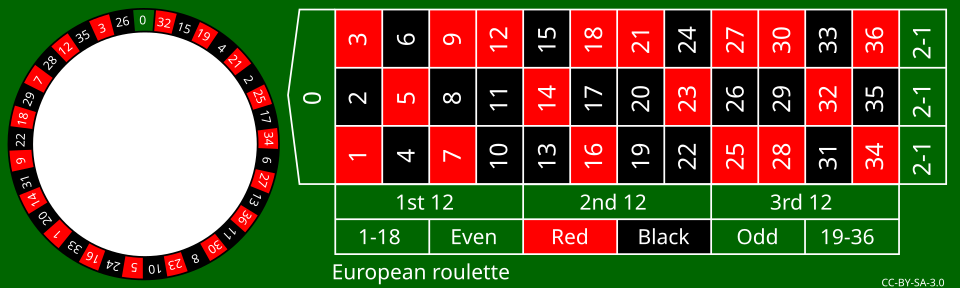
In general the odds are calculated to be fair, if you ignore the zero. So for example, the odds on a 50/50 bet, such as red v. black, are even; the odds for single number bets are 35:1; and so on. If you win, you keep your stake and collect your winnings. So if there were no zero on the wheel, your wins would exactly balance your losses – and if you could play for long enough, you would always, eventually, break even.
But of course, there is a zero, and that tips the odds in favour of the House. If the wheel comes up zero, the usual arrangement is that all bets – except those on zero itself – are lost. So it is simple to calculate the expected value of a £1 bet as follows:
In other words, the House Edge is 2.7%. So the expected value of any bet you place is 0.973 x your stake. If you make n bets, always gambling a fixed proportion of your chips, your remaining pile will track a geometric series that includes the term (0.973)n – so clearly trends towards zero as n increases. In American roulette there are 38 slots, including a double zero (‘00’), so the edge is 5.3% and the trend is steeper. There are even some tables with a triple zero. And factoring the zeroes supposedly explains why it is that the house always wins.
Except for the fact that everything I’ve said so far is a perfect pack of lies. I’ll explain why in a minute, but first let me just point out one thing. Although the text book says that all bets lose on zero, it’s actually very common - at least in the European game – for different rules to apply. Many tables will give you back half your stake, at least for outside bets, when the wheel spins zero. French tables offer a more elegant solution: when the wheel spins zero, they put your bet ‘en prison’, leaving it on the table and if the next spin would have given you a win, your stake is returned. These rules soften the blow for the punter, but crush the House Edge - if you believe that the House Edge depends on zero. So why do that? Why volunteer to crush your own edge?
It doesn’t make any sense, and the answer is that zero is not the House Edge, it’s just the cover story. Zero is the fig-leaf. Zero is there to prevent you from realising why the House really wins. And the reason the House wins is that your liquidity is limited, your bet size is limited, and you are very bad - as we all are – at quitting while you are ahead.
To explain how this works, imagine a roulette player who starts with £100 and plans to make a hundred consecutive £10 bets on red. Of course, since the bets are in units of £10, his float will go up or down by £10 after each round. But after a hundred spins of the wheel, he can expect to have lost 27p on average with each bet, if the House Edge is 2.7%. That makes £27 in total over the course of 100 bets. So allowing for the fact that we are working in £10 increments, this player ought to have £70 left at the end. I ran a simple Monte Carlo type simulation of this game, 100 times, with the following results. The median balance after 100 rounds is indeed £70, as shown.
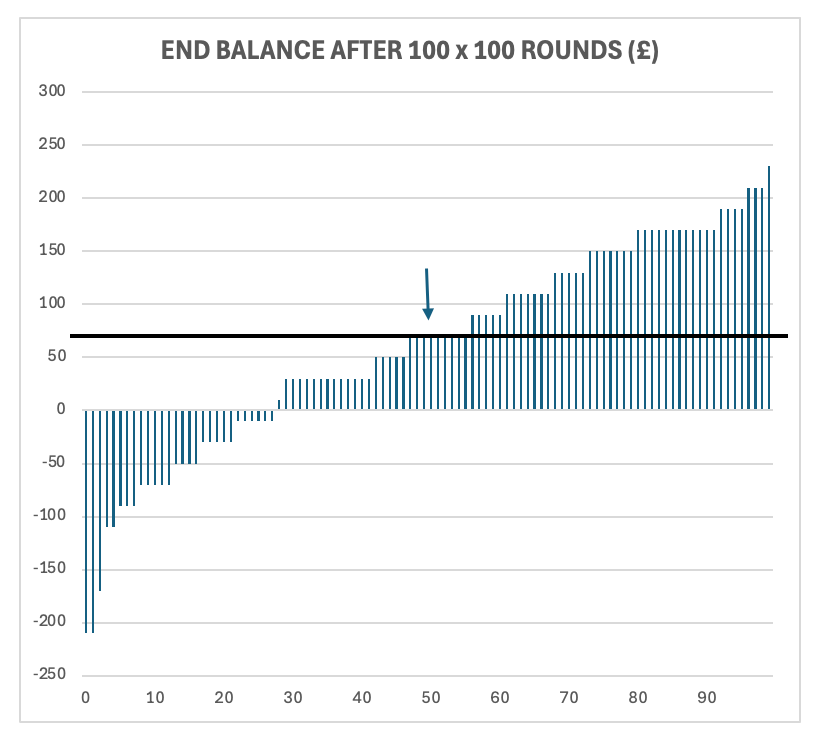
But now ignore the median for a moment and look at the distribution of outcomes. The player can easily experience a winning or losing streak and the end balance can be much higher or lower than £70. The second chart, also from my simulation, shows the highest balance a player held after each round (in purple) and the lowest balance (in dark blue), as well as the top and bottom quartiles. By definition, half the outcomes were better than the median, and half were worse. (For simplicity I have assumed for this chart that the player has credit and can run up a negative balance.)
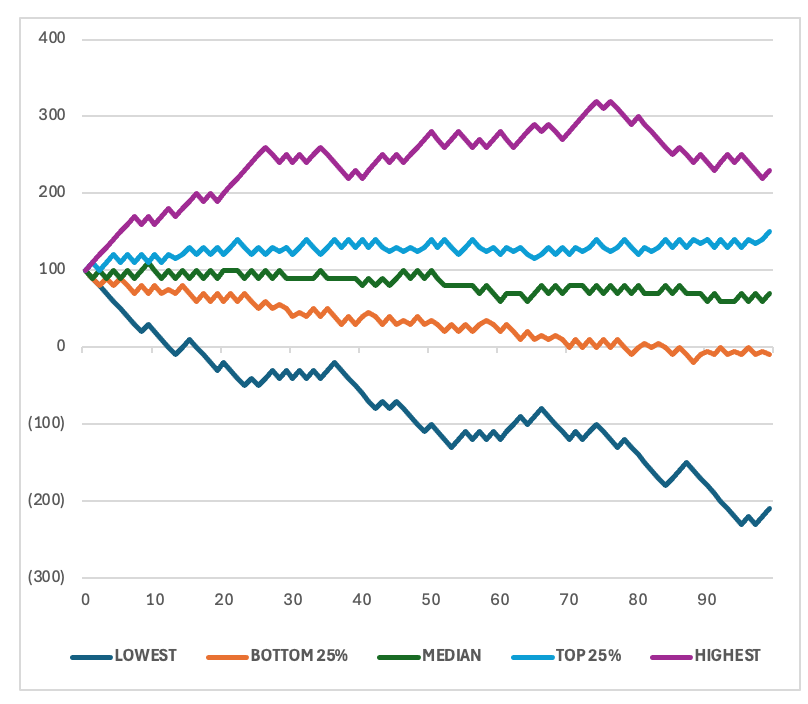
This is really the crux of it. The House Edge only explains the dark green, median line. It explains why the House wins on average. But that is not what we set out to explain. What we set out to explain is why the House always wins, and it should be becoming obvious now why that is. In real life, the game is not limited to 100 rounds, and a player who is ahead at that stage, on the light blue or purple lines for example, can always play on. They have chips! It feels good to be on a winning streak! And there is a very nice waiter coming past, with another free drink. A player who is winning can always keep playing until the law of averages reasserts itself.
But a player on the dark blue or orange lines has no such choices. Most jurisdictions prohibit players from gambling on credit, so a player who is out of chips cannot play ‘through’ a sour run of the numbers. When you’re out of chips, you’re out of chips – you have to swallow your losses and go home. There are usually also limits on the size of bets which can be placed, which rules out the Martingale, a strategy where the bet is doubled each round until the player wins - at which point, all previous losses are recouped. The rules banning credit or large bets are supposedly there to protect the player - but nothing is ever what it seems, and in reality, they protect the House.
In sum, The House Always Wins, but not because the odds are (very slightly) loaded against the player. That’s true, but largely irrelevant. The House Always Wins because players lack liquidity and aren’t allowed to double up. So when Lady Luck is against them, they are forced from the table with empty pockets. But when she is on their side, they can (and do) play on … but only until the gunpowder runs out at the heels of their boots.2
The numbers will appear to be in random order on the wheel, but in fact, they are carefully arranged such that the slots in any similar sized segment of the wheel will sum to a similar total. Funnily enough, the sum of all the numbers on the roulette wheel is 666.
A small prize if you know where this quotation comes from. Do you? Answer here – a poem written to test the claim of the actor Charles Macklin, who believed he could repeat any text verbatim, after hearing it only once.


