Management
Cosmic Principle No. 4
Don’t fall off the Cliff of Trust
Management
Cosmic Principle No. 4Don’t fall off the Cliff of Trust
Finance
The economics of the happy coupleA reminder of what you are looking for in a financial investment, and a warning against a common mistake
History
Are you related to Harry Kane?Yes, you are and so am I. And that is the true beauty of the World Cup.
Culture
MazawatteeTalented people should build things step by step, like an Indie band
Economics
Who should pay tax?Everyone, surely. But some of our compatriots are enjoying the greatest of all loopholes.
Technology
The alternative to a social media banI propose a new model based on the latest, on-demand technology and a regulatory construct which has worked for over a century in other industries
Management
Cosmic Principle No. 3Leave your top performers alone (they already know what to do)
Culture
Computer games are good for youAlthough, as a kid, I was always told the opposite
Politics
Vance is Gletkin.Revolutions are started by people who believe that something must change. But they are sustained by a second generation who do not ask questions, and use the revolution to advance their own positions.
Strategy
What exactly is an insight?A 2 minute read for anyone in a management role
Economics
How to blow your own foot offPick up the musket called 'tariff policy' and start yanking on the trigger
Technology
How to fix social mediaA good start would be for all users to say who they are
Politics
Common sense? Nonsense.The problem with 'common sense' is that it is a status quo concept and frequently antithetical to progress
Management
Cosmic Principle No. 2Something to think about as you finalise your New Year resolutions
Management
Cosmic Principle No. 1If we could each have an eponymous law, this would be mine
Business
The Bad Good IdeaWhat happens when corporate innovation goes wrong
Life
Life advice – from chessIf you don't have a master-plan, do what you can to build your position.
Probability
The House Always WinsBut do you know why?
Environment
Every cloud has a sulphur liningA look at the unexpected climate benefits of sulphur pollution
Economics
We only have 5 thingsAnd I am thinking about re-naming this newsletter after one of them.
Climate
Electric vehicles and the parable of the magic buttonA short contrarian read about the vehicle replacement cycle
Education
Advice for a college freshmanA 10 point plan for anyone you know who is heading off to university this year
Management
You're the decision maker nowCongrats – you earned it! But how will you know if you are doing a good job?
Finance
The most crowded trade in the cityA look at the perils, or potential, of TG61 – a very long duration bond.
Education
The College Essay is dead – Long Live the 'AI Viva'A simple solution to the problem everyone is talking about on campus
Finance
Everybody makes the same valuation mistakeThey forget to factor the fade.
Management
If we could each have an eponymous law, this would be mine
A lot of people have had interesting laws named after themselves. Many of the best ones are helpfully listed on Wikipedia’s page of eponymous principles and adages, an internet rabbit hole which generously rewards the curious explorer.
Many eponymous adages are really quite good. I mentioned Amara’s Law in my last post: an aphorism from the 1970s which describes how we over-estimate the pace of technological change in the short run, but under-estimate it in the long run. It’s very relevant to the phenomenon of stock market bubbles which I wrote about here.
I have also had frequent reason to fall back on Sturgeon’s Revelation, which baldly asserts that ‘90% of everything is crud’. The origin of this one was a conference at NYU in the 1950s, when someone challenged Sturgeon, an American science fiction writer, with a question along the lines of ‘But isn’t 90% of science fiction crud?’ To this, allegedly, Sturgeon replied: ‘Yes, but isn’t 90% of everything crud?’ The observation was written up in a science fiction magazine as follows:
“Eureka! – ninety-percent of everything is crud. All things – cars, books, cheeses, hairstyles, people, and pins are, to the expert and discerning eye, crud, except for the acceptable tithe which we each happen to like.”
Venture, September 1957 edition
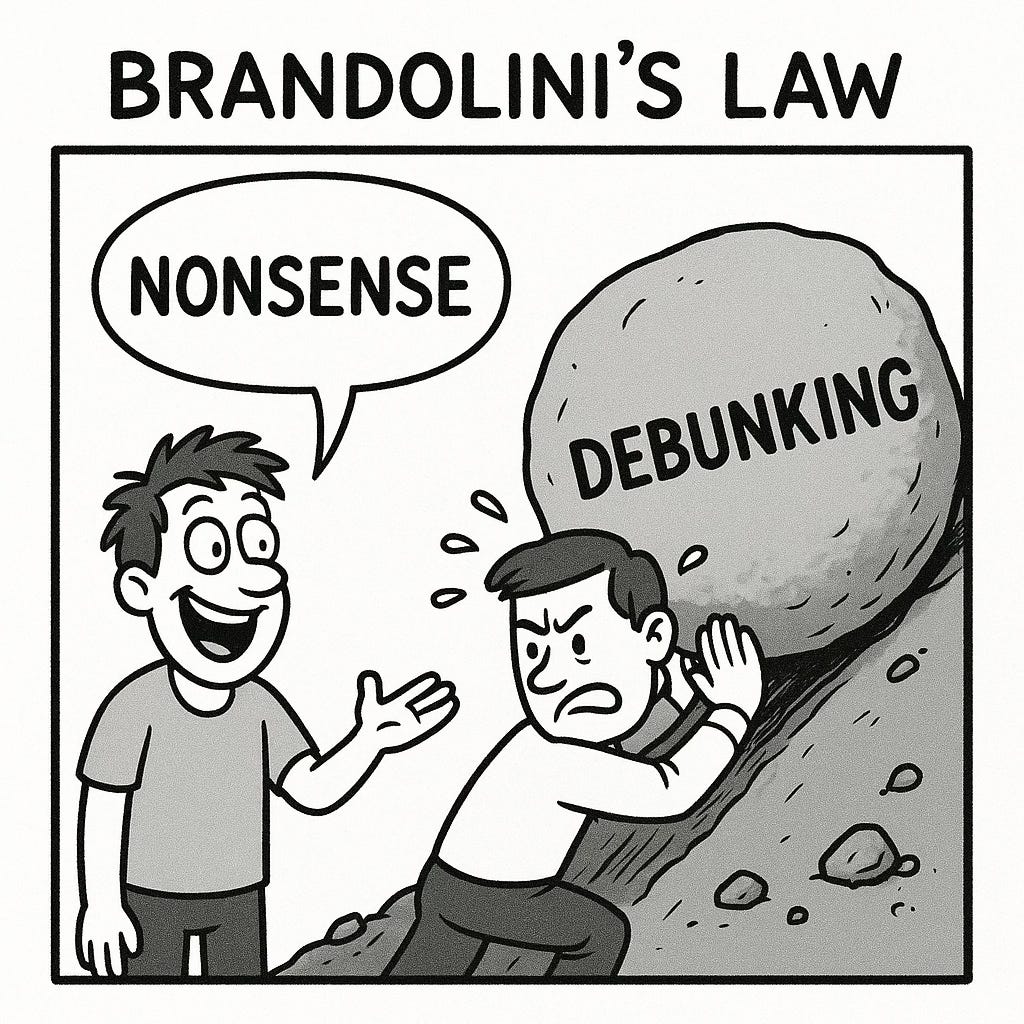
Sturgeon’s Revelation is profound. It was I think originally intended as a law about subjectivity, but of course, it’s objectively true as well (in my opinion). It is therefore likely to be at least a second cousin of ‘not even wrong’ (an adage coined by Wolfgang Pauli, in response to assertions that are so bad that you cannot even refute them using normal arguments) and a first cousin of Brandolini’s Law (which observes, surely correctly, that the effort required to refute nonsense is an order of magnitude greater than the effort required to produce it in the first place).
A final but favourite example is Hofstadter’s Law, which says that whatever it is, it always takes longer than you expect - even when you take into account Hofstadter’s law. (Being properly self-referential definitely adds something to the quality of the law.)
All this leaves me with the question: what universal law or adage would I want to have named after myself? I think my best shot would be something I used to refer to on the research desk as Sam’s Cosmic Principle No. 1, in the hope that this would help the team to keep it front of mind when listening to corporates or speaking to investors. And it boils down to this: everyone is talking their own book.

In case you are not familiar with the phrase, ‘talking your own book’ is just finance jargon for the situation where someone is trying to persuade you to buy a security they have already bought, or to sell one they have already shorted. They are telling you to adopt some point of view, when it would be good for their own positions if you were to do that.
Examples are almost too numerous to list, in finance and in life, and it’s not always a bad thing. But one memorable example which stands out to me is from a conference a few years ago where I had the chance to ask a well known energy CEO if he thought that there was any remote chance of achieving the Net Zero 2050 target which the UK government had recently adopted. Yes, he answered, and the particular boon that would get us there would be energy efficiency - a new plank on which his company had recently relaunched a major part of their strategy.
Now, everybody knows that energy efficiency makes perfect sense for an individual company, so I’ve no objection to companies developing strategies in that area. If you are not efficient at what you do, your competitors will beat you on price and you will lose market share. So fair enough, if a company can offer services in this area, they should be able to make a return. It’s hard to imagine anybody suggesting otherwise.
But it’s also fairly clear that at the national or global economy level, energy efficiency does us no good. Most forms of energy consumption have roughly tripled in the last 50 years or so, in absolute terms, while energy efficiency has improved enormously in almost every walk of life. The reason for the apparent inconsistency is the Jevon’s Paradox, also known to economists as the Khazzoom-Brookes postulate, and sometimes even more simply just as the Rebound Effect.1
Whatever you call it, the point is that as you become more efficient in the use of a fuel, the fuel itself becomes more valuable to you. You can, by definition, do more with it: you get more bang for your buck. Thus you end up using more, and there tends to be a positive correlation between improving efficiency and increasing total consumption, as the Victorian economist W.S. Jevons first observed with regard to the extraction and consumption of coal.
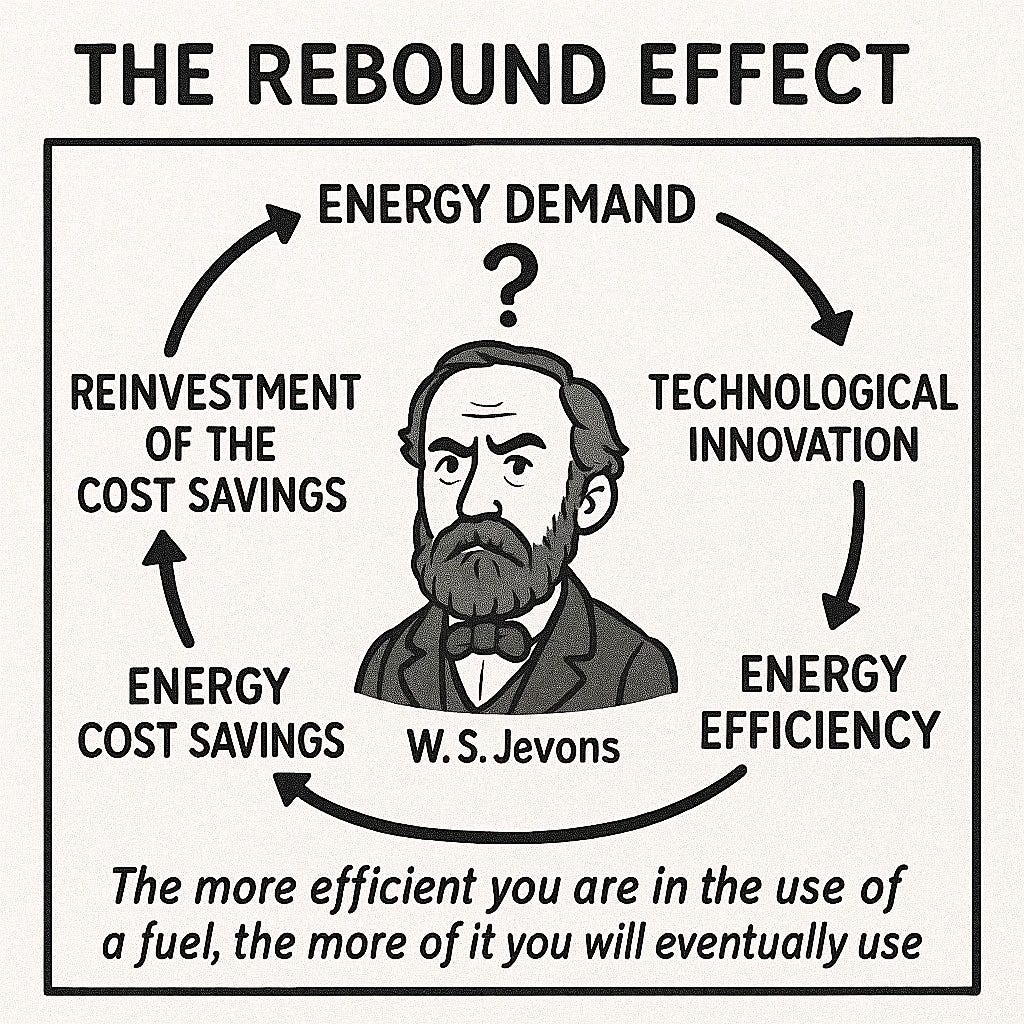
The bottom line is that energy efficiency in the aggregate (i.e. across the economy as a whole) tends to be a driver of energy demand, rather than a mitigator.2 This is very counter-intuitive, since you would assume that with lower efficiency processes, we would consume more energy. But this is usually only true in a static and theoretical comparison which ignores cost. What time series data on actual consumption attest is that when efficiency is low, cost is high, and there is less activity overall. Of course, a corporate which is launching a new strategy in energy efficiency is not going to help you figure out this kind of un-intuitive relationship. They are just going to tell you how helpful they are being - and hope that nobody notices the truth.
Over the years, this is perhaps the thing I found most awkward to deal with when listening to corporates. And the problems are exaggerated when, as is commonly the case, corporates have more detailed knowledge and expertise in their given field than their regulators or policy makers. You would want the corporates to use this knowledge to lay out good solutions for society. But it is their job to advocate good solutions for themselves, and the two do not always overlap - frequently creating a conflict of interest.
You might ask: how often do these conflicts of interest arise? And I would say 90% of the time, referring you to Sturgeon’s Revelation.
You might ask: why not just call them out when they occur? And I would say because the effort is immense, referring you to Brandolini’s Law.
You might think: these are just bugs in the code of capitalism, couldn’t we come up with some kind of a solution? And I would say don’t hold your breath, referring you to Hofstadter.
So what can we do? Just remember Sam’s Cosmic Principle No. 1: everyone is talking their own book. At least if you remember that, you won’t be fooled into believing other people’s marketing if it isn’t really true.
There are differences in each of these concepts, but broadly speaking they are all getting at the same thing.
I know there are studies which purport to show the rebound effect is only partial. But these are micro studies. At the macro (i.e. global) level: efficiency improves, and consumption goes up. It just does. Tant pis.


