Management
Cosmic Principle No. 4
Don’t fall off the Cliff of Trust
Management
Cosmic Principle No. 4Don’t fall off the Cliff of Trust
Finance
The economics of the happy coupleA reminder of what you are looking for in a financial investment, and a warning against a common mistake
History
Are you related to Harry Kane?Yes, you are and so am I. And that is the true beauty of the World Cup.
Culture
MazawatteeTalented people should build things step by step, like an Indie band
Economics
Who should pay tax?Everyone, surely. But some of our compatriots are enjoying the greatest of all loopholes.
Technology
The alternative to a social media banI propose a new model based on the latest, on-demand technology and a regulatory construct which has worked for over a century in other industries
Management
Cosmic Principle No. 3Leave your top performers alone (they already know what to do)
Culture
Computer games are good for youAlthough, as a kid, I was always told the opposite
Politics
Vance is Gletkin.Revolutions are started by people who believe that something must change. But they are sustained by a second generation who do not ask questions, and use the revolution to advance their own positions.
Strategy
What exactly is an insight?A 2 minute read for anyone in a management role
Economics
How to blow your own foot offPick up the musket called 'tariff policy' and start yanking on the trigger
Technology
How to fix social mediaA good start would be for all users to say who they are
Politics
Common sense? Nonsense.The problem with 'common sense' is that it is a status quo concept and frequently antithetical to progress
Management
Cosmic Principle No. 2Something to think about as you finalise your New Year resolutions
Management
Cosmic Principle No. 1If we could each have an eponymous law, this would be mine
Business
The Bad Good IdeaWhat happens when corporate innovation goes wrong
Life
Life advice – from chessIf you don't have a master-plan, do what you can to build your position.
Probability
The House Always WinsBut do you know why?
Environment
Every cloud has a sulphur liningA look at the unexpected climate benefits of sulphur pollution
Economics
We only have 5 thingsAnd I am thinking about re-naming this newsletter after one of them.
Climate
Electric vehicles and the parable of the magic buttonA short contrarian read about the vehicle replacement cycle
Education
Advice for a college freshmanA 10 point plan for anyone you know who is heading off to university this year
Management
You're the decision maker nowCongrats – you earned it! But how will you know if you are doing a good job?
Finance
The most crowded trade in the cityA look at the perils, or potential, of TG61 – a very long duration bond.
Education
The College Essay is dead – Long Live the 'AI Viva'A simple solution to the problem everyone is talking about on campus
Finance
Everybody makes the same valuation mistakeThey forget to factor the fade.
Politics
Revolutions are started by people who believe that something must change. But they are sustained by a second generation who do not ask questions, and use the revolution to advance their own positions.
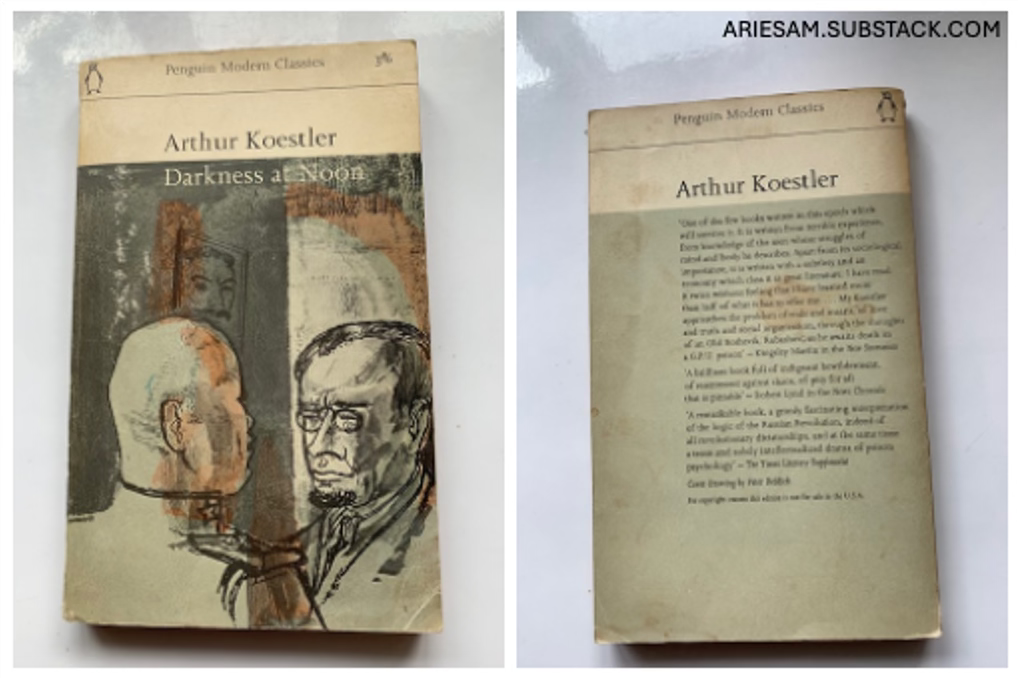
I thought of Arthur Koestler this week when - in Budapest, the city of his birth - we saw his famous political pendulum in action.1
And yet, after re-reading Darkness at Noon (1940) this week, I realise that the analogy of the pendulum is not the only political insight we can take from this seminal, anti-totalitarian novel. We can also learn something about the characters who conspire to install and sustain totalitarianism, and who show us how the system takes root.2
The central character is Rubashov, a revolutionary leader who has recurring nightmares of his own arrest. In the first chapter, he wakes from such a nightmare to discover that he is in fact being arrested in real life. In prison, Rubashov is interrogated and pressured to confess to spurious charges, although he is not guilty. Eventually he confesses and, in the final pages (spoiler alert), he is executed.
On the surface, the novel attempts to explain why a revolutionary thinker would confess to crimes he did not commit. Koestler had followed the Moscow show trials of Zinoviev, Kamenev and Stalin’s other adversaries in 1936-38, and the book is in some ways a response. He shows Rubashov gradually realising that if historical necessity calls for his sacrifice to the revolutionary cause, in the same way as he has required others to be sacrificed in the past, then logic dictates he too must yield.3
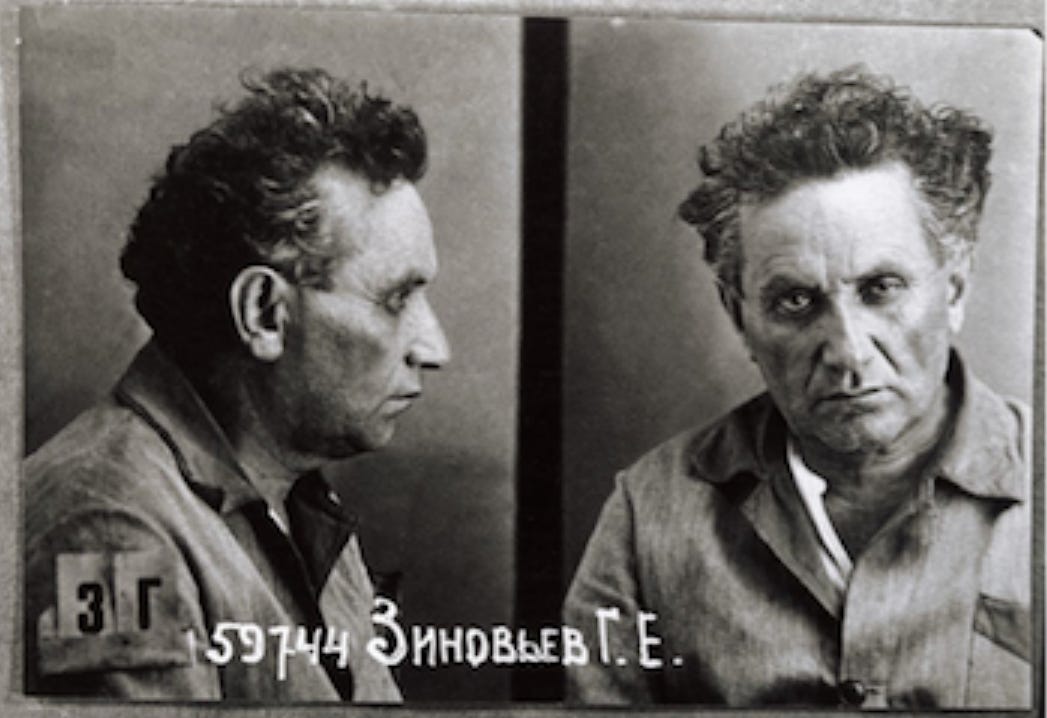
Yet more important than the conclusion is how we get there. Rubashov’s interrogator is Ivanov, an older guard, who shares a revolutionary past with Rubashov and remains somehow intellectual, dialectical, reflective, and occasionally shows a glimpse of humanity. He debates the situation with his prisoner, seeking to convince him that a confession is the best option. Ivanov is relatable, but at the same time dangerous as a character: it is his creative persuasiveness which justifies the edifice of repression.
The younger guard, Gletkin, is different. He doesn’t buy into Ivanov’s intellectual process or psychological manipulation of the prisoner and thinks a few basic torture methods would be more effective. Their difference of opinion becomes clear when the two meet to discuss the case:
Gletkin: It is the method which I consider wrong. It will never make him give in.
Ivanov: When Rubashov capitulates it won’t be out of cowardice, but by logic. It is no use trying the hard method with him. He is made out of a certain material which becomes the tougher the more you hammer on it.
Gletkin: That is just talk. Human beings able to resist any amount of physical pressure do not exist. I have never seen one. Experience shows me that the resistance of the human nerve system is limited by Nature.
Ivanov: I wouldn’t like to fall into your hands
Darkness at Noon, “The Second Hearing”, Chapter 1.
The point about the younger man is that he has no patience for reasoning or negotiation. He has no position of his own on the question of whether or not Rubashov should confess, he only knows that he must achieve this goal; that it is expected of him; and that it would be good for him if he can be the one to extract the confession. He is dangerous too, of course, but not in the same way as Ivanov. He does not seek to justify the system of repression: he only seeks to deliver it.
You might ask what Koestler is trying to do by setting up these two characters, Ivanov and Gletkin, in apposition to each other. Which does he mean to warn us is more dangerous? But the answer is soon obvious as Ivanov disappears from the story, reported to the authorities by none other than Gletkin, and quietly executed. There is some authorial sympathy for Ivanov and his loyalty to the revolutionary ideal, whatever we readers may think of that. But there is no sympathy for Gletkin, the cynical and impatient subordinate, who lacks subtlety of any kind; doggedly chases power; and doesn’t hesitate to advance himself whenever he can.
Returning to the modern era, it’s hard to argue that Trump is Ivanov. He lacks the intellectual sophistication and the idealism. But you could at least say that he is an iconoclast, who rose to power on the back of his own strong belief - whether you agree with him or not - that something was wrong and needed to be changed. And while he has not shown himself open to debate on those beliefs, he has been willing to change position - often, and surprisingly. He may be narcissistic and vainglorious, for sure, but he is not rigid. And he can be, as we have seen, extraordinarily persuasive.
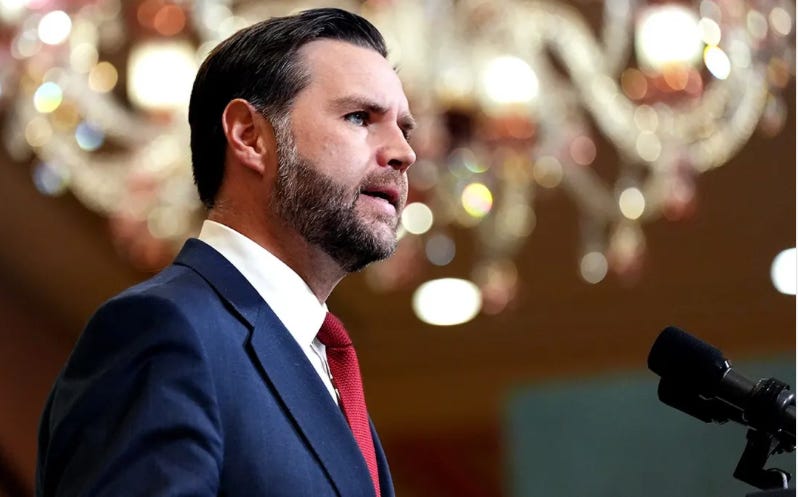
In JD Vance, on the other hand, it is relatively simple to see the outline of a Gletkin, who is the model for the zealous but dangerous subordinate. He signs up to the intellectual agenda of the party leader, Number 1, but he doesn’t interrogate it. He is only concerned with implementing that agenda and using it to climb the power ladder. You might say that for Ivanov, revolutionary ideology was the goal; but for Gletkin, the ideology was a means to an end, as it surely is for JD Vance.
Many commentators have noticed that JD Vance has had a bad run of luck of late, and they conclude from that his political star may be fading. Granted, his appearance in support of Viktor Orbán was a bust, as was his trip to Pakistan to negotiate with the Iranians. But I fear it may be too early to conclude that his star is fading.
The problem with that analysis is that it seems to want to judge Vance on the same terms as Trump, as a first generation revolutionary leader. But as Koestler’s epic novel shows us, that’s not who Vance is or wants to be. He doesn’t invent, assess, reflect or change tack - as even Trump does. We should think of him instead as the second generation revolutionary, chiefly concerned to advance his own position, or to parrot the party line when necessary, or to deliver a pragmatic beating to anyone who gets in his way. But just don’t expect him to invent something new, articulate the vision for a new movement or paint a picture of the sunlit political uplands.
No, that’s simply not the game for the second generation Gletkins. And if you keep the following scene in mind, then you’ll know why:
“It is all right,” said Ivanov. “To-morrow he [Rubashov] will sign. But I had to sweat to repair your idiocy.”
Gletkin did not answer; he stood stiffly in front of his desk. Ivanov, who remembered the sharp scene he had had with Gletkin before his visit to Rubashov’s cell and knew that Gletkin did not forget a rebuff so easily, shrugged his shoulders and blew cigarette smoke into Gletkin’s face.
“Don’t be a fool,” he said. “You all still suffer from personal feelings. In his place, you would be even more stubborn.”
“I have a backbone, which he hasn’t” said Gletkin.
“But you’re an idiot,” said Ivanov.
Darkness at Noon, “The Second Hearing” (Chapter 7)
In one of Rubashov’s prison reflections, he talks about how the pendulum of society can swing from liberal democracy to totalitarianism, and underlines the importance of understanding the ‘law of motion’ which the pendulum follows. The key passage is as follows
“A hundred and fifty years ago, the day of the storming of the Bastille, the European swing, after long inaction, again started to move.
It had pushed off from tyranny with gusto; with an apparently uncheckable impetus, it had swung up towards the blue sky of freedom. For a hundred years it had risen higher and higher into the spheres of liberalism and democracy.
But, see, gradually the pace slowed down, the swing neared the summit and turning-point of its course; then, after a second of immobility, it started the movement backwards, with ever-increasing speed.
With the same impetus as on the way up, the swing carried its passengers back from freedom to tyranny again. He who had gazed upwards instead of clinging on, became dizzy and fell out.
“Whoever wishes to avoid becoming dizzy must try to find out the swing’s law of motion. We seem to be faced with a pendulum movement in history, swinging from absolutism to democracy, from democracy back to absolute dictatorship.”
- Rubashov’s diary (20th day in prison)
The title of the novel is supposedly an ironic reference to communism’s own claim that it sheds daylight as at high noon. Others refer to Job Book V, and to the image of the blind sinners. But for me, the title has always conjured Samson Agonistes (‘dark, dark, dark … amid the blaze of noon’) which has the added benefit of several additional layers: the concept of betrayal (and yet, so it turns out, it was Rubashov who betrayed his girl, Arlova, the reverse of the standard Samson and Dalilah story), and the concept of the protagonist wrestling with his own faith (although again, Rubashov eventually confesses and is defeated, the reverse of the standard Samon story where he rediscovers his faith, and pulls the temple down on his enemies). Interestingly, the title was suggested by a translator - after the publisher rejected Koestler’s original title for the work (Sonnenfinsternis, or Solar Eclipse).
To me it’s not clear this is an argument in its own right, more an exposure of the speciousness of the original belief. In other words: it’s not that Rubashov must now submit to his own, prior logic - but a demonstration that his own prior logic was wrong, and yet he can’t abandon it.


