Management
Cosmic Principle No. 4
Don’t fall off the Cliff of Trust
Management
Cosmic Principle No. 4Don’t fall off the Cliff of Trust
Finance
The economics of the happy coupleA reminder of what you are looking for in a financial investment, and a warning against a common mistake
History
Are you related to Harry Kane?Yes, you are and so am I. And that is the true beauty of the World Cup.
Culture
MazawatteeTalented people should build things step by step, like an Indie band
Economics
Who should pay tax?Everyone, surely. But some of our compatriots are enjoying the greatest of all loopholes.
Technology
The alternative to a social media banI propose a new model based on the latest, on-demand technology and a regulatory construct which has worked for over a century in other industries
Management
Cosmic Principle No. 3Leave your top performers alone (they already know what to do)
Culture
Computer games are good for youAlthough, as a kid, I was always told the opposite
Politics
Vance is Gletkin.Revolutions are started by people who believe that something must change. But they are sustained by a second generation who do not ask questions, and use the revolution to advance their own positions.
Strategy
What exactly is an insight?A 2 minute read for anyone in a management role
Economics
How to blow your own foot offPick up the musket called 'tariff policy' and start yanking on the trigger
Technology
How to fix social mediaA good start would be for all users to say who they are
Politics
Common sense? Nonsense.The problem with 'common sense' is that it is a status quo concept and frequently antithetical to progress
Management
Cosmic Principle No. 2Something to think about as you finalise your New Year resolutions
Management
Cosmic Principle No. 1If we could each have an eponymous law, this would be mine
Business
The Bad Good IdeaWhat happens when corporate innovation goes wrong
Life
Life advice – from chessIf you don't have a master-plan, do what you can to build your position.
Probability
The House Always WinsBut do you know why?
Environment
Every cloud has a sulphur liningA look at the unexpected climate benefits of sulphur pollution
Economics
We only have 5 thingsAnd I am thinking about re-naming this newsletter after one of them.
Climate
Electric vehicles and the parable of the magic buttonA short contrarian read about the vehicle replacement cycle
Education
Advice for a college freshmanA 10 point plan for anyone you know who is heading off to university this year
Management
You're the decision maker nowCongrats – you earned it! But how will you know if you are doing a good job?
Finance
The most crowded trade in the cityA look at the perils, or potential, of TG61 – a very long duration bond.
Education
The College Essay is dead – Long Live the 'AI Viva'A simple solution to the problem everyone is talking about on campus
Finance
Everybody makes the same valuation mistakeThey forget to factor the fade.
Finance
A look at the perils, or potential, of TG61 – a very long duration bond.
This is not financial advice. But this is an unusual security, and a good opportunity to discuss the dynamics of duration.
If you lend me £20, and I pay you back next week, the duration of that loan is 1 week.
On the other hand, if I promise to give you a tenner next week, and another in three weeks, then the duration of the loan from your point of view will be 2 weeks. ‘Duration’ in this sense is a kind of weighted average timing of the cash flows you are going to get.
Adding interest payments only makes things slightly more complicated. If you make me a loan for two years, and I pay you interest annually, then you will get a small interest payment after one year, and then another interest payment, plus the return of the original loan amount, after two. So the properly weighted duration will be just slightly less than 2 years. If you want to do the calculation, you can use this formula:
(Here, Ct is simply the cashflow at maturity t, so we are just working out the average maturity of the bond, weighted by the size of each payment. )
It follows then that two things will define the duration: first, how long will it be until you get your money back? And second, how large are the interest payments along the way? So for example, if you had a very long dated bond, at a very low interest rate, the duration would be extremely long. Enter the beast known to markets as TG61, which has been, for some time now, one of the city’s most crowded personal account trades.
TG61 is a UK government bond, issued with a c40 year maturity back in 2020, when rates had been cut almost to zero as part of the COVID response. Those were the salad days. The Treasury somehow managed to issue £13.5 billion of debt, not repayable until the 2060s, and at a coupon rate of 0.5%. What a steal for the taxpayer!1
Still, a great deal for the government was not such a great deal for the bondholders. As interest rates have risen, the price of the TG61 has had to fall to keep its yield in line with other securities. But because it is such a long duration bond, the price has to do a lot of work even when rates have only moved by a moderate amount. Currently the TG61 is trading at 24% of par. It has lost 3/4 of its value in 4 years. Not bad for a gilt-edged bond, which we were always taught to think of as far safer than equities.
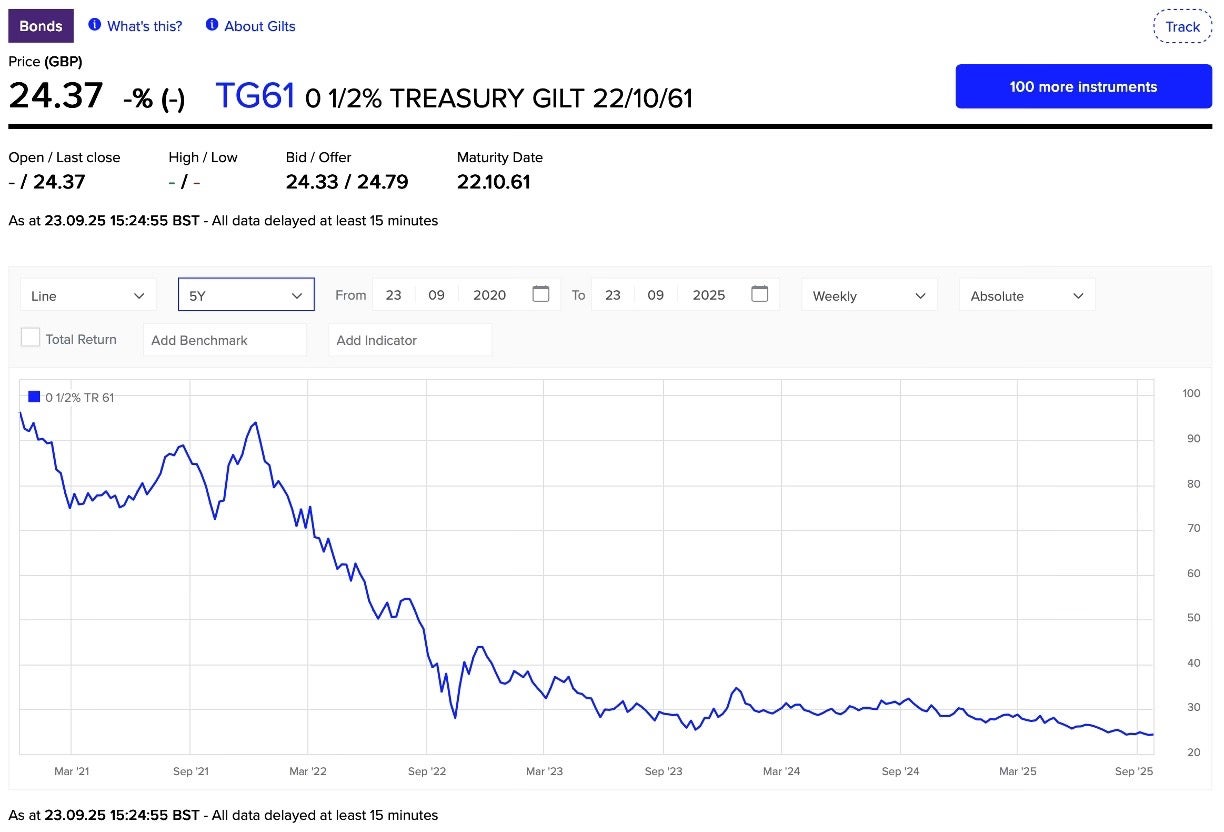
Despite this terrible performance, or perhaps because of it, TG61 is now, according to one blogger, the most popular bond since Sean Connery. But if you look at a table of UK gilt yields, it’s actually one of the more expensive ones. It trades at a yield of about 5.2%, relative to the 5.4 - 5.5% which the broader yield curve would suggest. It’s a little “rich on the spline”, in bond market speak.
So what are people paying that premium for? The answer is: some convexity, but a lot of duration.2 And why pay a premium for duration? Because with only a little bit of maths, duration becomes sensitivity. Start with a simple formula for the present value of a bond, and differentiate with respect to r, the annual interest rate, to get this:3
Now you have an expression which shows you how the price of the bond will change for each small change in the interest rate. To express that sensitivity as a percentage, divide the above expression by the price again, to get the following:
This is known as the modified duration and to cut a long story short, it gives you the sensitivity of the bond to interest rate changes. You can calculate it yourself, or just look it up. The standard UK 10 year bond, TG35, for example, has a duration of 9.5 years and a modified duration of 9.25. This means that a 1 percentage point fall in interest rates would mean the price of this bond goes up in value by 9.25%. But for TG61, the modified duration is 27. So if you get just a 1% reduction in rates, this beast-of-a-bond will leap by a supercharged 27%. And on top of that, no capital gains tax to pay, which is likely why this one is so popular for the personal account.
So, with all this in mind, we can start to see why TG61 is a crowded trade. Something similar happened to clean energy stocks back in the renewa-bubble which peaked in January 2021. The wind and solar developers had very long term growth plans and very low dividend yields, so they were in effect long duration names, just like TG61. But the bubble burst when inflation arrived and rates started rising, and many renewable energy stocks are still trading far below the valuations they briefly achieved 4 years ago.
So that in a nutshell is the story of duration. But before you speed-dial your broker, remember that sensitivity works in both directions, and almost everyone who tried the trade has lost money so far, as the first chart shows. A security which is down 75% can always fall further, as one war-weary investor said to me a long time ago: ‘it doesn’t matter what price you are buying in at, you can always lose more’.4
So how to summarise all this? I think the lessons for investors are as follows:
The last point is perhaps the most important here: people who bet on TG61 seem to have been asking: what is the most rate-sensitive security in the market? When they should have been asking: do I have a better view than everyone else on rates? If you do, then yes, TG61 gives you a supercharged way to express that view, either long or short. But if you don’t, then it will be your losses which are supercharged.
It was slightly less good than it sounds, since the bond sold initially for 97/100, but the difference is irrelevant.
The benefit of convexity is that for larger rate moves, the upside/down skew is not symmetrical. But for small moves, there is not a huge difference, and things get a bit complicated in a short article if we try to deal with both at the same time. So I’m sticking to duration (the first derivative point) as the focus of this article (and we can save the second derivatives for another time.)
There is more on how this all works in Berk & Demarzo, Corporate Finance, Chapter 30.
At least with government bonds, the default risk is low. So you are likely to recover the face value eventually, although you might have to wait half your lifetime for it. With equities, there is no such backstop: even if you are buying in after a 75% fall, you can always still lose 100% of your investment.
This point is mitigated, but only partially, by the convexity point, since it introduces the idea of asymmetry in the upside/downside cases. But there is still sensitivity in both directions, and investing for convexity alone, without your own differentiated view on rates, is like investing in VCTs because you get a tax break. Things go wrong when tails wag dogs.


