Management
Cosmic Principle No. 4
Don’t fall off the Cliff of Trust
Management
Cosmic Principle No. 4Don’t fall off the Cliff of Trust
Finance
The economics of the happy coupleA reminder of what you are looking for in a financial investment, and a warning against a common mistake
History
Are you related to Harry Kane?Yes, you are and so am I. And that is the true beauty of the World Cup.
Culture
MazawatteeTalented people should build things step by step, like an Indie band
Economics
Who should pay tax?Everyone, surely. But some of our compatriots are enjoying the greatest of all loopholes.
Technology
The alternative to a social media banI propose a new model based on the latest, on-demand technology and a regulatory construct which has worked for over a century in other industries
Management
Cosmic Principle No. 3Leave your top performers alone (they already know what to do)
Culture
Computer games are good for youAlthough, as a kid, I was always told the opposite
Politics
Vance is Gletkin.Revolutions are started by people who believe that something must change. But they are sustained by a second generation who do not ask questions, and use the revolution to advance their own positions.
Strategy
What exactly is an insight?A 2 minute read for anyone in a management role
Economics
How to blow your own foot offPick up the musket called 'tariff policy' and start yanking on the trigger
Technology
How to fix social mediaA good start would be for all users to say who they are
Politics
Common sense? Nonsense.The problem with 'common sense' is that it is a status quo concept and frequently antithetical to progress
Management
Cosmic Principle No. 2Something to think about as you finalise your New Year resolutions
Management
Cosmic Principle No. 1If we could each have an eponymous law, this would be mine
Business
The Bad Good IdeaWhat happens when corporate innovation goes wrong
Life
Life advice – from chessIf you don't have a master-plan, do what you can to build your position.
Probability
The House Always WinsBut do you know why?
Environment
Every cloud has a sulphur liningA look at the unexpected climate benefits of sulphur pollution
Economics
We only have 5 thingsAnd I am thinking about re-naming this newsletter after one of them.
Climate
Electric vehicles and the parable of the magic buttonA short contrarian read about the vehicle replacement cycle
Education
Advice for a college freshmanA 10 point plan for anyone you know who is heading off to university this year
Management
You're the decision maker nowCongrats – you earned it! But how will you know if you are doing a good job?
Finance
The most crowded trade in the cityA look at the perils, or potential, of TG61 – a very long duration bond.
Education
The College Essay is dead – Long Live the 'AI Viva'A simple solution to the problem everyone is talking about on campus
Finance
Everybody makes the same valuation mistakeThey forget to factor the fade.
Management
Don’t fall off the Cliff of Trust
Early in my consulting career, I was staffed on a particularly painful short project: a 48 hour sprint to produce a strategy pack for a bank, in which I am afraid the part I was on the hook for did not go well. I was at least lucky enough to have a kind and patient mentor who took me aside and told me about the Cliff of Trust. It’s such a good idea that it belongs in this column. I’m calling it Cosmic Principle No. 4.
Cosmic Principle No. 4 - Don’t fall off the Cliff of Trust.
(If you missed the first 3 cosmic principles, you’ll find links at the end of this article.)
Here’s how it works. Professional success requires trust; trust must be earned; and you can only earn it slowly, over time. Even so, as a new joiner in any organisation you won’t be starting from zero. You may have just graduated from a fine university, or just been hired away from a famous competitor, and those credentials will say something helpful about you already. They say that somebody, somewhere thinks you were the right person to hire.
So if you are in a new role, you will start out with an unofficial Trust Score among your colleagues of something like a 2 out of 10. They won’t tell you of course that this is your score, but trust me - that is what they are thinking, even if they would not be so rude as to say so out loud.
It’s not much, in other words, but at least it’s a start. And if you show up to the first meeting on time, well slept, properly attired and listening carefully to the brief, you’ll soon be climbing nicely up to a 3. And if you come back to the next meeting with a good job done, and ready for the next one, then maybe now you’ll be a 4 in everybody’s mind.
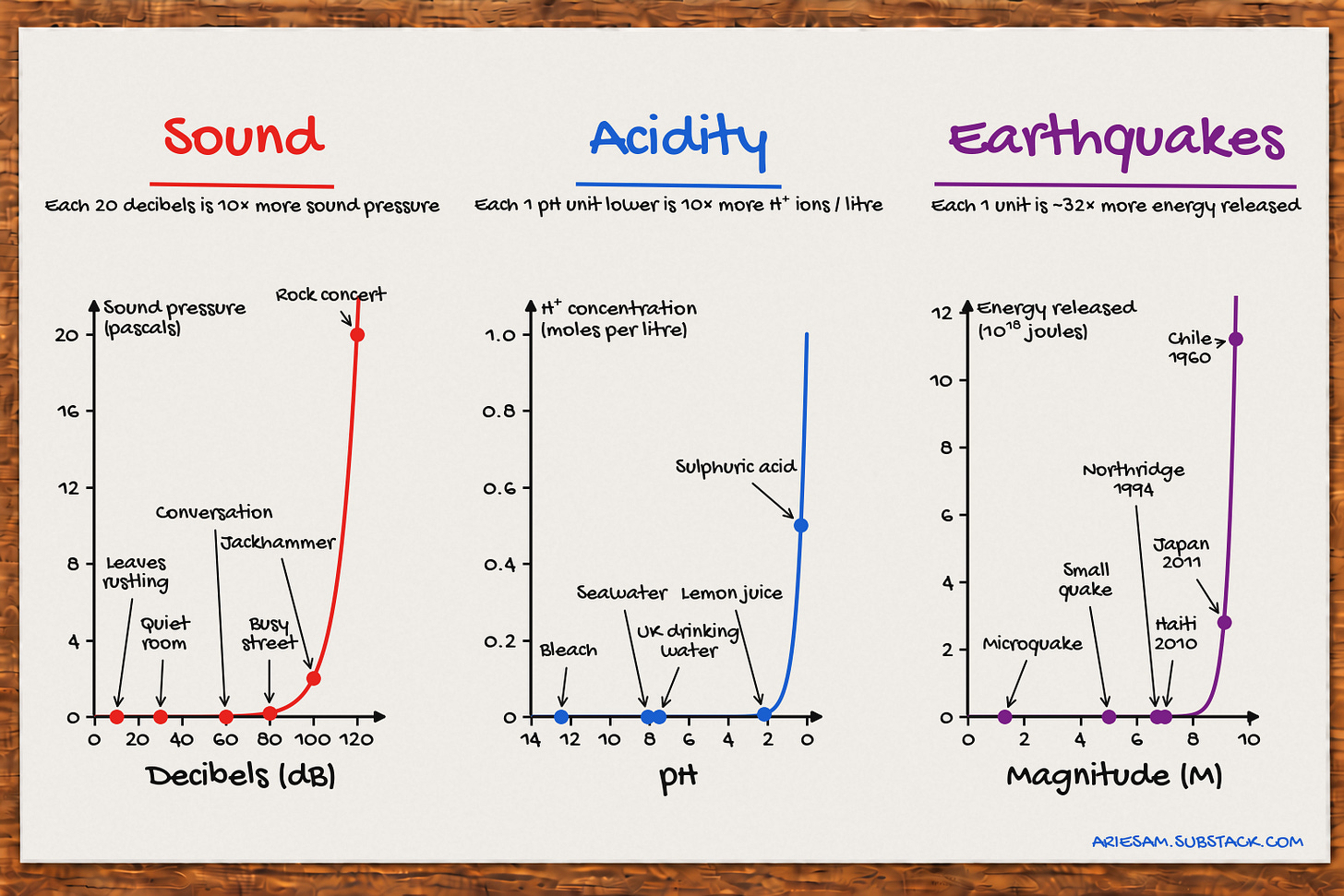
Fast forward a few weeks and months and you’ve been repeating this process a whole bunch of times. You’ve been to the important client meeting and said the right things when asked. Then there was the time you spotted a glaring mistake in some important document just before it went to print, and saved everybody’s skin. You’re climbing nicely to a 5 or a 6 now, maybe even a 7, but then you notice that the last pull to the summit starts to get really steep. What you really want to be is an 8, 9 or 10, but the Trust axis - like the scales used to measure so many other scientific quantities - is frustratingly logarithmic. A 9 is ten times higher than an 8; an 8 is ten times higher than a 7; and a 7 is … already a high score it will have taken you a long time to earn.
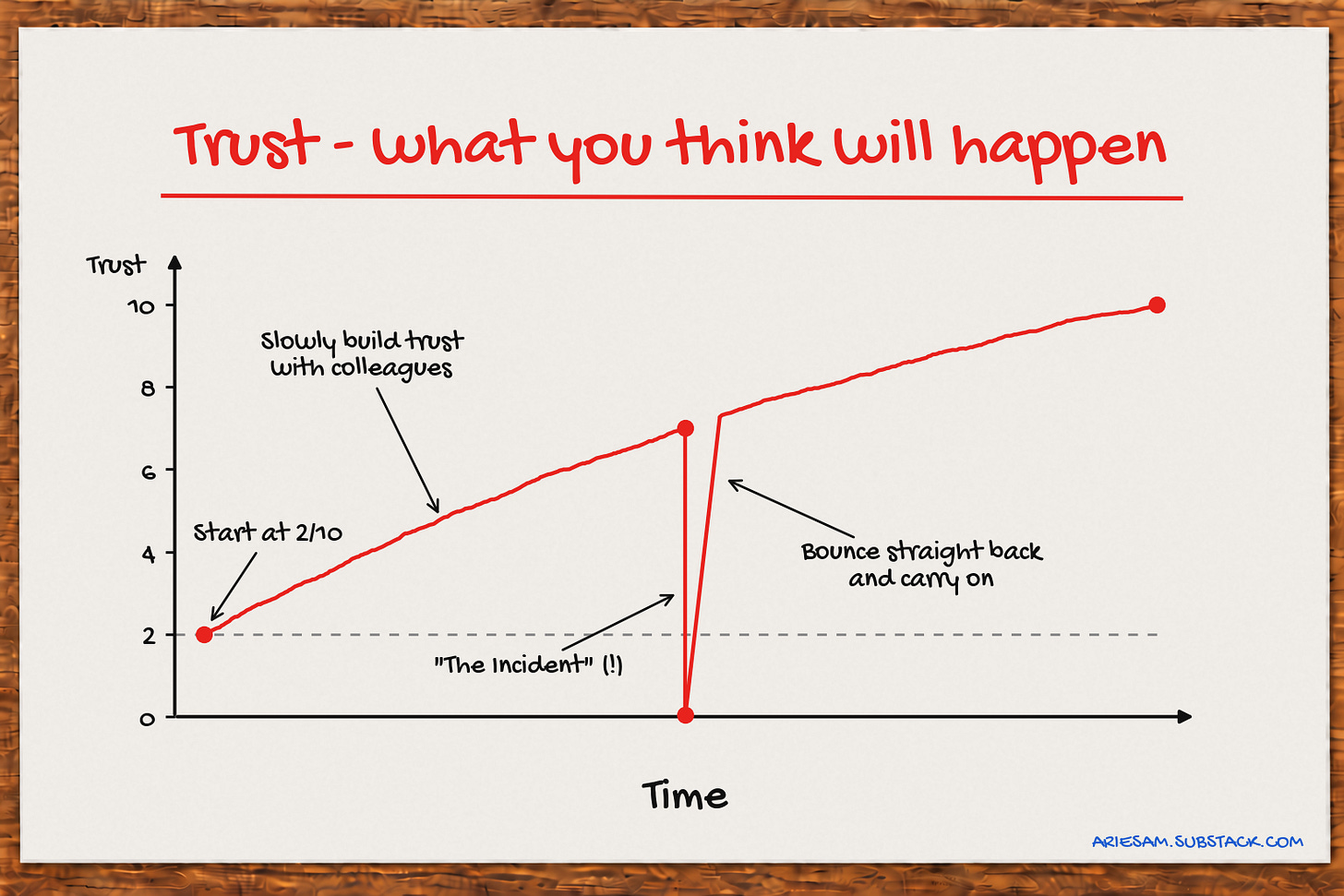
So what happens if you’re climbing the steep part of this mountain and you foul something up, as I did on that banking project? Well: the partners are sitting with the Chief Exec, doing their best to chat strategy, and instead they find themselves arguing with the client and wondering if the data they are presenting has somehow gotten garbled. That’s not the conversation they wanted to be having, and they will remember that I was the one who made the slides. So no surprise that I wasn’t picked for the follow-on assignment.
In the framework we’re talking about, I was climbing up the Cliff of Trust and then I fell right off it. And when you fall off the cliff, you go all the way down to the bottom. Worse, you go to the bottom and now there are rocks in your backpack, which means: when you do something perfectly well the following day, you won’t just bounce back up again to where you were before. You’ll experience what’s known in game theory as the grim trigger. Your only option will be to climb the whole mountain again, only this time it’s harder because you’re starting from zero and carrying more weight.
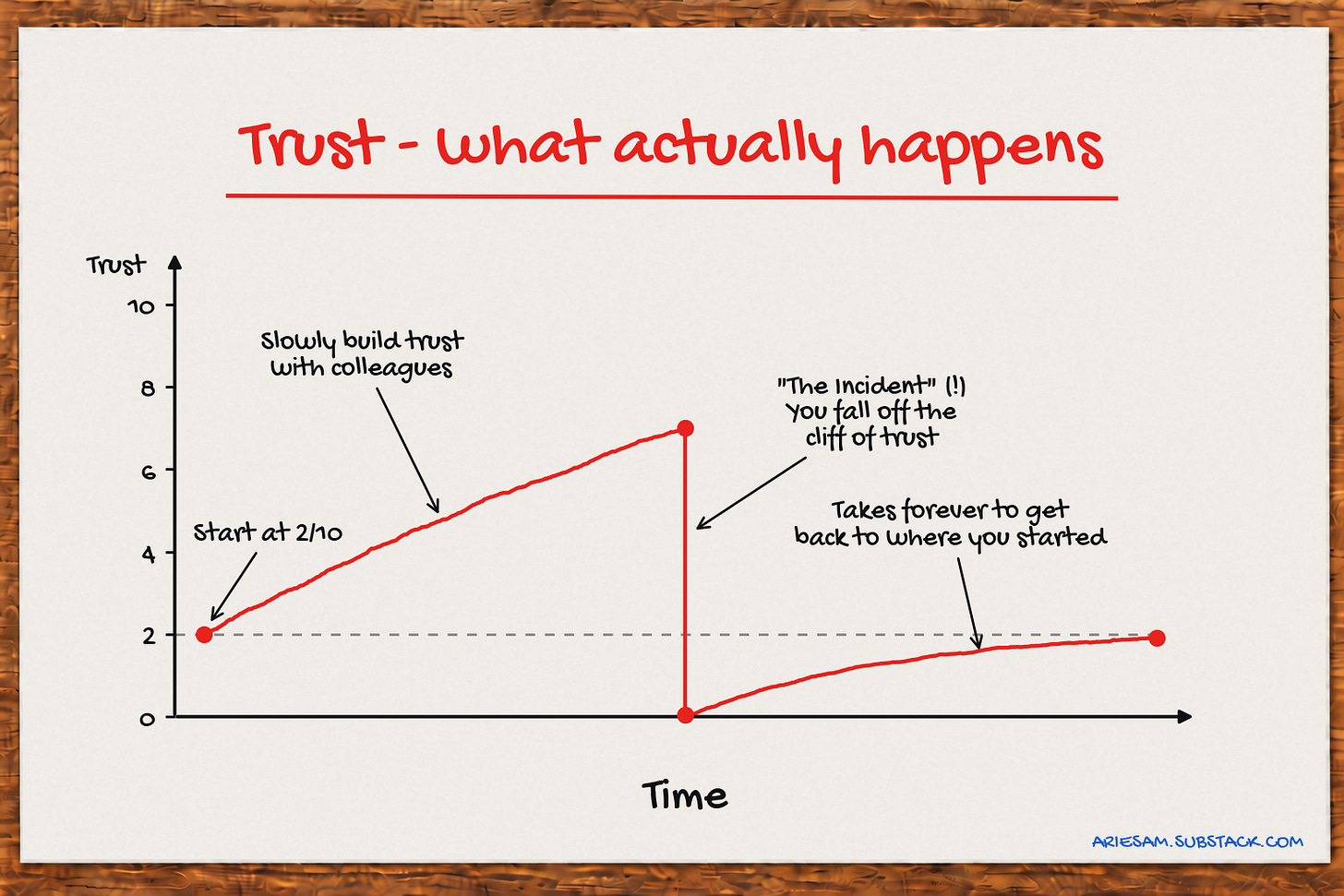
So what should you take from all this? First, that you really don’t want to fall off the Cliff of Trust. It will set you back. But the second and more useful thought to take away is that every task you are working on is really two tasks: there is the thing you’ve been asked to do, and then there is the contribution which doing that thing (well or badly) will make to your long term relationships. Once you have the second task in mind, you are likely to apply more checks, be more diligent and more communicative, and - this is the hardest one - perhaps more likely to treat your colleagues as clients, which is not a bad strategy at all.
Before we finish, another observation on the Cliff of Trust is that it can apply in many other situations. The restaurant which gave you food poisoning won’t be booking you in for dinner again next week. The spouse who confesses an affair won’t be sleeping on the couch for just one night. In the extreme case, when Gerald Ratner described his own products as “total crap” and said that a pair of earrings bought in his store would cost the same as a prawn sandwich but not last as long, the market value of his company collapsed, Ratner himself was fired and his eponymous brand disappeared forever from the UK high street. He fell off the Cliff of Trust more spectacularly than anyone I remember in British business.
And the same thing can happen to nations too. From the point of view of the Rest of the World, the US today looks a lot like a nation that is falling off the Cliff of Trust. One reason may simply be that the current President sees every interaction as a one-off game, seeking to maximise value from that single moment. He doesn’t seem to have been told about the second task. But he should reconsider, because international relations is a repeated game and, as the economist Robert Axelrod showed in the early 1980s, value maximisation in a repeated game depends mostly on trust.
The irony is that the preferred strategy to come out of Axelrod’s simulated competitions was known as tit-for-tat. Under that strategy, you withdraw your cooperation immediately if the counterparty withdraws theirs, but you also return to the table immediately if the counterparty comes back. Under “generous” tit-for-tat, you even ignore or forgive some defections, on the assumption they were temporary aberrations. This is perhaps how nations have tried to handle the Trump administration until now, but there are signs (Canada? Spain? UK under Starmer?) the response may be edging towards the grim trigger strategy, in which a single defection is enough to push the counterparty off the Cliff of Trust.
It’s interesting to pause on why that shift is occurring. Why would nations move from generous-tit-for-tat to the grim-trigger? Game theory gives us a neat answer, which also explains why trust in the workplace operates the way it does. Generous tit-for-tat is a good strategy when failure to cooperate is just a move. But in real life, a defection is more than a play. It contains information not only about what your counterparty has done, but also about what they are like. In a world where you have options (you can staff another consultant to the project, you can sign a trade deal with another partner) punishing counterparties on the basis of what they are like is a powerful deterrent.
Indeed, it may be the only thing you can do to encourage your counterparties to be more trustworthy in the future.
🇨🇦


