Literature
The undiscovered 'Easter Egg' in Stegner's masterpiece
It has to do with raw chicken. Let me explain.
Literature
The undiscovered 'Easter Egg' in Stegner's masterpieceIt has to do with raw chicken. Let me explain.
Culture
The power of a pure idea: The Finger-SpaceThe rip-roaring tale of Marc Antoine de Muret, Fragment 31 and the greatest literary scoop of the 16th century
Earth Science
Our brains are not wired to understand geologic timeIf they were, we might reach some very different conclusions about our planet
Drama
Sophocles and the Pink Pony ClubWhat we learn about how a good society works from a survey of world literature
Age of Discovery
Volta do marWe must sometimes risk the perils of the wide open ocean if we are to discover new worlds
Culture
Has intelligence gone out of fashion?It might soon be time for a retro revival
Finance
How financial markets actually workI'm taking a swipe here at a Nobel Prize winner - maybe not a good idea, but if you work in finance you'll understand my motivation
Politics
The end is near for Sir KeirHe seems to have a nasty case of Stanley Baldwin disease
Society
A red traffic light at 3amNot a soul in sight and the town is fast asleep. What do you do?
International Relations
NATO and 1984Will Ukraine be betrayed by doublethink and boiled rabbits?
Markets
Is the AI bubble bursting now?Opinions are divided (but I have taken a view)
Climate
Bill Gates and Point BreakA look at the Gates climate letter through the lens of an iconic, 1990s surf dude film
Politics
The dumbest thing a Congressman saidSo daft, you won't know whether to laugh or cry
Climate
A look at the Gates climate letter through the lens of an iconic, 1990s surf dude film
Last week, Bill Gates delivered his inevitable climate apostasy (‘Three tough truths about climate - What I want everyone at COP30 to know’). Having warned of climate disaster in the past, he now thinks climate change is not too bad. It won’t finish us off, anyway, so we need to focus on other things. The congregation at his new church (of climate pragmatism) are delighted. Clerics at the old church (of climate apocalypse) are still clutching their cassocks. But who is right?

First, let me declare my own hand. I’m with the pragmatists. But I got there with difficulty, and with low conviction, for reasons which are hardly ever discussed and do not figure in the Gates letter. (I’ll come back to those reasons in a minute.) Anyway, I did not get there via the winding road that Bill has taken in his latest essay, and which may be more an act of political contrition than economic analysis. To explain what I mean by that, let’s start with two obvious analytic problems in the essay.
First, Gates softens up his reader with a claim that the project of global emissions reduction is going well. His reassuring assertion (supported by the chart below) is that ‘innovation has cut future emissions by 40% in just 10 years’. Well, he knows exactly what he is saying here, but you need to read that sentence again carefully to make sure you noticed what he actually said. I mean: who uses the past tense (‘we have cut’) in reference to something which hasn’t happened yet (‘future emissions’)?
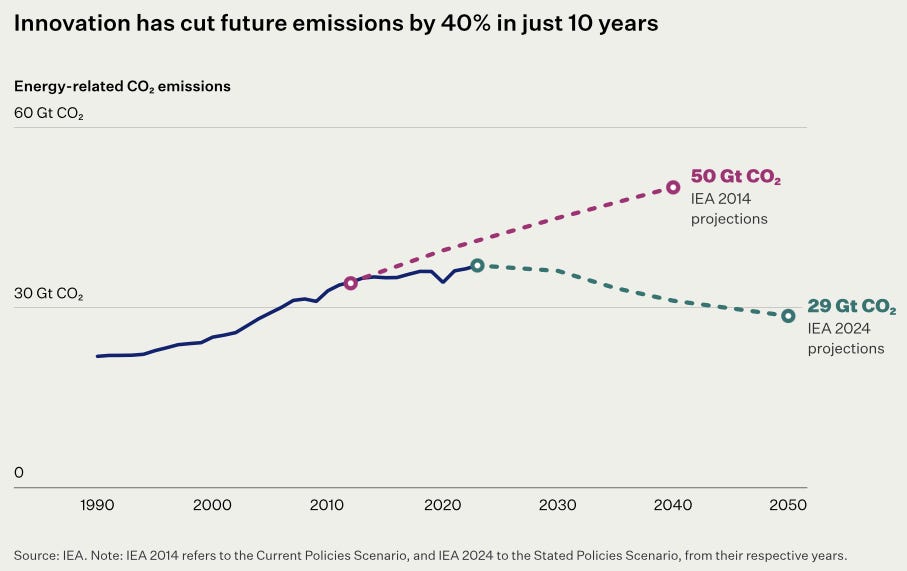
The reality is that global emissions have increased over the last 10 years, despite COVID (which encouraged remote working and less travel) and despite the gas crisis (which sharply raised the relative cost of fossil fuels). So what Gates is highlighting as a success is that the IEA, an OECD agency governed by national energy ministers, has recently reduced its long term emissions forecasts. The correct story of the last 10 years is one of forecast emissions getting better, while actual emissions got worse.
How long would a Sales Director keep their job at Microsoft, I wonder, if they delivered falling sales every year but came to each quarterly review with the claim that ‘despite falling sales for the last decade, sir, we have raised future sales by 40%’. Not long, I think. There would be some grins and chuckles, and then I think the individual in question would be encouraged to explore opportunities outside the Microsoft group.
In this context, it’s also worth remembering that the IEA forecasts Gates refers to relate to the flow of carbon emissions, not the stock. So the Gates claim really boils down to the following: ‘in the last 10 years, energy ministers have started saying that, over the next 25 years, we can slightly reduce the rate at which we increase the stock of carbon pollution’. I would give a rather tiny round of applause for that.
The second misleading message, in my opinion, has to do with what Gates calls the green premium, by which he means the extra cost of a zero carbon product relative to a fossil one. Gates talks about the green premium across various activities, for example as in the chart below, and argues we must keep trying to drive this premium to zero. So much, so fair enough. His letter name checks a long list of innovative companies who are trying to do just that, many of which - to be fair - he has invested in.
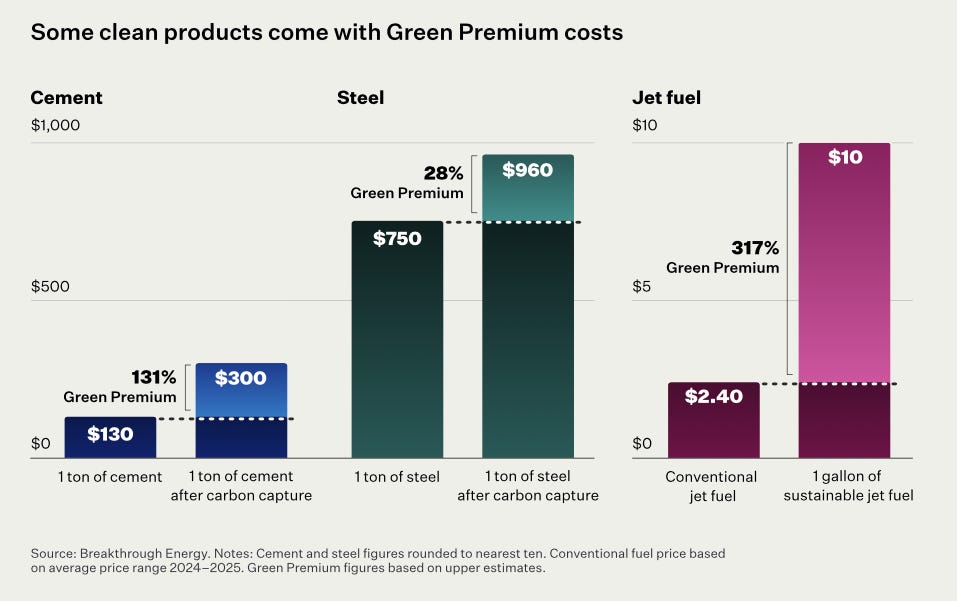
So what’s my problem with the green premium? Simply that I think Gates undercooks the size of it. Even his own charts (above) show clean steel at +28%; clean cement at +131%; and sustainable jet fuel at +317%. But I am suspicious that these figures may still be too low. For example, they might not reflect a completely carbon free alternative; they might not capture all the end to end costs; or they might not bake in a suitable return on capital for whoever finances the risky new product. Or perhaps these estimates may have all three problems? Experience tells me that these kind of costs are best interpreted as an aspiration or a target, and there is often a wide gap between aspiration and reality. 1
I must say, I noticed the same problem when I read Bill Gates’s book (‘How to Avoid a Climate Disaster’) a few years ago. The general message of both the book and the essay is that the green premium is falling fast and will soon disappear completely. But this just doesn’t square with my own experience as an energy and climate analyst.
In renewable power for example (which is the main driver of the IEA’s improving emission forecasts above) there has been incredible progress on costs. IRENA’s latest report shows global average solar power costs down 90% since 2010 and onshore wind down 70%, but we are still at $34 - 43 / Megawatt-hour (MWh) today, before adjusting for intermittency and grid costs. Lazard’s annual survey of renewable costs shows US wind & solar at $50-61 /MWh, up about 50% from 2021 to 2024, compared to the most efficient combined cycle gas plant at $38 - 45 /MWh, depending on the market cost of gas.
This may sound encouraging, but as suggested, this is not yet a fair comparison, since a gas plant can be dispatched at will, whereas renewables come and go with the weather. Intermittent power is not the same as firm power. The same Lazard report estimates the cost of renewables at $67 - 177 / MWh after using battery storage or a gas peaking plant to compensate for the intermittency.2
And again, even this is not a fair comparison, because it doesn’t include the extra spend on the grid which is needed to integrate new renewable supply and increased power demand. And in general, the cost of absorbing intermittency and expanding the power grid rises as renewable penetration increases in the system, so the headwinds for renewables get stronger the faster they progress.
And that’s the situation in the power industry today which has been working on the decarbonisation problem for decades, but only accounts for 25-30% of global emissions. For the remaining 70-75% (mostly from buildings, transport, industry and farming) there is a lot of R&D, a lot of venture capital activity, and some very exciting ideas. But the short answer is that for most things we humans do, we still do not yet have technologies with zero carbon emissions across the full lifecycle. And in the rare cases where we do have a zero carbon lifecycle solution, it is generally still much more expensive than the dirty / fossil option.
This last point is clear, although saying it out loud tends to trigger objections. The difficulty is always the gap between what we would like to be true, and what is true. We would all be delighted if there was a suite of available technologies which are already cheaper and cleaner than fossil fuels, but we are not there. And for those who disagree, I offer a climate equivalent of the Fermi Paradox: if so many cheaper and cleaner technologies exist already, well … where are they? Why is nobody using them? Why do global emissions keep going up?
We would all be delighted if there was a suite of available technologies which are already cheaper and cleaner than fossil fuels, but we are not there. And for those who disagree, I offer a climate equivalent of the Fermi Paradox: if so many cheaper and cleaner technologies exist already, well … where are they? Why is nobody using them? Why do global emissions keep going up?
So, to summarise what I’ve said so far, I think Gates is too optimistic about what’s already been achieved, and much too optimistic about what will be required to drive the global green premium to zero. Yet I also think Gates is an admirable guy. He’s my favourite tech oligarch, anyway. So the purpose of this essay is not to sling mud at him.
But I do find myself wondering why his view on the green premium is so skewed, and why he sets more store on the forecasts than the facts? In the end my best guess is that this may be a function of his good motivations: he has a lot of money, and spends a lot of time with innovators and start ups. I would do the same in his shoes. But if you are a billionaire speaking to entrepreneurs, what do you hear? Constant optimism, of course.
Each start up pitches to Gates that they have found a problem and solved it. Each one pitches that in some way, through ingenuity and experimentation, they have made the impossible possible and only need the capital now to ‘scale it up’. In this context, Gates’s comment that - for example - many companies ‘have found a way’ to produce zero carbon cement is deeply ambiguous. It needs unpacking, again.
What does it really mean? It might mean that these companies have pioneered a new product or process, perhaps in the lab or at a demo plant. It doesn’t mean those companies have solved all the problems which need solving to produce and supply their product at industrial scale. It doesn’t even mean they are close, or that the product works, or that the economics are sustainable. 3
Again, Gates knows exactly what he is saying and has chosen his wording very carefully. But if you don’t also read it very carefully, you might misunderstand. There is a world of difference between finding a way and actually getting there.4 (I have found a way to be President by the way - but I’ll tell you about that some other day.)
So far I have been talking about the Gates essay on its own terms, but let me take step back and talk about my own reasons for shifting to a more nuanced view of the climate problem. For this, a much better read than the Gates essay would be Daniel Susskind’s 2024 bestseller, Growth: A Reckoning, which provides a sensible (and economically insightful) account of the tradeoff between climate protection and growth, which I could broadly paraphrase as follows:
This seems to me a good summary of our situation, but to come back to the reasons why I made my own apostasy (and joined the church of climate pragmatism long before Bill Gates) we need to link Susskind’s insight to those of another author, Graham Allison, and to the topic of national security. Because this is what really worries me.
In his 2017 bestseller, Destined for War: Can America and China Escape Thucydides Trap, Allison set out to answer the question of what happens when a ruling nation (i.e. one with economic dominance) is challenged by a rising nation (i.e. one which is catching up, because it has faster economic growth). He is obviously focused on the potential challenge to the USA from China. Looking back, he finds 16 examples in the last 500 years, and notes that 12 out of the 16 ended up in a hot war – commonly triggered not by the protagonists, but by a provocative third party, and frequently with the incumbent power defeated or seriously damaged by the chain of events which follow. The implication is that sacrificing economic growth can be a very dangerous thing to do, however pure your motivations.
Here is the unsettling list of historical cases, and their outcomes:
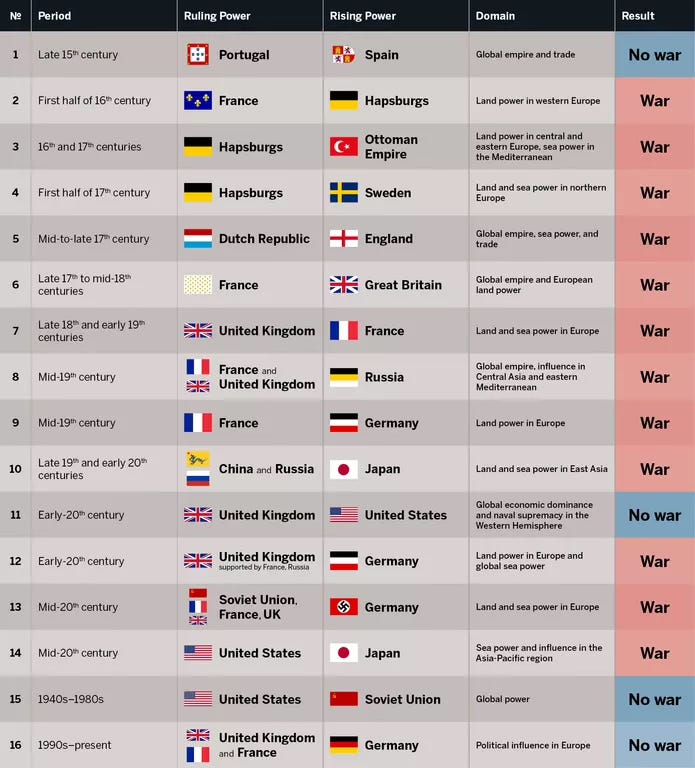
So putting the insights of the two experts together: Allison says that national security is about maintaining relative economic power, and Susskind says that there is a tradeoff between economic power and climate action, at least for a significant period of time. So it follows that there is a tradeoff between climate action and national security. And that, right there, is the rub.
For those who haven’t seen Point Break (1991), the film follows Federal Agent Johnny Utah (Keanu Reeves) as he goes undercover with a gang of surfers who fund their beach lifestyle by robbing banks (while wearing US President masks). The leader of the surf gang is Bodhi (Patrick Swayze), a charismatic but wholly untamed character.
In the final scenes of the film, Agent Utah seems at last to have caught up with Bohdi as he tries to make his getaway on a plane. But Bodhi turns to Utah and says: ‘I know it’s hard for you, Johnny. I know you want me so bad, Johnny, it’s like acid in your mouth … but not this time’ – then leaps from the plane with the last, and only, parachute.
With only a moment’s hesitation, Johnny Utah leaps after him. Without a parachute, it’s a suicidal play. But he dives and twists through the air until he catches up with Bodhi, binds one arm onto him in mid-air, and with his free hand, pulls a gun. The two are then locked in an aerial game of chicken, because at some point one of them has to pull the rip-cord. The longer they take, the closer they plummet toward to the ground. The dialogue goes like this:
Utah: Pull the chute, Bodhi!
Bodhi: You’re crazy!
Utah: Pull the … chute!
Bodhi: Why don’t you pull it?
Utah: No games, Bodhi! Pull the cord! Now!
Bodhi: Nah, you pull it. Go ahead, Johnny, pull it. Gotta drop the gun, right? If you use your other hand, what are you gonna hold on with?
Utah: Pull it right now, or I blow your … head off and pull it myself.
Bodhi: It’s the only way it’s gonna happen, my friend!
Utah: I swear to God I will!
Bodhi: Do it man, or you’re gonna die, Johnny!
(You can currently watch Point Break on BBC iPlayer here. For those without access to the iPlayer, the film script here is fun to read.)
Of course, the longer this goes on, the closer the ground hurtles up to meet the sky-bound heroes, just as the hard ground of economic reality (and national security) has been hurtling up to meet Bill Gates. In the film, Johnny Utah drops the gun with seconds to spare and pulls the rip cord. Bodhi lives to die another day.
And the point I want to make is that intense and gripping scene is exactly what you are watching when you read the Bill Gates climate essay. Bodhi is the dynamic and sometimes lawless world economy, doing its thing. And the Feds are the earnest, motivated, ideals driven climate movement, trying to get the wild economy under control. And Gates last week was Agent Utah, seeing how close the ground had come, dropping the handgun and pulling hard on the rip cord.
His essay was just a little less visual, that’s the only difference.

I have not inspected the Gates data - this is a general point, a ‘suspicion’ based on my general experience with this kind of data. Although Gates says he is showing the upper end of the range, my experience is that this kind of data is often theoretical. It comes from business plans and spreadsheet analysis, and sometimes from sources which are not independent (e.g. a company pitching its product).
In other words, after making investments that deal with the intermittency of renewables either by storing the energy and smoothing out the weather, or by building a gas peaking plant which can fill the gap when the sun or wind is not available.
Again, I’m not taking a potshot at any of these fantastic start ups with ideas and proposed solutions for the cement industry. I have not even reviewed their material. I am sure I would love them if I heard the pitch, and I am sure I would invest if I were Gates. All I am doing here is unpacking the language Gates uses, because it has been very carefully chosen - and without unpacking in detail, can be misleading.
I’ll even go one step further. Gates is a US tech billionaire, and he keeps company with other US tech billionaires. And in tech, things move fast. Software scales fast. Websites scale fast. AI scales fast. Even pocket size consumer electronics like the iPhone scale fast. But solutions to the high emissions sectors (power stations, buildings, transport, heavy industry) are the opposite: they do not scale fast. These are capital intensive, often regulated sectors with lumpy investments and slow moving supply chains.
Some have argued that there is no tradeoff, and that decarbonisation can be achieved at no cost. But usually there is some kind of fallacy going on. The most common mistake is to talk about all the green jobs which will be created (without trading off against all the fossil jobs lost), or to assume that technology breakthroughs in heavy industry will arrive quickly and roll out at the speed of software or consumer electronics. Not for me to resolve this argument, I simply recommend the discussion in Susskind’s book.


