Literature
The undiscovered 'Easter Egg' in Stegner's masterpiece
It has to do with raw chicken. Let me explain.
Literature
The undiscovered 'Easter Egg' in Stegner's masterpieceIt has to do with raw chicken. Let me explain.
Culture
The power of a pure idea: The Finger-SpaceThe rip-roaring tale of Marc Antoine de Muret, Fragment 31 and the greatest literary scoop of the 16th century
Earth Science
Our brains are not wired to understand geologic timeIf they were, we might reach some very different conclusions about our planet
Drama
Sophocles and the Pink Pony ClubWhat we learn about how a good society works from a survey of world literature
Age of Discovery
Volta do marWe must sometimes risk the perils of the wide open ocean if we are to discover new worlds
Culture
Has intelligence gone out of fashion?It might soon be time for a retro revival
Finance
How financial markets actually workI'm taking a swipe here at a Nobel Prize winner - maybe not a good idea, but if you work in finance you'll understand my motivation
Politics
The end is near for Sir KeirHe seems to have a nasty case of Stanley Baldwin disease
Society
A red traffic light at 3amNot a soul in sight and the town is fast asleep. What do you do?
International Relations
NATO and 1984Will Ukraine be betrayed by doublethink and boiled rabbits?
Markets
Is the AI bubble bursting now?Opinions are divided (but I have taken a view)
Climate
Bill Gates and Point BreakA look at the Gates climate letter through the lens of an iconic, 1990s surf dude film
Politics
The dumbest thing a Congressman saidSo daft, you won't know whether to laugh or cry
Politics
He seems to have a nasty case of Stanley Baldwin disease
On the face of it, Sir Keir Starmer would appear to have little in common with his predecessor of the last century, Stanley Baldwin.
Stanley Baldwin (who rose to the office of Prime Minister three times, in 1923, 1924 and 1935) was born with the proverbial silver spoon in his mouth. Son of a wealthy industrialist, he was educated at Harrow School and Trinity College, Cambridge; his cousin was the Victorian super-celebrity, Rudyard Kipling; and when he became the MP for Bewdley in 1908, he was taking over that seat in parliament from, of course, his own father.
Starmer on the other hand traces his origins from the other end of the social spectrum. He has made his working class family background, along with the fact that he was the first in his family to go to university, an important part of his personal story. He became Queen’s Counsel, Director of Public Prosecutions, a Knight of the Realm, and finally Prime Minister all by the impressive power of his own bootstraps. And of course, he is a Labour politician, not a Conservative.
Yet if I am not mistaken, the two very different Prime Ministers share a common weakness, and it seems to be the one which, above all else, risks bringing Sir Keir Starmer’s impressive career to a premature end.
Readers of this column may know that I spent a long-ish period of time in the management consulting industry. It’s admittedly an industry which does not always enjoy a glowing reputation: at the least, there are some vocal detractors. Yet it is an industry in which even small successes tend to be hard won, and I do feel that I learned a lot from the years I spent trying to deliver management and strategy projects.
One of the most important lessons, perhaps instinctive to practitioners after a while but not always vocalised explicitly, is the importance of staying out in front of, rather than behind, your problem-solving process. It’s connected to the idea that in a consulting firm, as in politics and many other walks of life, there is no stasis: you are either in a virtuous circle, or a vicious cycle, and there is little room for anything ambiguous in between.
But what does ‘staying ahead of your problem-solving’ process mean? To give one example, the first thing that happens when you kick off a strategy project is that you set up a team. So on Day 1, you find a bevy of fresh-faced and eager, young consultants assigned to your project and wanting instructions. Of course, you have no idea yet how to instruct them, because it’s Day 1 and you are still thinking it all through yourself. But the team needs to know that you know what to do - so you better give them their marching orders, pronto.
You have to decide very quickly what activities the team should get started on while you figure out the masterplan. Some of my colleagues would simply send the new team off to “collect together the background reading”. But this tactic only scores you a temporary win: yes, you get 24 hours to do some planning, but on Day 2 the team will be back in your office with a pile of random documents and imagining you will read them. And since time is of the essence, if you start engaging with those random documents, you will be done for. The client will feel neglected and the team will quickly notice that you don’t know where you’re going - and you will start to lose their confidence.
In the end, you are forced to try something harder. You are forced to identify on Day 1 at least some of the key questions that will need answering before the project concludes, and you need to get the team working on them straight away. At this stage, you won’t have a project plan and you may not have much a feel for the issues. But still, you need to take an early stab at what matters most - and get the team to focus their efforts on that.
It’s uncomfortable at times, because you know that as you kick off, you only have a partial picture. But the key is to get out in front of the team and show them the direction they need to follow. And you need to get the direction at least broadly right, since minor corrections later on are OK - but big reversals tend to be costly and frustrating.
Likewise, you need to get out ahead of the client. For some, this means giving the client tasks, so that their chief concern, as deadlines loom, is not to fumble their own part of the project - rather than to figure out if you have fumbled yours. But much more importantly, in my opinion, you need to be generating insights from Week 1 and creating a sense of progress at speed. You want your client thinking: wow, this work is really blazing ahead. I need to keep up!
The good news is that when your project is traveling at speed like that, your colleagues and other stakeholders get drawn into the slipstream. They have no choice but to cling to your metaphorical tail fins. And it is generally harder to stand in the way of something when you are clinging on to its tail fin.
Others will perhaps disagree, but my guess is that what is true for modest strategy projects like the ones I used to run may also be true for grand strategy projects, like the one a Prime Minister is running every day. And if so, arguably, the problem with Starmerism as a project is that it just never got moving at the required pace.
To begin with, the goalposts kept moving around. Starmer ran his election campaign around five big missions, but once in government the missions were stirred back up into a confusing soup of milestones, foundations and ‘first steps’ leaving it unclear to the voters what the real goals were. And indeed, what exactly was not a goal?
Starmer himself went on to say that there is no such thing as Starmerism, although - to be fair to him - some heard that message with relief. At least it didn’t sound like he was going to be a self-important populist, a political profile which was clearly in over-supply during the Brexit and COVID years. From that point of view, it was good to be told there were no more -isms on the way.
But the flip side was that the Keir Starmer project fell behind. Instead of moving out in front of public opinion and his own backbenchers, Starmer seemed to stand back and wait to be overtaken. He seemed happy to be taking a managerial approach to the problems of the hour (trade deals, junior doctors, rail strikes), but what was it all for? Where was it all going? With a lack of intellectual direction from Number 10, backbenchers started agitating; the policy u-turns began to accumulate; and the wandering eye of the Labour voter started noticing other attractive parties, as the polls now painfully show.1
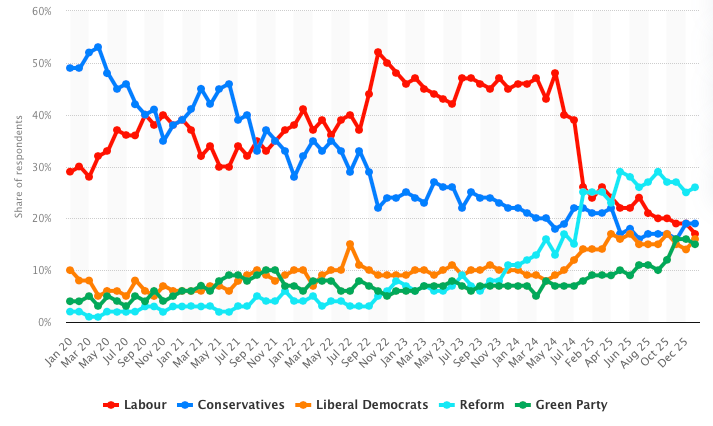
It is this, the lack of any coherent sense of overall, intellectual direction, which will perhaps bring Starmer and Baldwin together in the history books. For Baldwin, like Starmer, was a self-declared moderate and a centrist and in that mode he had some successes. He dealt with a General Strike (1926) and the abdication of a King (1936). His government lowered the voting age for women from 30 to 21, making it the same as the male voting age. And yet he was described by one of his biographers as “a good co-ordinator of his coalition who did not block colleagues who proposed various small reforms”.2 In other words, despite his election wins and policy successes, he was not himself a visionary reformer. He was a pragmatic, managerial type.
And in the end, as is well known, his managerial instincts led to his participation in appeasement of Hitler and the Nazi Party in Germany - and in the missed opportunity to prepare the British nation for war, for which he has been severely criticised. Churchill supposedly said it would have been better if Baldwin had never lived, and Lloyd-George (in private, allegedly) that he ought to have been hanged.3
Starmer cannot be accused of appeasement, and in fact his stance on Russia and the war in Ukraine may be the single issue on which he has found his voice. In his opposition to Russia and support for Ukraine, and for unity in NATO and Europe, he seems to have found total clarity. So in Foreign Affairs, to be clear, he is no Stanley Baldwin. 4
But on domestic policy, it is much harder to mount the defence. Keir Starmer has been pragmatic to the point of seeming to have no North Star. And as a result, the bottom line is that he has kicked off his project too slowly. He has fallen behind his client (the voter) and fallen behind his own team (the backbenchers). And it seems unlikely he will be able to get out in front of them again.
In all this, I am reminded of a priceless anecdote recounted by Gyles Brandreth on the outstanding Rosebud podcast.5 (If you have not yet tuned into Rosebud, do it now - you won’t regret it.)
The story was told to Gyles, as a young Conservative MP, by Frank Pakenham, later known as Lord Longford, who remembered meeting Stanley Baldwin at a country house conference in the 1930s. Baldwin invited Pakenham to join him for a walk in the grounds, an intimidating moment as we can imagine for the younger man. Conversation began easily enough but soon came to an awkward standstill and Frank found himself reaching for a safe question to ask the great man. He gave it his best shot, as follows:
Pakenham: May I ask, sir, which great thinkers have influenced you the most?
[A pause]
Baldwin: … Sir Henry Maine
Pakenham: How so?
Baldwin: Because Rousseau said that all progress was from ‘Contract’ to ‘Status’, but it was Sir Henry Maine who realised that the real movement was from ‘Status’ to ‘Contract’.
[Another pause]
[His face darkens]
Or …. was it the other way around?
For me, that mischievous (and caliginous) Brandreth anecdote captures, and perfectly skewers, the essence of Baldwinism - showing it to be a sophisticated package, but with little intellectual substance inside. It explains why Baldwin failed to grasp the greatest issue of his time and ultimately fell short of history’s expectations. And if the same anecdote also captures the essence of Starmerism, then our Prime Minister’s days are surely numbered - for this century, it is already clear, will be even less forgiving than the last.
I couldn’t decide if it was OK to include this meme, so I have demoted it to the footnotes.

Thorpe, Andrew. “Stanley Baldwin.” In Biographical Dictionary of British Prime Ministers, edited by Robert Eccleshall and Graham Walker, Routledge, 1998, pp. 273–281. Indirectly referenced from wikipedia.
These comments are widely referenced on the internet but I don’t have firm sources. GPT claims the Lloyd George quote can be sourced to Colonel Roderick Macleod and Denis Kelly (eds.), Time Unguarded. The Ironside Diaries. 1937–1940 (New York: David McKay Company, 1963), p. 311, but who knows? That is the kind of thing that the AI gets wrong.
It is worth acknowledging that some will feel Starmer has been guilty of appeasement v. the Trump Presidency and its more radical notions.
www.rosebudpodcast.co.uk


