Literature
The undiscovered 'Easter Egg' in Stegner's masterpiece
It has to do with raw chicken. Let me explain.
Literature
The undiscovered 'Easter Egg' in Stegner's masterpieceIt has to do with raw chicken. Let me explain.
Culture
The power of a pure idea: The Finger-SpaceThe rip-roaring tale of Marc Antoine de Muret, Fragment 31 and the greatest literary scoop of the 16th century
Earth Science
Our brains are not wired to understand geologic timeIf they were, we might reach some very different conclusions about our planet
Drama
Sophocles and the Pink Pony ClubWhat we learn about how a good society works from a survey of world literature
Age of Discovery
Volta do marWe must sometimes risk the perils of the wide open ocean if we are to discover new worlds
Culture
Has intelligence gone out of fashion?It might soon be time for a retro revival
Finance
How financial markets actually workI'm taking a swipe here at a Nobel Prize winner - maybe not a good idea, but if you work in finance you'll understand my motivation
Politics
The end is near for Sir KeirHe seems to have a nasty case of Stanley Baldwin disease
Society
A red traffic light at 3amNot a soul in sight and the town is fast asleep. What do you do?
International Relations
NATO and 1984Will Ukraine be betrayed by doublethink and boiled rabbits?
Markets
Is the AI bubble bursting now?Opinions are divided (but I have taken a view)
Climate
Bill Gates and Point BreakA look at the Gates climate letter through the lens of an iconic, 1990s surf dude film
Politics
The dumbest thing a Congressman saidSo daft, you won't know whether to laugh or cry
Society
Not a soul in sight and the town is fast asleep. What do you do?
Imagine this: you’re driving home, it’s late, and you come to a red light. You can see in all directions, and there are no other cars on the road. The town is asleep. There is no red light camera. Are you gonna sit here like a goody-two-shoes, waiting for the light to turn green? Or are you just gonna nose forward, check for yourself that it’s safe and then drive on through - to get yourself home a few precious minutes earlier?
What do you think? I assume some readers will say that you should wait, because it just feels wrong to drive through a red light - while others will say it’s obvious that you should ignore the red light, since you’re the only person around, nobody is harmed and you will get home sooner - so in some small but real sense, there will be more happiness in the world that way.
It’s a perennial debate. But what is most interesting to me about this question, as we pick it apart, is that it will help us understand what happened this week in Venezuela. Bear with me, because as usual I’ll be taking the indirect route.
If you ever studied philosophy, you will have seen the traffic light dilemma play out in the discussion of utilitarianism, the apparently simple idea that the right thing to do is whatever delivers the most happiness, or utility, overall. But you won’t have had to scratch your head for long before you encountered an annoying question: are you talking about act utilitarianism, applied to each individual thing we do, or about rule utilitarianism, which concerns the rules and laws we adopt in general?
In the traffic light example, an act utilitarian will say: sure, you should drive through the red light, because there is more utility that way. But a rule utilitarian will say wait - no - if the rule is that you can cut a red light when you think it’s safe, then there is going to be chaos. Yes, a few people will get home faster. But many others are going to be caught up in crashes and traffic jams which should never have happened. So the rule which maximises utility is this: everybody wait at the red light, even if you think that you don’t really need to. We’ll all be worse off, they will say, if individual drivers have discretion to bend the rules.
You can see where this goes next.
There are many examples where collective improvements have been achieved by applying rules which might seem unnecessary at first. My favourite example is the World Health Organisation’s Safe Surgery checklist, a list of simple questions which has been shown to cut surgical complications and post-op mortality by a third in theatres where it is adopted. You might not believe it, but the first question on the checklist is a version of: “Have we got the right patient?” and “Are we doing the right procedure?” A later and still important question is a version of: “Does anyone have any concerns?”
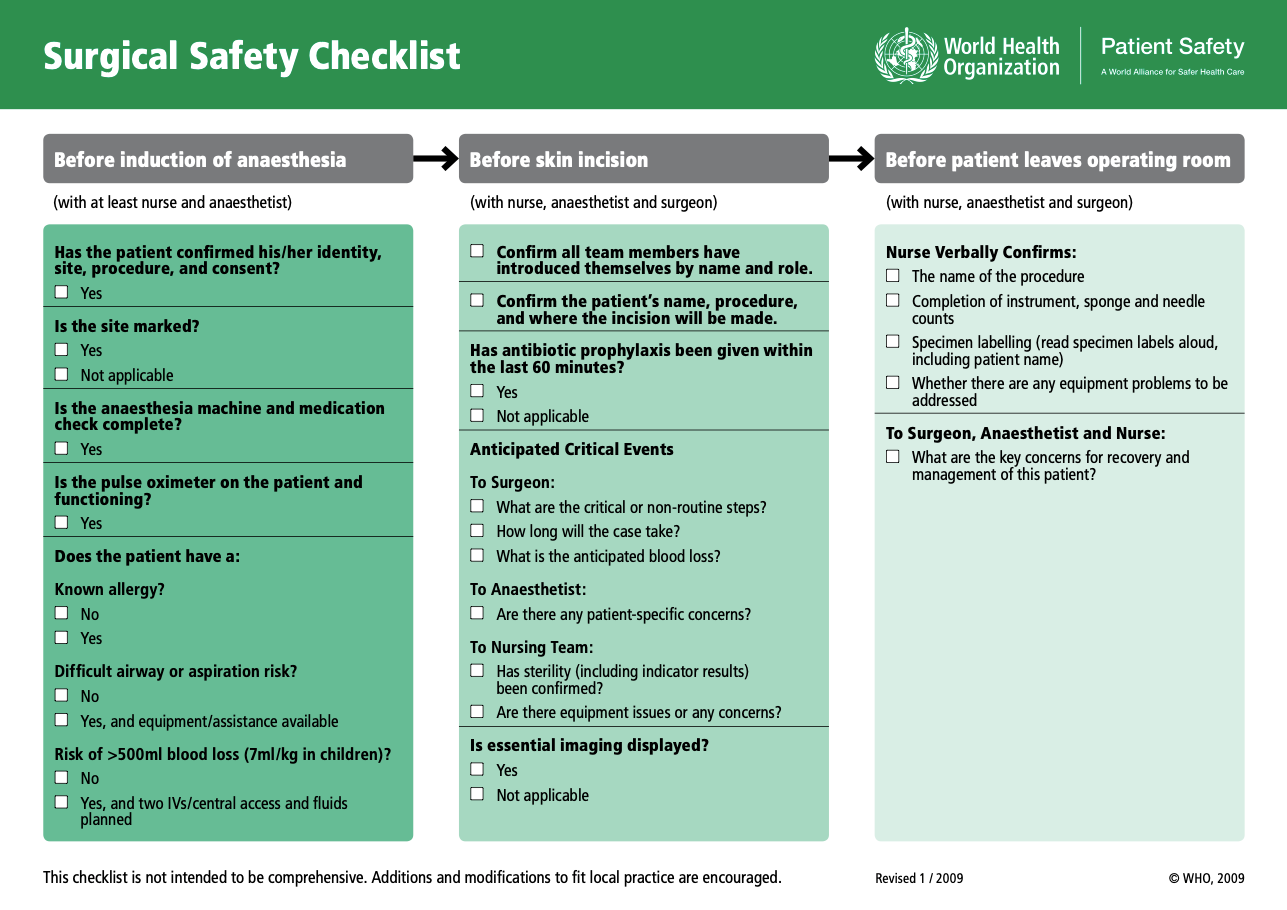
For most surgeons and most surgeries, these questions are unnecessary. Because most hospitals already have ways to make sure the right person is wheeled into theatre and that the right limb is amputated (or the left, or whatever the correct procedure may be). And those teams already talk to each other and will have noticed if a colleague is worried about something.
But in a way, that is exactly the point: for nearly all surgeries the checklist isn’t necessary, in fact it’s a bit of a pain in the neck. But for the ones which are going to go wrong the checklist is literally a lifesaver. And of course, you don’t know in advance which ones are going to go wrong, so the only solution is that everybody has to do the checklist.1
And that right there is the rub. If you have a problem (like traffic accidents or surgical fatalities) which is already at a relatively low incidence level, then by definition the events which will still occur are the ones which slip through the net. But when they slip through, they are often catastrophic - and the only way to prevent the catastrophes is to tighten the net for everyone. Every driver has to stop at a red light, and every surgical team has to go over the checklist, because we don’t know in advance where the errors and fatalities are going to occur.
Applying tighter controls to everyone is generally annoying, and in most industries it leads to a simple corollary: better quality outcomes generally have higher costs. To have fewer road traffic accidents, some drivers will have to wait pointlessly at red lights on empty roads. To have better post-op survival rates, some surgeons have to run their teams through a checklist of questions they have already answered. To have better equity research, I might add, some analysts will have to run their research notes past compliance before publishing - even if they would deeply prefer not to bother.2 These are all examples of individual costs which have to be incurred to make gains at the system level.
On this basis, we can now formalise the model. Let’s assume that quality problems can have a high or low incidence, and that the consequence of errors when they happen can be large or small. Then we can say for each situation, what the value is of enforcing a global process step which improves quality control? I think the result will be something like this:
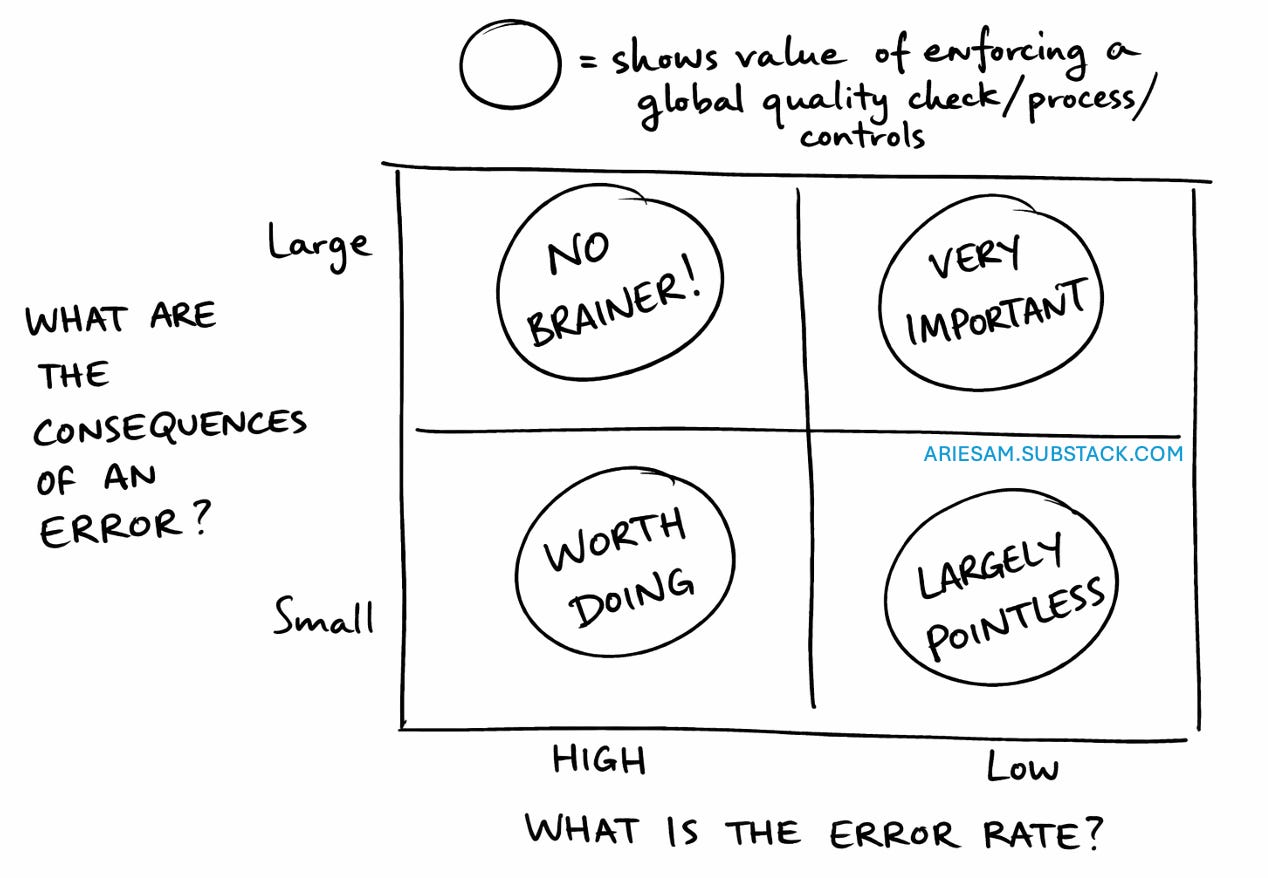
In short: when the consequences of an error are important, there is a lot of value in applying a quality control process to everything, even when the background error rate is low. Jettisoning the quality controls only really makes sense if you are in a process with a small number of errors which don’t really matter. And if you agree that this is a fairly straightforward representation of reality, then we can turn to the final industry example: Foreign Affairs.
The starting point for Foreign Affairs is that, for all the ups and downs, the world has seen pretty good, directional progress over the last 80 years. One way to demonstrate this progress is to look at all the possible international relationships which can exist between pairs of countries, categorise each one according to the current state of the relationship, and then track this back over time. Remarkably, Paul F. Diehl and colleagues have done this work for us and produced the following graphic.3
(Note for readers on a small screen: the red and orange areas show the country-pairs described as a “severe” or “lesser” rivalries, and the green areas show those described as “warm peace” or a “security community”.)
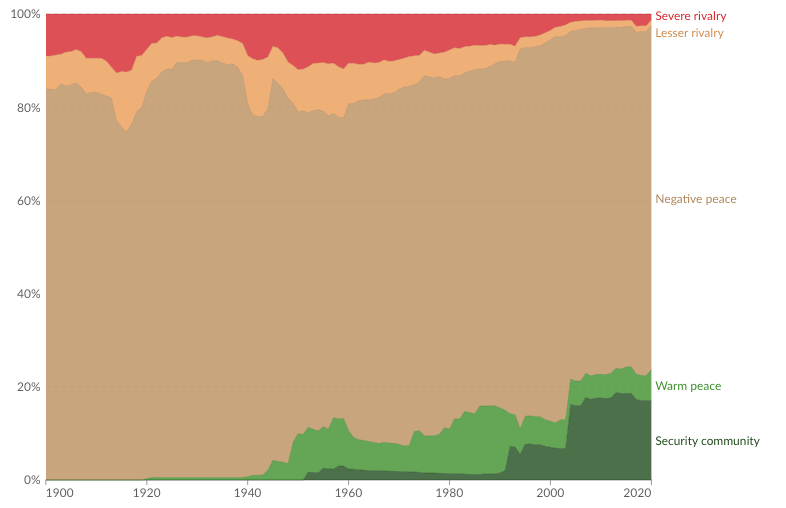
My interpretation of this chart is that, at least until 2020, the output quality of the Foreign Affairs ‘industry’ was on an improving trend. The world was getting safer and more secure. Despite the headlines, severe rivalries were becoming a serious but relatively low incidence problem - not unlike traffic or surgical fatalities.
This conclusion is also well supported by a number of studies looking at the number of conflict deaths over time as a proportion of the world population. The spectacular chart below - covering the period from 1400 to the present day - is a good example, and shows the unprecedented progress which was made over the second half of the twentieth century, essentially by doing a better job on Foreign Affairs.
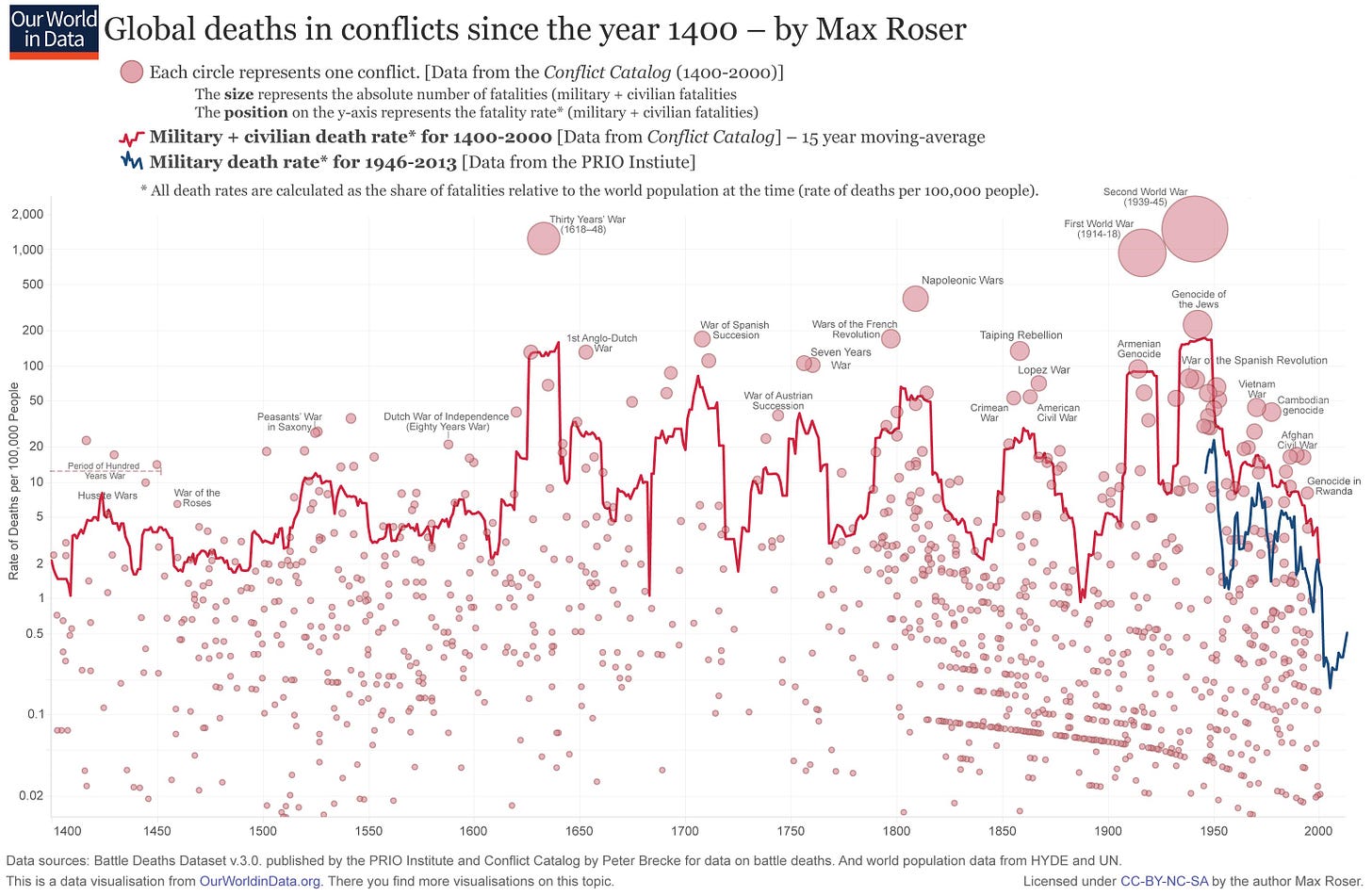
If you have been agreeing with my logic up to this point, then you will perhaps already see where we are going with the conclusion. If the world has become safer and more secure, then it follows that some kind of quality control or process regulation step must have been introduced - and returning to our matrix, that does make sense - given the high cost of errors in this industry. Foreign policy clearly inhabits the upper quadrants, and probably the upper left one.
The question is: what was the quality control or process regulation step which was introduced? And what do those terms even mean in the arena of Foreign Affairs? I think the question is best answered by saying that after World War 2, a set of ever more cautious norms and practices were applied which - over time, and not without tragic exceptions - succeeded in reducing the number of serious and dangerous rivalries in the world, and therefore also the death toll from conflict between states. In short, you could say, the quality control process was a kind of self-restraint - exercised on all sides, sometimes unilaterally, and sometimes through the mechanism of more formal international agreements, alliances, treaties and conventions.
The same answer can also be reached through the lens of the corollary that better outcomes generally come at higher cost. In that case we just need to ask: what was the cost we were carrying in exchange for 80 years of gradually improving global peacefulness? What was the equivalent to the cost of sitting at a red traffic light in the middle of the night, knowing that you could get home quicker if you ignored the rules? Or of making your scrubbed-up surgical team stand in a circle and go through the annoying checklist?
The cost of a more peaceful world was, I think, the cost for the great powers of not being able to get their own way. It was the cost of being a powerful state like the United States but not being able to control your irksome neighbours in Cuba or Venezuela - or to stop them turning eastwards, towards Russia and China, if they wanted to. Or it was the cost of being Russia, but not being able to stop your irksome neighbours in Ukraine from turning westwards, to NATO and the EU, if they wanted to. Or the cost of being China, but not being able to control your irksome neighbours in Taiwan, or to stop them remaining independent, if they wanted to.
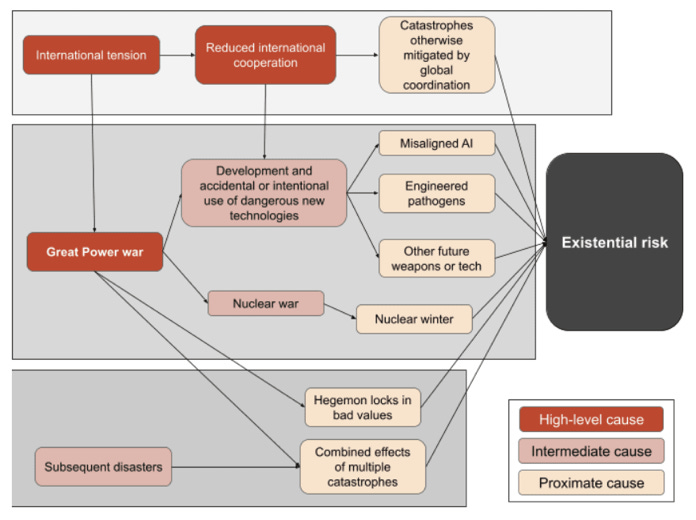
In each case, the pattern is clear. The cost of a long term, positive trend in peace and security was some kind of self-imposed restraint in the short term exercise of power. In most of the contentious situations we see, it has long been clear that the great powers could get their way by force, in the short term, especially in their own backyards. But in our lifetimes they have mostly not tried to do that, because they could see the industrial workflow - nicely drawn out by Stephen Clare in the graphic below - which traces the journey from individual actions which ratchet up international tension, all the way (eventually) to existential risk.4
So in conclusion, all this is to say the following: for those who think in single steps, one action at a time, it makes a lot of sense to drive through a red traffic light at 3am, if the roads are empty, or to send the Delta Force in by helicopter to detain a head of state who is not cooperating, if the state in question is weak and cannot stop you. Likewise, it makes a lot of sense to skip the checklist and get on with the surgery, or to roll the tanks across the border to seize the nearby lands or assets you would like to control.
But to those who think in terms of interconnected systems over time, or of iterative relationships which play out over long lifetimes with multiple rounds - rather than through single, isolated actions - those kind of strategies will look like a kind of madness. Better to wait at the red light at 3am, they will say, frustrating though it may seem in the moment, in order to make sure that the traffic management system works overall.
And better for the surgery team to take 10 minutes to go over the checklist, even if on this occasion it seems like everything will be fine. Because if the rule is you don’t have to do the checklist if you don’t feel like it, then busy surgeons are just not going to do it. And over time what you are going to see is an awful lot of surgical mistakes, and an awful lot of post-operative, iatrogenic patient mortality.
The story of the Safe Surgery Checklist is brilliantly told in The Checklist Manifesto: How to Get Things Right, by Atul Gawande (New York: Metropolitan Books (Henry Holt), 2009). Gawande was an architect of this brilliant project.
In case anyone reading this doesn’t know, I was an equity research analyst for quite a long time. I never enjoyed the process of checking my research with compliance.
Diehl et al. (2025) – with minor processing by Our World in Data. “Severe rivalry” [dataset]. Diehl et al., “Peace data v3.1.1” [original data]. Data retrieved in Apr 2025, the original publication behind the dataset is Paul F Diehl & Gary Goertz & Yahve Gallegos (2021) “Peace data: Concept, measurement, patterns and research agenda”, Conflict Management and Peace Science, Peace Science Society (Intel), vol. 38 (5).
Of course there were salient exceptions, but I am talking about the underlying trend, over many decades.


