Literature
The undiscovered 'Easter Egg' in Stegner's masterpiece
It has to do with raw chicken. Let me explain.
Literature
The undiscovered 'Easter Egg' in Stegner's masterpieceIt has to do with raw chicken. Let me explain.
Culture
The power of a pure idea: The Finger-SpaceThe rip-roaring tale of Marc Antoine de Muret, Fragment 31 and the greatest literary scoop of the 16th century
Earth Science
Our brains are not wired to understand geologic timeIf they were, we might reach some very different conclusions about our planet
Drama
Sophocles and the Pink Pony ClubWhat we learn about how a good society works from a survey of world literature
Age of Discovery
Volta do marWe must sometimes risk the perils of the wide open ocean if we are to discover new worlds
Culture
Has intelligence gone out of fashion?It might soon be time for a retro revival
Finance
How financial markets actually workI'm taking a swipe here at a Nobel Prize winner - maybe not a good idea, but if you work in finance you'll understand my motivation
Politics
The end is near for Sir KeirHe seems to have a nasty case of Stanley Baldwin disease
Society
A red traffic light at 3amNot a soul in sight and the town is fast asleep. What do you do?
International Relations
NATO and 1984Will Ukraine be betrayed by doublethink and boiled rabbits?
Markets
Is the AI bubble bursting now?Opinions are divided (but I have taken a view)
Climate
Bill Gates and Point BreakA look at the Gates climate letter through the lens of an iconic, 1990s surf dude film
Politics
The dumbest thing a Congressman saidSo daft, you won't know whether to laugh or cry
Age of Discovery
We must sometimes risk the perils of the wide open ocean if we are to discover new worlds
With thanks to John Kay and Lewis Dartnell for the inspiration.
Let me begin with a question I came across some years ago when reading Obliquity: How our goals are best achieved indirectly (Profile, 2010) an excellent and insightful, short book by economist John Kay.1
Obliquity opens with an unexpected question about the Panama Canal. What we are asked to figure out is this: which way would we be sailing, if we transit from the Atlantic to the Pacific through the Panama Canal? Take a moment to think about that, and figure out if you would be going East to West, or West to East.
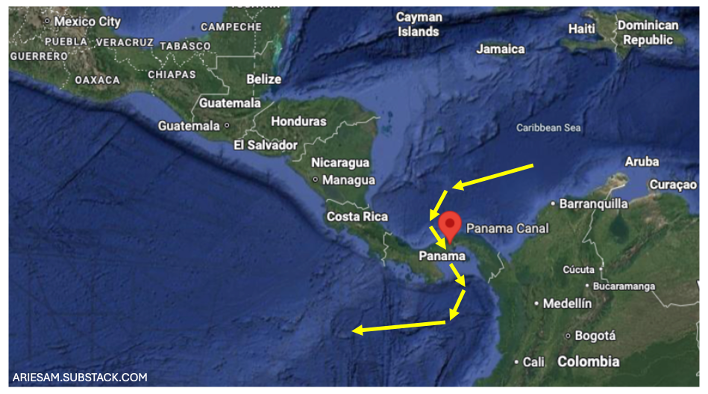
The answer, as the map shows, is that while you are heading westwards overall, to get through the Panama Canal you must first double back on yourself. You must go east, in other words, in order to go west, at least for a while.2 This metaphor embodies Kay’s principle of indirectness, which he attributed in turn to the eminent 20th-century pharmaceutical researcher, Sir James Black, (father of the beta-blocker, among other things) who had explained it as follows:
“I used to tell my colleagues that if they wanted to make money, there were many easier ways to do it than drug research. How wrong could I have been! In business as in science, it seems that you are often most successful in achieving something when you are trying to do something else. I think of it as the principle of obliquity.”
Sir James Black, OM FRS FRSE FRCP
Well, if you have enjoyed my substack this year, for which I adopted the optimistic title In Search of Good Ideas, then I hope it is fair to say that you are someone who is interested in good ideas. And that being the case, the principle of obliquity may be of some importance to you - as it turns out to be quite fundamental to the discovery of new ideas. At least, the most important ones.
For a breakthrough idea, history shows that you often need to go in a completely different direction. You need to find the insights which are currently not obvious, but which will only seem obvious after you have discovered them. And if you do discover a good one, whatever it is, it will seem so obvious once you have discovered it that you will struggle to believe this was once a thing you didn’t know.
I began to realise how true this is when reading another excellent book about discovery, by Lewis Dartnell, an astrobiologist who wrote his PhD on subsurface ionising radiation on Mars. In his time off from studying the Martian death rays, he has also produced Origins: How the Earth Made Us (Bodley Head, 2019), a masterly overview of the ways in which the geology of planet Earth has interacted with and determined human history. And it is from this fantastic book that I learned how much the original Age of Discovery depended on Sir James Black’s principle of obliquity.
The story of discovery which Dartnell tells goes back to the 13th Century, when Portuguese sailors first began to explore the globe. They were blocked to the landward side by Castile, and what they faced on the other side were, for want of a better phrase, the secular powers of the Atlantic thundering. To the north, were Gauls, Brits and eventually Vikings. So if they wanted to explore, the only sensible way to go was south.
To begin with, they followed the coastal currents that took them down towards North Africa where they met traders arriving over the trans-Saharan caravan, loaded with oriental riches. They realised that they were separated from the source of that wealth by the desert, and what they wanted more than anything was to find a sea route around it. We all know how that story ended, but what is less well known is the remarkable detail of how the sea route itself was eventually cracked open.
The first step was to get to the Canary Islands, about 100km off the coast of Morocco. You could make it pretty easily to the Canaries on the coastal currents, and in the early days you would be sailing a galley, with oars, so when it came to the return trip, you would row. It worked well enough, but of course rowing put a limit on the distance you could travel. What you really wanted was a way to sail home, and when this was eventually discovered, they called it the volta do mar. You might translate that as the turn of the sea, or perhaps the return of the sea. But whatever you call it, it was the can-opener which tore the ragged lid off the world for European explorers.
What then was the volta do mar? Instead of trying to row back north from Africa, against the current and into the wind, the Portuguese discovered that you could push off outward from the coast, westwards towards Madeira, and make a loop. And the benefit was that once you got to Madeira, you could pick up the south-westerlies, which blow towards the north-east and bring you back home. So in this example, to go north-eastwards, first you had to sail west.
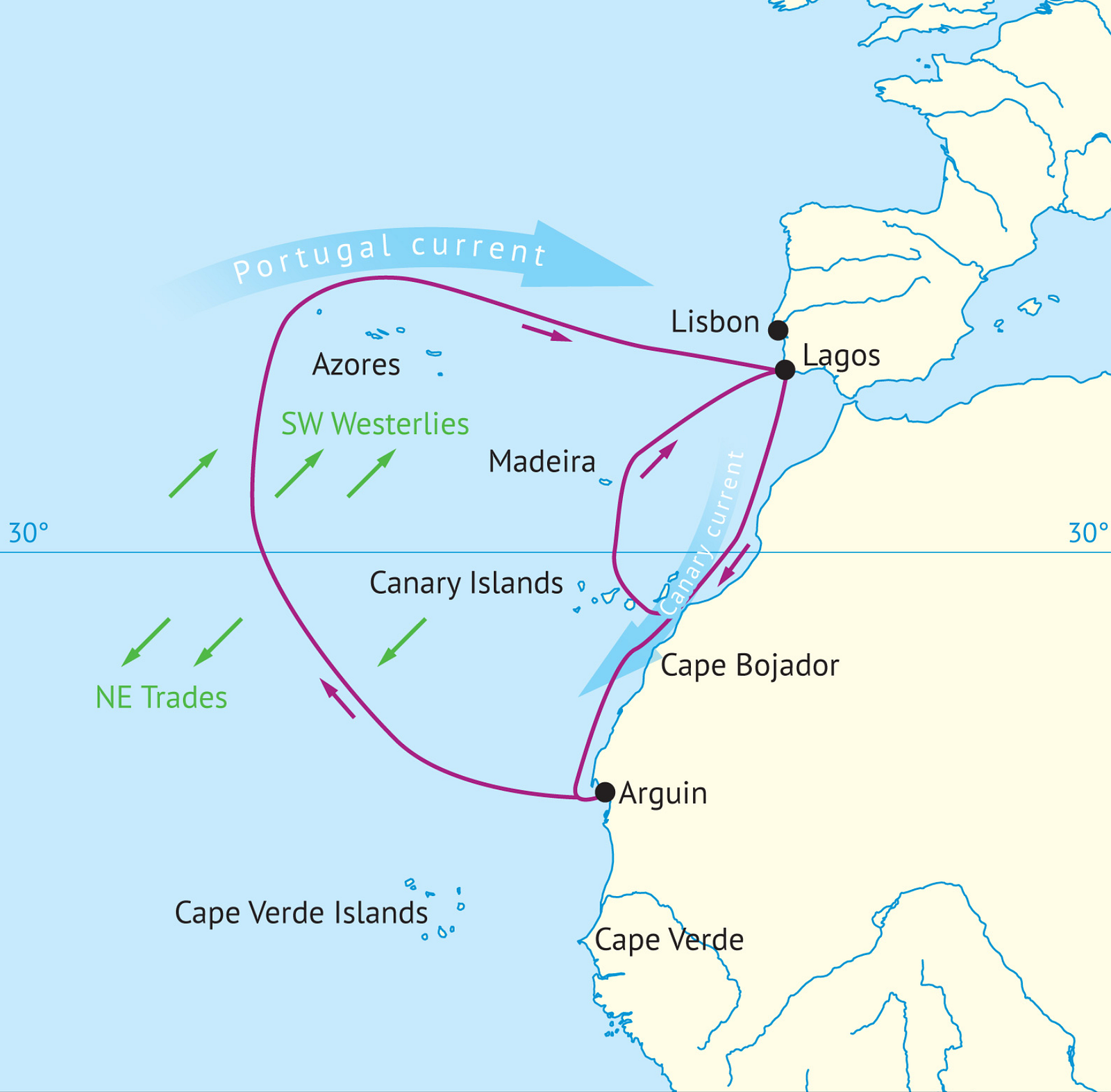
There is a very good reason why the volta do mar was possible, although our late medieval explorers could not have guessed it. Today, we know that the prevailing wind changes direction around 30 degrees north (and south) of the equator, and again at a similar distance from the poles, because of the way that hot and cold air circulates around the planet. (The latitude line of 30 degrees north falls just above the Canaries, just below Madeira and some way south of the Azores.)
In short: hot air rises at the equator, and cold air sinks at the poles, but the air rising at the equator doesn’t make it all the way to the poles. It starts to cool and sink back to the surface at around 30 degrees north and south, creating two mini-rotations of air, turning like cogs in a mirror image of each other around the equator, and known as the Hadley Cells. A similar logic creates Polar Cells, at the poles, and the result is that in between the two there is a third system, the Ferrel Cells, whose air currents must therefore rotate in the opposite direction. The circulation system as a whole looks like this:
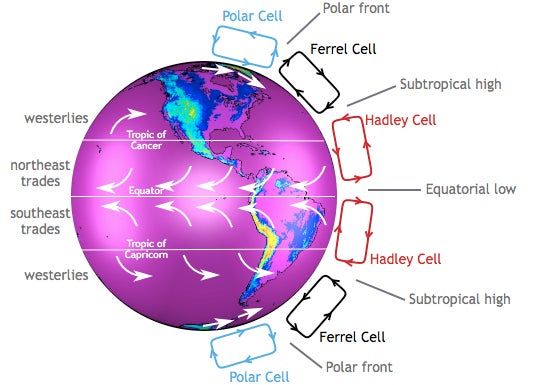
This tells you why the north/south winds blow towards the equator, from either side. But to explain why the wind also blows in opposite east/west directions above and below the tropics, you need to add in the Coriolis effect. The Coriolis arises because the Earth is widest at the equator, so land at the equator is further from the Earth’s axis and therefore spinning faster than land at the poles. This means that the closer the air is to the equator, the faster it is moving relative to the ground beneath, and consequently winds in the northern hemisphere appear to bend to their right, whichever north/south direction they are blowing (and those in the southern hemisphere will appear to bend to their left).
Specifically for our adventurers, this means that the winds blowing N-to-S in the Hadley cell (i.e. below 30 degrees north) end up seeming to blow west, from the point of view of a person on the ground. And those blowing S-to-N in the Ferrell Cell (i.e. above 30 degrees north) seem to be blowing eastwards. Since the dividing line between the cells is just north of the Canaries, the upshot is that if you can make it over the line to Madeira, then you can sail home to Portugal on a westerly wind which, for those who first discovered it, must have seemed nothing less than heaven-sent.
But still, the volta to Madeira didn’t fully solve the traveller’s problem, because there was a second obstacle in the form of Cape Bojador - or Abu Khatar as it was known in the Western Sahara, the Father of Danger. Nobody could sail past Abu Khatar, because as you rounded it you would pick up the east winds coming off the desert, and a dangerous mix of strong currents and shallow waters below, and then you would eventually be ripped out into the open Atlantic and lost at sea. (You could not simply do another volta, because below the 30th parallel the prevailing winds are north-easterlies, blowing you south-westwards and away from home.)
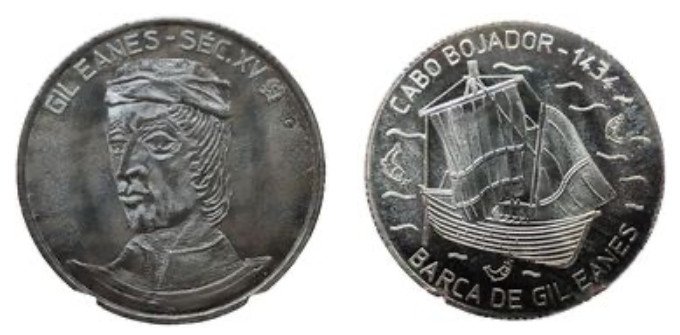
The problem of Abu Khatar was not solved until the Portuguese navigator Gil Eanes (‘jhilienz’) in the middle of the 15th century cracked the technique of current sailing, which is a perfect example of a brilliant insight because when you realise what it is, you will think: but that’s too obvious to be an insight, which is true, although 700 years ago it was not. The breakthrough, as Dartnell explains, was to be able to measure the strength of the current, and then to factor its effect into your navigation path, so that you would cut into the current much harder than you first thought you needed to, in order to keep a true line.
This simple idea was enough to get the Portuguese around Cape Bojador and most of the way to the Cape Verde islands, and from there they would eventually discover a second and much larger volta do mar which took them all the way out to Santa Maria and the Azores, which are the tips of a cluster of underwater volcanoes, nosing above sea level some 800km west of Lisbon. And from there, again, they could sail home quickly on the westerly winds.
Now, stay with me, because we are only just getting around the coast of West Africa and into the Gulf of Guinea, and here there are new problems to solve. The first was that as you crossed the equator, you lost sight of the Pole Star, whose angle to the horizon was used to measure latitude. Without Polaris in sight, the sailors were lost, they were literally desnorteado (or ‘un-northed’, a term in Portuguese which still means confused or disoriented) and the problem continued until they found the Southern Cross, a constellation visible in the southern hemisphere which can be used in the same way as Polaris, to figure out your latitude.
But the Cape of Good Hope was a still a long way off, and wasn’t rounded until Bartolomeu Dias got there in 1488, and he only managed it by inventing a third volta do mar, this time going in the opposite direction, because in the southern hemisphere the bands of wind are a mirror image of the northern hemisphere. So Dias sailed out south-west from the coast, to skirt around the treacherous currents on the cape now known as the Agulhas Retroflection, and to pick up the westerly winds coming off Antarctica which took him below and around the cape and eventually up towards Madagascar and into the Indian Ocean.
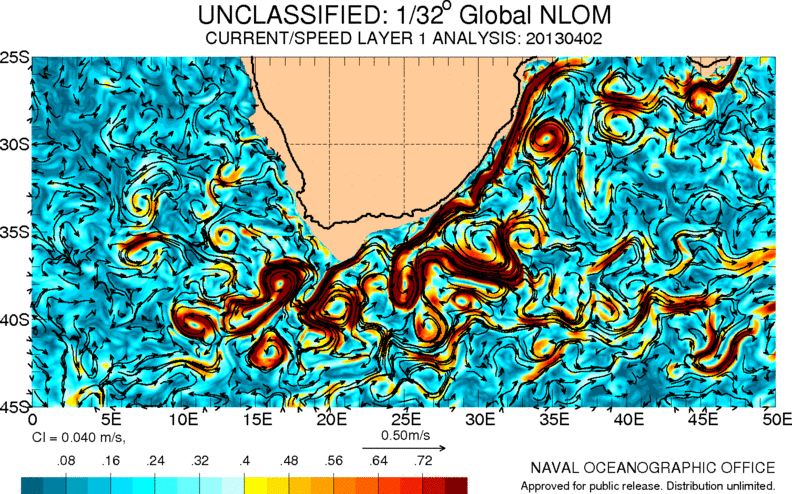
It’s hard to overstate what an achievement this was. Dias showed that there was an end to the African continent - and he, and then Vasco da Gama following the same route, would eventually open up the sea route to the East Indies. But it took 100 years or more, a new technique for measuring and navigating the currents and three different volta-do-mars to get them there.3
Now, you have followed this story for a while, so don’t worry I’m not going to embark on the whole story of Columbus and the other way to get to the Indies. But I will just say that he too headed off into the open ocean, when he couldn’t have known for sure where he was going, and he got incredibly lucky in his choice of setting off point. He was lucky because to begin with, nobody would back his expedition: he tried the Portuguese, the Genoese, the Venetians and the English, but they all thought his numbers were cooked and they wouldn’t pony up the cash.4
The only sponsor he could find was Queen Isabella, of Castile and Leon, whose marriage to Ferdinand of Aragon in 1469 had effectively created the unified nation of Spain. But another thing which Isabella had done, 10 years later, in 1479, is more important for our story: she had signed the Treaty of Alcáçovas with the Portuguese, granting the Canary Islands to Spain, and leaving Madeira and the Azores to Portugal.
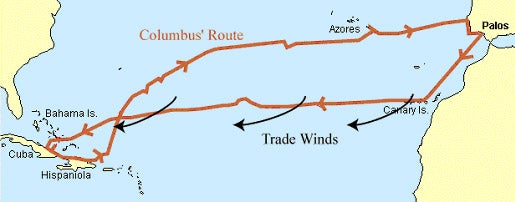
The same treaty gave Portugal the rights to explore South from the Canaries, so what could the Spanish do but explore to the west? Columbus had no choice but to go west. He set off from the Canaries, which belonged to Spain, rather than from the Azores, which he surely would have preferred since they are another few hundred kilometres towards his hoped-for destination.
But in the end this combination of circumstances was extremely fortunate, because which way does the wind blow from the Azores? We already know: it blows from west to east, and takes you back to the Iberian mainland. So if Columbus had set off from the Azores, he would have been sailing into the wind, and he doubtless wouldn’t have succeeded. Instead he set off from the Canaries, and he rode the trade winds out to the New World, and then rode the Westerlies back home. If you think about it that way, his whole expedition was a volta do mar, perhaps the biggest one of all.
So let’s wrap this up and bring things back to life, work and our modern era. What am I trying to say with all this? Sometimes, inevitably, you have no choice. You have to follow a well-trodden path in life and do what everyone else has always done. If the rule is that you sail out with the current and row yourself back home, then that’s what you have to do. There’s no good choice really except to put your back into it.
You can of course spend time and effort to optimise the process. There are good oars and bad oars, and you can always find something to improve in a small way. But your slow galley, rowing against the current, will one day become outdated if someone comes up with a completely different way of getting to the same destination, or a completely different destination to go to. You don’t want to be the person with a huge mortgage out on a fleet of rowboats when someone comes up with the volta do mar.5
So what do you do? What probably excites you the most is to be the explorer, to go out and look for the new destinations, or the new way of getting to the old ones. It’s risky, and everyone thinks you’re mad, everybody turns down your proposals, and you can get lost at sea, which is not a great idea especially if you have a lot of expenses, or young children, or both. And even if you don’t get lost, you can starve, and get scurvy, and have to row home again anyway after all without finding your new world. So let’s face it, the whole project of ‘discovery’ can be quite off-putting.
And yet, even now, perhaps I’m not really describing the situation correctly. Because although there were many risk takers in the Age of Discovery, the lesson of the story I have just told is a little bit different. The details show how a number of moderate and incremental risks were taken, one at a time. There was the small volta to Madeira – not too risky, but it worked. There was the discovery of current sailing, which got Gil Eanes around Cape Bojador. Then there was the medium volta to the Azores, then the new navigational trick of following the Southern Cross, then the big volta around the Cape of Storms6, and finally the huge one that opened up the Americas for Columbus. It was if you like a sequence of layered obliquities, steps taken in a new or different direction, each of which required courage and originality for sure, but which all had a justification of sorts.
And I think that is the idea I want to share with you here. If you are someone who feels a little bit constrained by the realities of what you do, then you are not alone. It might even be a part of the human condition, to chafe at the yoke; to think, you know, that there could be a different way to do this thing that we always do, whatever it is.
If that sounds like you, then I encourage you to think about obliquity. Think about whether you have to keep going in the same direction as everyone else, or if you can somehow find your own volta do mar and see what happens if you head out in a new and unknown direction.
Of course, you don’t have to sail out alone for months on end in search of the New World. But just think about what the small voltas-do-mar could be which you can use to make a start. Have a think about whether they might allow you to get out into the open ocean, feel the sun on your arms and the wind in your hair, and discover something new and wonderful to tell the rest of us about.
Obliquity: Why our goals are best achieved indirectly, Profile Books (2010), is all about the importance of going at problems in an oblique way. John Kay, now Sir John Kay, was the founding Dean of the Saïd Business School where I now do some (very enjoyable and rewarding) teaching work.
It’s easy to forget that Boston (on the East Coast of North America) is in the same time zone as Santiago (on the West Coast of South America). From Massachusetts to Chile, you pretty much fly due South. Accordingly, Central America has to offer a horizontal land bridge between Colombia and Mexico, and it is this horizontal stretch which you must cut through as you navigate the Panama Canal.
I am undecided between volta-do-mars and voltas-do-mar. I am reminded of Don Sadoway and his Attorneys General, but it is not helping me to decide.
It seems that he had under-estimated the size of the Earth in order to make his journey seem more achievable, but experts saw what he was up to and didn’t want to risk losing everything to an impossible voyage. Until, of course, Isabella.
If you don’t believe me, ask Sam Altman.
Later remarketed as the Cape of Good Hope, as Cape of Storms was thought to be off-putting to the traveller, no doubt correctly.


