Literature
The undiscovered 'Easter Egg' in Stegner's masterpiece
It has to do with raw chicken. Let me explain.
Literature
The undiscovered 'Easter Egg' in Stegner's masterpieceIt has to do with raw chicken. Let me explain.
Culture
The power of a pure idea: The Finger-SpaceThe rip-roaring tale of Marc Antoine de Muret, Fragment 31 and the greatest literary scoop of the 16th century
Earth Science
Our brains are not wired to understand geologic timeIf they were, we might reach some very different conclusions about our planet
Drama
Sophocles and the Pink Pony ClubWhat we learn about how a good society works from a survey of world literature
Age of Discovery
Volta do marWe must sometimes risk the perils of the wide open ocean if we are to discover new worlds
Culture
Has intelligence gone out of fashion?It might soon be time for a retro revival
Finance
How financial markets actually workI'm taking a swipe here at a Nobel Prize winner - maybe not a good idea, but if you work in finance you'll understand my motivation
Politics
The end is near for Sir KeirHe seems to have a nasty case of Stanley Baldwin disease
Society
A red traffic light at 3amNot a soul in sight and the town is fast asleep. What do you do?
International Relations
NATO and 1984Will Ukraine be betrayed by doublethink and boiled rabbits?
Markets
Is the AI bubble bursting now?Opinions are divided (but I have taken a view)
Climate
Bill Gates and Point BreakA look at the Gates climate letter through the lens of an iconic, 1990s surf dude film
Politics
The dumbest thing a Congressman saidSo daft, you won't know whether to laugh or cry
Earth Science
If they were, we might reach some very different conclusions about our planet
The human brain is superbly adapted for some astonishingly complex tasks. We are only now coming close to a point where robots, after years of cutting edge innovation and investment, can begin to do certain things that any 8 year old could do: fold a t-shirt for example, or catch a tennis ball.
Catching a tennis ball is a hard job for a robot. It has to identify the projectile, distinguish it from the background, forecast its trajectory in three dimensional space, and then use fine motor control and precise timing to reach out and seize it from the air. But humans do all this instinctively. You might theorise that catching projectiles was a useful skill for our ancestors, favoured by evolution until it became perfectly intuitive for us.
Other things, sadly, are not at all intuitive for us. Probability. Statistics. Abstract logic. Exponential growth. Non zero-sum conditions. There was not much need for these things on the savannah. Yes, in the modern era, we can train our minds to grasp these concepts, but must recognise that we do not set out with good intuitions.
Another concept which we grasp extremely badly is geologic time. We are just not used to thinking about things which happen over millions or billions of years, and it’s easy to understand why. Someone who cares passionately about their grandchildren might have a time horizon of 100 years. About their grandchildren’s grandchildren? Perhaps 200 years. After that, it’s all a blur. And even a century or two is a fraction of a blink of an eye, in geologic time.
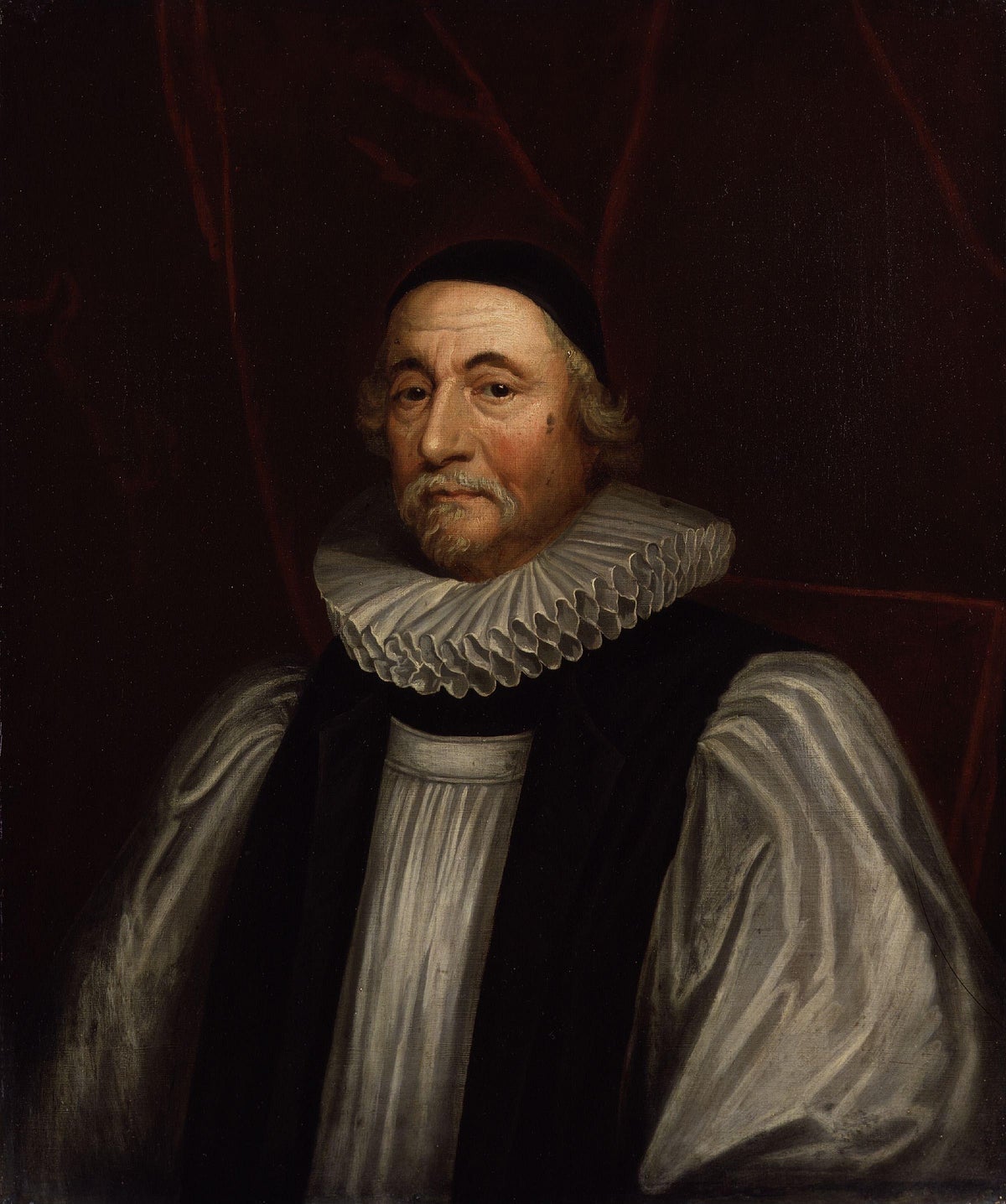
As a result, we make big mistakes. Until not long ago, the brightest and best of us believed that Planet Earth was little more than a few thousand years old. The Ussher chronology, compiled by a 17th Century Archbishop in Ireland, attempted to parse the history of the planet by counting the generations mentioned in the bible, from Adam and Eve to Jesus Christ, and updating from there. Notable detail was applied to the exercise, which led the author to conclude that the world began on 23 October, 4004 BC. But before you scoff, bear in mind that Ussher was not alone: Kepler thought the correct date was 3992 BC. Newton himself went for 4000 BC.1
It was not until the late 18th century that the simple insight of uniformitarianism began to be understood: namely, that the same physical and chemical processes which we see in the natural world today must have operated in more or less the same way in the past. In other words, these processes are uniform, and will also operate in the same way in the future. The first proponent of this simple idea was James Hutton, a Scottish physician and farmer, who memorably concluded his 1788 paper on the Earth’s history, presented to the Royal Society of Edinburgh, with the line: “The result … of our present enquiry is, that we find no vestige of a beginning—no prospect of an end.”2
Hutton was, of course, correct in his central idea. But he was wrong in his conclusion that there was no beginning, nor any prospect of an end. In fact, although details remain the subject of debate, we understand the origin story of Planet Earth pretty well today, and we have a pretty good view of how the future will pan out too. And yet this understanding has not been widely internalised outside of academic circles, and ignoring it has led to some remarkable echo chamber thinking in the modern environmental debate. Governments, corporates and NGOs all talk as if the future of the planet, or even the future of life itself, is in our hands – whereas in reality, if we force ourselves to look at the problem through the difficult lens of geologic time, we find that the opposite is true.
To explain what I mean by this, we need to cover quite a bit of ground. I’m going to need to hold your attention over a few perplexing but eventful billennia. But if you stay with me to the end, you might find that you look at the big environmental questions of our day in a slightly different way. I have been having that experience myself as I researched these topics: I find that my views have evolved quite a bit, and I am motivated to share what I have learned. Let me try to explain why, starting with the origin story of Planet Earth – which goes more or less like this.
The best estimates are that the Earth, Sun and Moon are all about 4.6 billion years old. The first half a billion years or so of that history is known as the ‘Hadean Phase’, named for the ancient underworld, as it was a nightmare landscape of swirling, burning gases. But where there is heat, there is eventually heat loss, and so over time there is cooling. As the cooling proceeds, the first rocks start to appear, about 4 billion years ago. And once there is something firm to cling to, it is not long until there is LUCA.
LUCA was not exactly the first life on Earth, but the Last Universal Common Ancestor of all living things today. LUCA was pretty quick to show up, perhaps in a hydrothermal vent in the deep sea, or in similarly extreme conditions on the edge of a volcano. But to get from LUCA to modern life took billions of years. First, there was a long period where all you really had were archaea and bacteria. They are both prokaryotes, or single cell life forms. And what is the only thing that we all know about a cell? That it has a nucleus? No, the prokaryotes didn’t even get one of those.3
These are simplest of simple life forms. And in the early chapters of life on Earth, they have the simplest of energy systems. The bacteria, specifically, are still using what our friends in Silicon Valley might call Photosynthesis 1.0. This was the out-dated, no-longer-supported, anoxygenic version of the photosynthesis technology. It was the Internet Explorer of its day: it worked, but not very well. This is what it did:
CO2 + 2H2S ⟶ (CH2O) + H2O + 2S
In other words, bacteria used sunlight to make sugar. They did this by combining carbon dioxide and hydrogen sulphide into a simple carbohydrate unit (CH2O), which in combination could form glucose molecules, with water and sulphur as by-products. It was a form of photosynthesis which worked, but also stank – literally.
It took a long time to find a better way. But after about a billion years, there was a breakthrough we can call Photosynthesis 2.0, which was like the moment when your corporate IT department finally caved in and allowed everybody to download Chrome. Because Photosynthesis 2.0 was just better. Instead of using the sun’s rays to split apart the sulphide of hydrogen, the bacteria figured out how to split apart the oxide of hydrogen, which is otherwise known as: water. And the main advantage of this was that there was a lot of water on the early Earth, so availability (of the electron donor) was no longer the limiting factor for the development of life.
Now, what’s interesting for our thesis is that although Photosynthesis 2.0 was a biotech breakthrough, it was also a catastrophe. To understand why, you have to look at the code for Photosynthesis 2.0, where you now see a very different reaction:
CO2 + H2O ⟶ (CH2O) + O2
In the new equation, water is the input not the output, and the by-product is oxygen rather than sulphur. Some innovative developments were required inside the cyanobacteria which first developed this new method: in short, they needed to generate enough power to oxidise the water molecules. But once they figured out how to do that, Photosynthesis 2.0 spread like wildfire around the shallow waters of the early Earth. And an awful lot of oxygen started to be pumped out.
To begin with, all this new oxygen reacted with the iron ions in the sea (Fe2+, Fe3+) precipitating heavier iron oxides which fell to the sea-floor and layered down the rusty coloured iron ores we dig up today - in the Australian Pilbara, and other places. But once the iron ions were used up, the oxygen started bubbling out into the atmosphere – which was almost completely anoxic until then. And this incredible development was a total disaster for life on Earth, at least to begin with.
It was a disaster because oxygen was a poison for all the prokaryotic life that was still running on Photosynthesis 1.0, which was maybe 80% – 99.5% or more of all living things at that time.4 This is hard to comprehend at first, but worth repeating: the breakthrough technology of Photosynthesis 2.0 was a poison to most other forms of life on Earth. Most of our planet’s earliest life forms were suffocated in oxygen, which among other impacts interfered with the enzymes they used to fix nitrogen from the air. The great oxygenation event, as it is now known, took place around 2.4 billion years ago, and it was an ecological tragedy.5
Fortunately, however, the story doesn’t end there. Planet Earth knows not to waste a crisis. First, oxygenation led to creation of the ozone layer, which had the benefit of sheltering life on the surface from harmful UV rays. And second, as well as the cyanobacteria enjoying their new technological advantage, other life forms quickly emerged which could make use of the waste product (oxygen) which Photosynthesis 2.0 was producing. What did they use the oxygen for? They invented respiration: a process of breaking down glucose to release energy in the form of ATP. Some of these life forms were proto-mitochondrions which may have ended up on the inside of other bacteria, which is a good theory about how we got to the eukaryotes, cells with a nucleus at last.
This was a key milestone, but we are still about 2 billion years ago in history, and it takes another billion years, including at least 2 and perhaps 3 or 4 different times when the whole planet froze over into a Snowball Earth, before we can get to multi-cellular algae. The path to multi-cellular algae is key because somewhere along that road, perhaps as far back as 2 billion years ago, the eukaryotes needed to make the important step of inventing sex, which can be defined as the process of merging genetic information across two members of a species. And from sexually reproducing eukaryotes, there is a path to the simplest and perhaps first of all animals: sponges.6
But we still have not come anywhere close to what you would call complex life until we get to the jelly-like biota of the Ediacaran period, about 600 million years ago, and it’s still another 100 million years after that before we come at last to the Cambrian explosion, a sudden flourishing of many relatively sophisticated life forms. This is the first time we see life forms with firm bodies, shells and skeletons, and because they now have those things, these life forms also have deliberate and sophisticated movement. And with deliberate movement comes that core element of the cycle of life as we understand it today, predation.
Yes, life had been around for about 3 billion years at this point (and happily having sex for about half that time) but it is only when we finally get to the Cambrian explosion, about 500 million years ago, that life gets to work on the really gruelling job of chasing all the other life forms around in order to consume them.7
The rest of this story you probably know. From the Cambrian explosion to today, we have 500 million years of evolution. The plants come on land, searching for a supply of phosphorus and pushing their roots down into the rocky crust to find it. The fish come on land and become amphibians and reptiles. The dinosaurs. The mammals. And so on.
What was the climate like during this time? It’s impossible to give a single answer. Thanks to repeated episodes of extreme volcanism, in the Siberian traps and elsewhere, carbon dioxide levels in the atmosphere varied from a few hundred parts per million to 7 or 8 thousand, which is an order of magnitude higher than today and then doubled again on top. So it is thought that average surface temperatures would have varied in a range from 10-11 degrees at the low end, to as high as 25 or even 35 degrees at the high end. This means that today’s global climate, averaging around 15 degrees, is towards the colder end of the range which life on Earth has experienced so far.
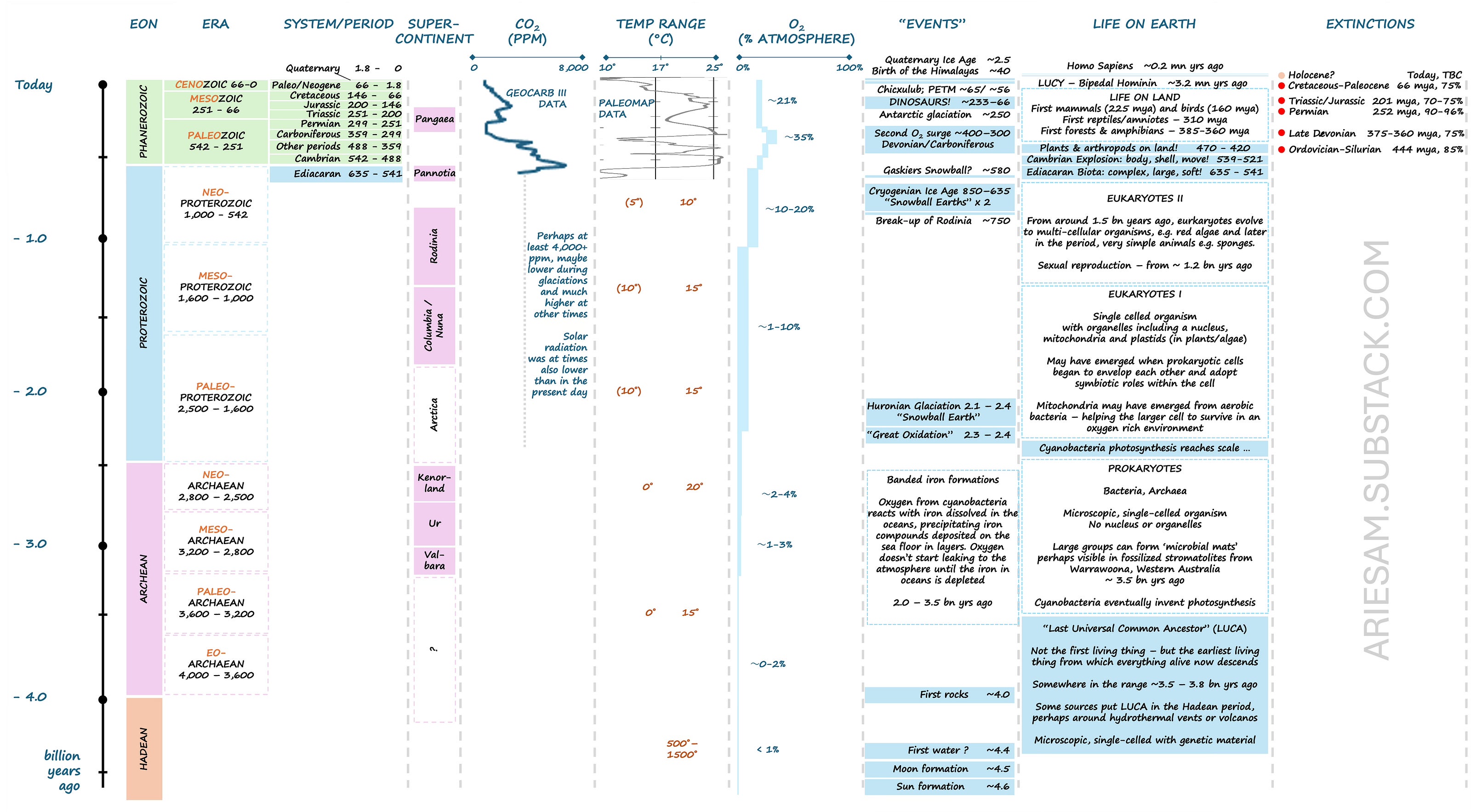
And in addition, throughout these turbulent climate periods, we have had 5 major extinctions, on each occasion taking out 75% or more of the species alive at the time, including the one which finished off the dinosaurs and was most likely triggered by the asteroid which struck Earth on what is now Mexico’s Yucatan peninsula, leaving its mark in the Chicxulub impact crater, some 180km in diameter. And before that, the Permian extinction of 250 million years ago is thought to have taken out 90-96% of all living things. But it is only because of these extinctions that life has taken the path we see today. Granted, things did not end well for the Stegosaur. But the end of the dinosaur age created the niche for mammals to flourish, while some dinosaurs (birds) survived and diversified further.
And importantly for us, we also think that in the very recent past (so now I am talking about just the last million years or so) it may have been the very volatility and variability of the Earth’s climate – a pulsing pattern of glacial advances and retreats caused by the slight variance in the roundness of the Earth’s orbit and the tilt and wobbliness of its axis, which created evolutionary pressure for a life form to emerge which was capable of sophisticated adaptation. In other words, for a life form capable of intelligence, and which has ultimately led, in the last 300 thousand years or so, all the way to our own species, Homo Sapiens.8
So that, if you like, is a potted version of our Origin Story. But what about if we look forward to the road ahead? What is the destiny of our planet?
We understand our planetary destiny quite well now, because the expansion of scientific knowledge in the modern era has been relentless. That kind of comment may seem like a platitude, but recall that only 100 years ago, if you had gathered together the world’s top scientists and asked them to explain to you what the sun was made of, they would have calmly told you that it was mostly made of iron.
Yes. It is only a little over 100 years since the world’s best minds believed, in all sincerity, that the sun was made of iron. When Cecilia Payne-Gaposchkin proved that this was not true, in her legendary Harvard PhD thesis of 1925 (I have taken out a copy from the library stacks and enjoyed holding this one in my hands) her supervisor made her include a recantation – a line to the effect of ‘this is what my research seems to have proven, but I must have got my calculations wrong’.9

And yet, Cecilia was not wrong, she was just the first to be right.10 A century on from her ground-breaking work, we have many reasons to be confident that the sun is indeed a huge nuclear fusion reactor, with about 1.4 trillion, quintillion kilos (1.4 x 1030 kg) of hydrogen fuel in a plasma form, the fourth state of matter, burning at around 6,000 degrees Celsius at the surface and 15 million degrees at the core. And we have a fairly good understanding of the phases this fusion reactor will go through as it burns, which may be broadly described as follows:
First, solar radiation is slowly increasing, and is expected to rise on average by about 10% every billion years. This will be enough, in about 500 million years, to start the process of evaporating away the Earth’s oceans and creating a moist greenhouse state, expected to be uninhabitable for complex life.
As the oceans evaporate, you may ask, where will they go? At first into the atmosphere as water vapour, which is itself a greenhouse gas. So as they say in the study of system dynamics, there will be a reinforcing feedback loop. The evaporating oceans lead over time to a runaway warming effect, increasing the insulating properties of the atmosphere. Surface temperatures will rise from around 15 degrees Celsius today to maybe 100 or 200 degrees. It is difficult to be precise, but the direction is clear.
As the humidity and temperature increases, water vapour rises to higher and higher altitudes, where the water molecules will be struck by incoming UV radiation and break apart. Some of the lighter, hydrogen atoms will escape into space and some will be stripped away by the solar wind. Once they are gone, they are lost forever. At this point there is no getting the oceans back.
And the process continues: after 3 to 4 billion years the sun is expected to be 30-40% more luminous than today and the temperature at Earth’s surface may reach 500 degrees Celsius, or higher. It’s hot, dry, sterile. The oceans are gone and so the tectonic plates have stopped moving around, meaning there is no longer any recycling of carbon out of the atmosphere into the mantle, a balancing feedback loop we have benefited from in the past, but which no longer functions. Our planet Earth has essentially become, at this point, Venus.
Fast forward another billion years, so we are now 5 billion years into the future, and the supply of hydrogen in the sun will start to run out, leading the core to collapse in on itself and the shell to expand – ending the ‘main sequence’ of the star and entering the “Red Giant” phase, where the radius of the sun, which is already 100 times that of the Earth, expands another 100 or 200 fold, engulfing the inner planets of the solar system (Mercury and Venus are done for) and either the Red Giant swallows Earth too, or comes extremely close and roasts us, or boots us out of orbit and deeper into space.
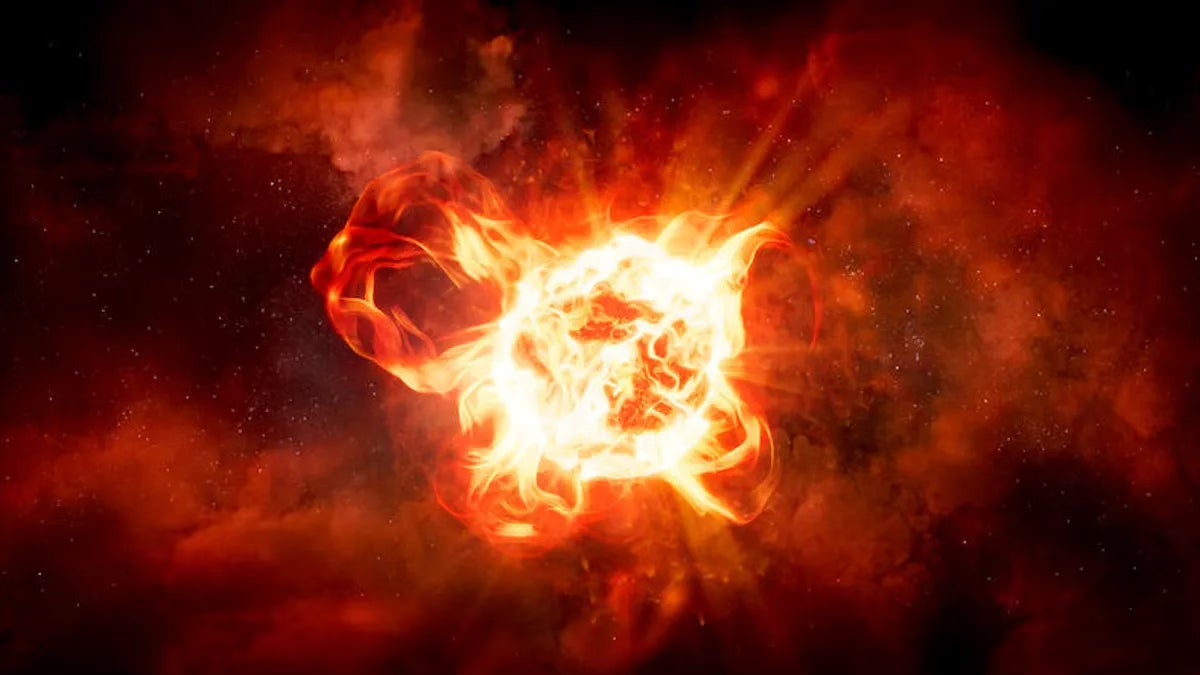
So one way or another, that’s all fairly un-survivable and pretty much the end of the story for life on Earth, although the Sun will still have a few billion more years to go. First it will have to burn off all the helium that was produced by 10 billion years of hydrogen fusion, and when that is all gone, it just needs to sit there, and cool down. This is the white dwarf phase, a sort of quiet finale after the Sturm und Drang of the Red Giant (which, by the way, is not entirely different from how I think about my late career decision to spend time writing obscure articles on substack).
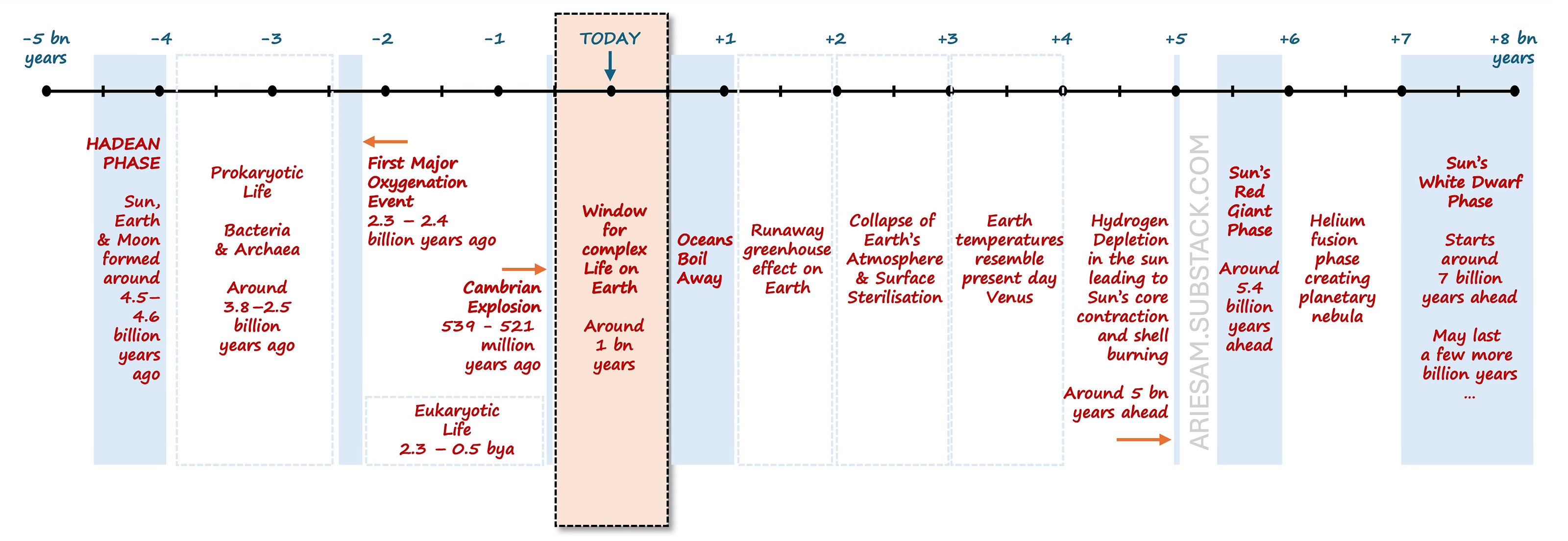
So to summarise, Planet Earth has maybe another 5 billion years to go, but it will only be during the first 500 million years of that when there is any chance of survival for large and complex life forms like us.11 That is what we see when we look forward through the windscreen at the road ahead. That is, in effect, our planetary destiny.
Some conclusions follow from this exercise of looking at our world through the uncomfortable lens of geologic time. The first is that although our planet may have a lifespan of roughly 10 billion years, the window in which conditions are supportive for complex life looks to be no longer than about a billion years. And we have used up the whole first half of that window, about 500 million years in total, to get from algae … to substack. But, on the bright side, we do still have another 500 million years to go.
The second conclusion you might reach is that across this timeline, disaster is frequent, yet life survives. Life has survived the deadliest hothouse and icehouse extremes and multiple, repeated extinctions, with different patterns and causes, and yet has always survived and adapted. Individual species however have not been resilient in the same way: they have come, and they have gone. I mentioned the Stegosaur. But what about the Smilodon, the Trilobites, Hallucigenia, Dunkleosteus or the Tiktaalik? Dead as the dodo, all of them, but replaced over time with other and better adapted forms of life.
Can you imagine a better adapted life form than sapiens? Perhaps not – but then again, Dunkleosteus and the Tiktaalik would have had some difficulty imagining you. So a third conclusion is that when we talk about “saving the planet” or “saving life on Earth”, these are misnomers on a planetary scale. Because if we look at our situation through the lens of geologic time (which we strain to do, since we understand geologic time so badly) it seems that we have very little influence on the long term trajectory of our planet, or of life itself. Those destinies were, almost literally, written in the stars.
This leads in turn to a final, and perhaps most important conclusion. Seen through the lens of geological time, it may be that our environmental challenges are more about the survival of our own species than anything else. This feels deeply unintuitive, and is in contrast to the common feeling that environmentalism is about selflessness, about preserving nature, and protecting it (almost altruistically) from mankind’s impact. But it is hard to escape the conclusion that the most conspicuous victim of an Anthropocene extinction, if it were to happen, would be mankind itself. If such an extinction were to take place, it might take a very long time, but based on what we have seen so far – life itself would surely rebound. Sapiens, however, might not.
If you’re uncomfortable with this conclusion, let’s test it quickly with a scenario: let’s assume that the environmental impact of human activities accelerates, and in one, or two, or a few more centuries’ time, the Anthropocene ends with another ecological wipeout. Let’s further imagine that sapiens and 80-90% of other life forms disappear, but then, after another 10 or 100 million years, new life forms and ecosystems evolve which are better adapted, and they flourish. Perhaps these life forms of the future would be more intelligent, more cooperative, better adapted to the planet’s new conditions, perhaps less resource intensive in their needs than we have been, perhaps more able to travel across the cosmos to other places. Would those life forms of the future then look back, and consider their condition to be worse than if the reign of sapiens had continued indefinitely?
I doubt that they would think that for a moment, just as we do not wish that the age of the dinosaurs had lasted forever, nor that of the Ediacaran biota or the anoxygenic phototrophs. And yet, this outcome – which future inhabitants of our planet might simply shrug at – would be catastrophic for our species. So it seems fair to say that our approach to environmental challenges should perhaps be looked at mostly through the lens of self-interest. And this in turn means that our environmental challenges, important though they are, may not have any intrinsic primacy over other the other kinds of survival challenges we face. In this sense, the early Greek philosopher Protagoras had a point when he said that man is the measure of all things.12
If these conclusions are on target, then there are going to be some important consequences for the way we think about our environmental goals. There is no suggestion that the challenges are not serious, only that they are serious because of their potential impact on us. Which means we need to balance those goals very carefully against other risks and opportunities we face, in a way that has not always been widely accepted in the environmental movement.
That final insight is really just a building block on which other arguments with more practical implications can make their foundation. So for now, I just want to conclude with the observation that a planet (which measures its life in geological time) may survive the effects of changing human behaviour far more easily than humans (who live in biological time) can survive the effects of a changing planet. And so, as much as we may squirm and wriggle at the thought, the intuition that environmental goals have some kind of special priority relative to our other goals may be little more than a mirage – and a function of our intuitive difficulty understanding and engaging with the deeply uncomfortable concept of geologic time.
Wysession, Michael E. How the Earth Works (The Great Lecture Series). The Teaching Company, 2008.
Tarbuck, Edward J.; Lutgens, Frederick K; Tasa, Dennis G. Earth Science, Global Edition. Pearson, 2015.
Dartnell, Lewis. Origins: How the Earth Shaped Human History. Basic Books, 2019.
Porder, Stephen. Elemental: How Five Elements Changed Earth’s Past and Will Shape Our Future. Princeton University Press, 2023.
Some data in the exhibits from GEOCARB III and Paleomap.
Many thanks to Mikayla for a geological fact check of this article. (But it’s not her fault if errors remain - blame those on me!)
We were encouraged by Stephen Jay Gould not to judge Ussher by modern standards. But while I understand the point, I have only limited sympathy for the view. There is a monument in my village to Henry Dundas, the First Viscount Melville, whose historical significance is to have inserted the word ‘gradual’ into William Wilberforce’s 1792 bill to abolish the slave trade. It is estimated that half a million Africans were sold into slavery in the years that followed, before abolition became effective. I don’t see a lot of value in judging that action by the standards of the day. Indeed, Wilberforce himself is a revered historical figure precisely because he is judged not by the standards of his day, but of ours.
Quoted and discussed helpfully in Tarbuck, Edward J.; Lutgens, Frederick K; Tasa, Dennis G. Earth Science, Global Edition (p. 369).
The archaea also deserve a mention here, they are the other branch of early prokaryotes to emerge from LUCA. But they are less important in the story I want to tell about photosynthesis, so with apologies, I rather gloss over them here.
Hodgskiss, M. S. W., B. A. Killingsworth, D. T. Johnston, et al., “A productivity collapse to end Earth’s Great Oxidation,” Proceedings of the National Academy of Sciences 116 (2019): 22795-22800, https://doi.org/10.1073/pnas.1900325116(pnas.org). The authors conclude: “our results show that the decrease in gross primary productivity across this transition eclipses even the largest extinction events in all of Earth’s history.”
The GOE may also have led to the first instance of a snowball Earth, with ice caps in the period of the Huronian Glaciation reaching as far as the equator.
I am sticking with what I take to be consensus, but on almost every point in this timeline there can be points of debate. In this case, some have argued that sponges were not the first animal lineage to branch from the tree of life, but were preceded by ctenophora, a kind of simple jellyfish. There doesn’t seem to be much significance for my wider point, although perhaps it is true that the ctenophores introduced predation a little earlier than I have said.
I am rounding off the numbers here just to make it easier to follow. The Cambrian period is usually measured as being from 542 - 488 million years ago, the Ediacaran 635-541 million years ago. The dates of the major eras and systems/periods within those are given in the exhibit, for those who prefer to be precise.
There is an excellent and detailed discussion of the geological pressures which may have led to the evolution of intelligence in Lewis Dartnell, Origins: How the Earth Made Us (London: The Bodley Head, 2019). Some recent discoveries suggest the emergence of sapiens may have been earlier than I have stated here.
Solar spectroscopy in the late 19th / early 20th century showed very strong iron lines, leading consensus to conclude that the sun was mostly made of iron. But by around 1920, Eddington had proposed that hydrogen fusion could be the source of the sun’s energy. Cecilia Payne-Gaposchkin’s contribution was to show, using Saha’s ionisation equation, that line strength in the solar spectra could be a function of temperature and ionisation state. From there, she was able to show that hydrogen and helium vastly dominate the composition of the sun, and indeed any star during its main sequence.
And as she herself said, in Stellar Atmospheres, the publication that summarised for the general reader the findings of her doctoral research: “There is no joy more intense than that of coming upon a fact that cannot be understood in terms of currently accepted ideas. No excitement is comparable to that of devising, or learning of, a new theory.”
I should again acknowledge some inevitable simplification. What is habitable? What is complex life? I think the consensus is that from about 500 million years in the future, the Earth is no use any more to large mammals or ‘complex life’ similar or equivalent to humans. But various other forms of life might survive somehow: grasses, hardy invertebrates, reptiles, maybe some aquatic and microbial life. But after about 0.8 - 1.3 billion years, then you are into territory where the experts think, no life at all can survive.
More on Protagoras here. Interesting guy. Plato didn’t like him much, however.


