Literature
The undiscovered 'Easter Egg' in Stegner's masterpiece
It has to do with raw chicken. Let me explain.
Literature
The undiscovered 'Easter Egg' in Stegner's masterpieceIt has to do with raw chicken. Let me explain.
Culture
The power of a pure idea: The Finger-SpaceThe rip-roaring tale of Marc Antoine de Muret, Fragment 31 and the greatest literary scoop of the 16th century
Earth Science
Our brains are not wired to understand geologic timeIf they were, we might reach some very different conclusions about our planet
Drama
Sophocles and the Pink Pony ClubWhat we learn about how a good society works from a survey of world literature
Age of Discovery
Volta do marWe must sometimes risk the perils of the wide open ocean if we are to discover new worlds
Culture
Has intelligence gone out of fashion?It might soon be time for a retro revival
Finance
How financial markets actually workI'm taking a swipe here at a Nobel Prize winner - maybe not a good idea, but if you work in finance you'll understand my motivation
Politics
The end is near for Sir KeirHe seems to have a nasty case of Stanley Baldwin disease
Society
A red traffic light at 3amNot a soul in sight and the town is fast asleep. What do you do?
International Relations
NATO and 1984Will Ukraine be betrayed by doublethink and boiled rabbits?
Markets
Is the AI bubble bursting now?Opinions are divided (but I have taken a view)
Climate
Bill Gates and Point BreakA look at the Gates climate letter through the lens of an iconic, 1990s surf dude film
Politics
The dumbest thing a Congressman saidSo daft, you won't know whether to laugh or cry
Culture
It might soon be time for a retro revival
The ebb and flow of fashion is a mysterious thing. In the 1970s, you needed room under your trouser leg to hide a small dog; in the 1990s, it was all about the straight-leg, 501 cut; these days, it’s hard to find a pair of jeans which don’t give you the tight-calf, fully shrink-wrapped look.
What’s interesting is that political fashions seem to ebb and flow over the years in just the same way.
In ancient times, Plato argued that in the ideal republic, political power and philosophical wisdom would be united in a single ruler, the philosopher-king. Granted, Plato was a philosopher, so his conclusion (that only a philosopher would be qualified to lead the state) must be seen for what it is: an example of talking his own book. But still, that doesn’t mean he was wrong.
Marcus Aurelius, the last of the five good emperors, who reigned in the second century AD and at the peak of the Roman Empire, is perhaps the closest we have seen to the philosopher-king. His fantastic Meditations show a leader wrestling with the daily responsibilities of power while trying to hold on to rationality, the pursuit of good outcomes and a certain level of internal detachment. And yet, among his more famous aphorisms, the idea that the quality of your life is determined by the quality of your thoughts, would seem entirely un-stylish today.1
In the modern era, it’s hard to come up with similar figures, but perhaps we can make a case for Václav Havel: Czech intellectual, playwright, dissident, and unifying political leader. Havel led his nation to freedom, through the Občanské fórum and the remarkable, unforgettable Velvet Revolution of 1989. But the soundtrack to that revolution was the anthem Pravda víťazí (‘Truth wins’, by Slovak band Tublatanka) whose lyrics would, again, feel desperately unfashionable today. 2 3
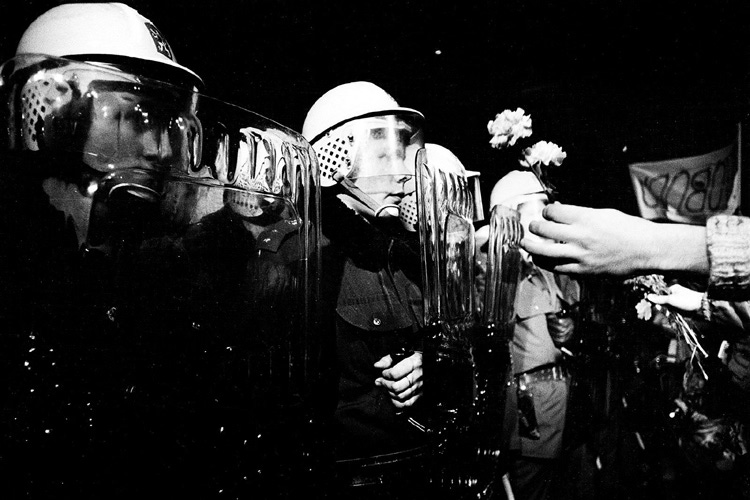
Today, what’s cool is to be anti-intellectual. Rahm Emanuel, who was once Obama’s chief of staff, wants to be President, but not in the reflective and professorial mode which Obama exemplified. He talks tough on wokery; brands himself as willingly, politically incorrect; and tries not to remind the media that he once won a scholarship to the Joffrey ballet.
Pete Buttigieg is a properly smart guy (who taught himself Norwegian, for example, in order to read Knausgård in the original)4 and he also wants to be President. But he is going down the same route: Ted Cruz stubble, talking tough and splitting wood in his Michigan retreat.
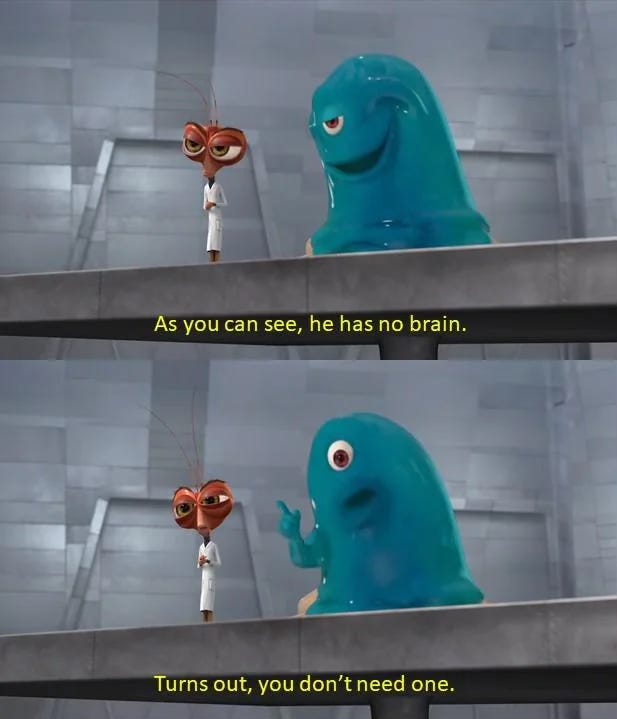
It’s not just in America where brains are out of fashion. In Europe, ‘technocratic’ seems to be a rude word now. A long list of would be demagogues - Farage, Salvini, Meloni, Kwarteng, Le Pen and many others - have answered reasonable concerns about their economic plans with hollow slogans. Macron and Wilders rolled back environmental protections based on little more than a claim about common sense, and Michael Gove says the public has had enough of experts. We do seem to have concluded, like B.O.B. in Monsters v Aliens, that brains are totally overrated.5
But is that right? What is this elusive “brain” thing which has become so degraded in the modern era? I’m certainly not talking about conventional book-smarts or some collection of fancy degrees. Some of the dumbest people have the most impressive qualifications:
No, what I’m talking about is a more rounded definition of intelligence, which the literature tends to define as ‘the ability to construct and use models to achieve goals under uncertainty’. Not a bad definition, and relevant for human as much as artificial intelligence, it rests on the following pillars:
Now, I may be showing my lack of fashion-sense here, but those seem to me good capabilities to look for in a political leader and I’m not sure what has made them suddenly unmodish. In addition, those abilities require a set of valuable personal attributes: representation requires empathy and imagination; inference requires logic and the ability to tolerate complexity; learning requires patience and humility; exerting control requires consistency, persistence and ultimately self-regulation.
These are all character traits I admire, aspire to, appreciate in my friends and encourage in my children. I would vote for them all at the ballot box. So I find it a great shame that such things have become so frankly untrendy. And yet I console myself with the thought that styles do change, and the pendulum of fashion must eventually swing back to the sensible centre.
Put another way, there are only so many ways to cut a pair of jeans. And so it must be only a matter of time until your loose-fit, 1990s, original-riveted, button-fly, black Levi 501s are seen again to be exactly what they always were: the apogee of good taste.
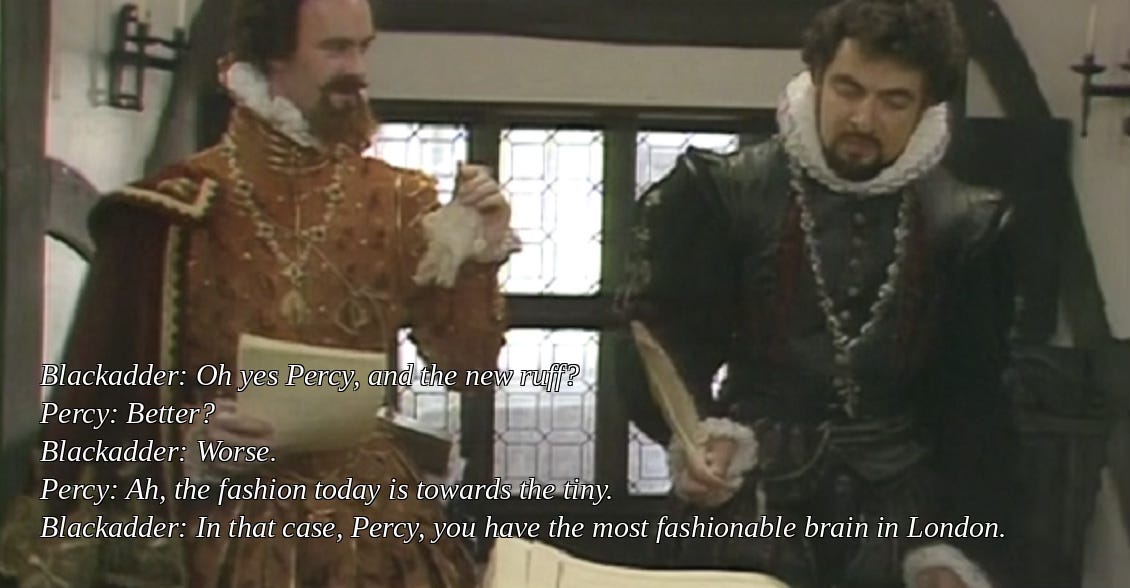
This brilliant and somewhat mystical quote is a loose translation from Book III, chapter 9:
Τὴν ὑποληπτικὴν δύναμιν σέβε. ἐν ταύτῃ τὸ πᾶν, ἵνα ὑπόληψις τῷ ἡγεμονικῷ σου μηκέτι ἐγγένηται ἀνακόλουθος τῇ φύσει καὶ τῇ τοῦ λογικοῦ ζῴου κατασκευῇ
It’s a little tricky to translate. The first part, you might translate these days as ‘hang on to your faculties, for everything depends on this’. The second part, perhaps as ‘… so that you don’t come up with any ideas which are perverse or illogical’.
The rest of the Meditations are rich with excellent quotes. Take this one, from Book IV, chapter 3, which is (again) open to a number of quite different interpretations:
‘ὁ κόσμος, ἀλλοίωσις· ὁ βίος, ὑπόληψις.’
I would say: “The universe is all about change, but life is all about ideas.’ However the Loeb translation is: “The universe - mutation; Life - opinion”, which gives it a rather different meaning. It is hard to imagine any modern leader coming up with anything so rich.
If you are one of those who reads the footnotes, then I know that you have come here for the lyrics in full. So thank you, and here goes. The original Slovak version is here. ‘Pravda víťazí’ was the national motto of Czechoslovakia, used by Tomáš Masaryk, the first President of Czechoslovakia.
The world is different than I used to think:
The world is quite sad to tell the truth!
Hollow people want to rule it,
Laugh in our eyes,
No truth fits them.The world is afraid of hollow people:
They get into the soul
Of those who struggle them,
Knife to their throat they plunge -
No truth fits them!Even so, it is never to be killed,
It will never die!
It lives even if they do not want it,
And no one who faces it will get away.Truth wins out,
No matter what an epoch is proceeding
Or what amount of almighty
money shine;
Truth wins out,
Unless you betray it yourself.
Truth always wins,
wins!Hollow people have enough power
To melt truth in wine,
And the whole world’s just waiting
Until their time will be up:
No one such truth fits!Even so, it is never to be killed,
It will never die!
It lives even if they do not want it,
And no one who faces it will get away.Truth wins out,
No matter what an epoch is proceeding
Or what amount of almighty
money shine;
Truth wins out,
Unless you betray it yourself.
Truth always wins,
Wins!Truth wins out,
No matter what an epoch is proceeding,
Truth always wins,
wins!
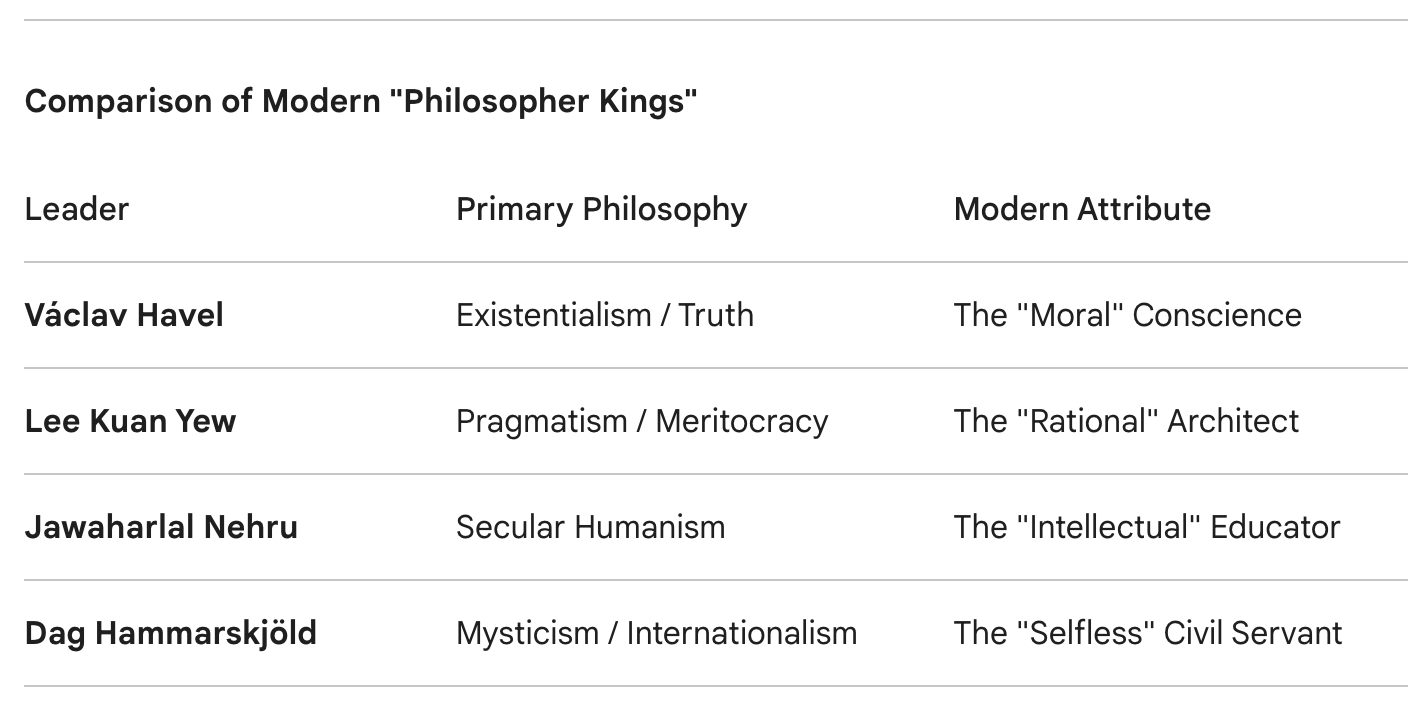
I asked Gemini for some other candidates for modern ‘philosopher king’, alongside Havel, and this was the answer. I will let you decide what you make of that.
Or so the story goes, although it might have been Erlend Loe he wanted to read, we’re not sure. Anyway: here is a video of Pete B. talking to the Norwegian media, in Norwegian.
Here’s the freeze frame, for those who don’t have time to watch the video. B.O.B. stands for Benzoate Ostylezene Bicarbonate, a blue jelly.
Actually, to be fair, Bongbong didn’t graduate from Oxford. He was a PPE student who failed Economics and Politics and was given a ‘special diploma’ instead. And he dropped out of his Wharton MBA as well. (All according to Gemini.) Turns out you don’t need an education either.


