Literature
The undiscovered 'Easter Egg' in Stegner's masterpiece
It has to do with raw chicken. Let me explain.
Literature
The undiscovered 'Easter Egg' in Stegner's masterpieceIt has to do with raw chicken. Let me explain.
Culture
The power of a pure idea: The Finger-SpaceThe rip-roaring tale of Marc Antoine de Muret, Fragment 31 and the greatest literary scoop of the 16th century
Earth Science
Our brains are not wired to understand geologic timeIf they were, we might reach some very different conclusions about our planet
Drama
Sophocles and the Pink Pony ClubWhat we learn about how a good society works from a survey of world literature
Age of Discovery
Volta do marWe must sometimes risk the perils of the wide open ocean if we are to discover new worlds
Culture
Has intelligence gone out of fashion?It might soon be time for a retro revival
Finance
How financial markets actually workI'm taking a swipe here at a Nobel Prize winner - maybe not a good idea, but if you work in finance you'll understand my motivation
Politics
The end is near for Sir KeirHe seems to have a nasty case of Stanley Baldwin disease
Society
A red traffic light at 3amNot a soul in sight and the town is fast asleep. What do you do?
International Relations
NATO and 1984Will Ukraine be betrayed by doublethink and boiled rabbits?
Markets
Is the AI bubble bursting now?Opinions are divided (but I have taken a view)
Climate
Bill Gates and Point BreakA look at the Gates climate letter through the lens of an iconic, 1990s surf dude film
Politics
The dumbest thing a Congressman saidSo daft, you won't know whether to laugh or cry
Politics
So daft, you won't know whether to laugh or cry
‘…. niemals stirbt die Dummheit aus in einem Parlamente’ ( ‘…no end to the stupidity of a Parliament’) - Max Glaser (1927)
Occasionally a clip surfaces on social media which frankly jars. One such clip is doing the rounds now (although it dates back to 2023, so I should say, this is not exactly brand new) in which Congressman Doug LaMalfa (Rep, California) is hearing testimony from a panel of low carbon transport experts. Now, I happen to agree there are some questions to be asked in this area and so I am not opposed to a rigorous interrogation of the experts. But rigour is one thing, and nonsense is another. And this episode, I’m sorry to say, was nonsense.
Here’s the clip for you to enjoy (you need to watch the first 2 mins, but I think you’ll find it entertaining):
So what exactly is going on here? Let’s break it down.
LaMalfa’s first point is that carbon dioxide (CO2) gas makes up a very small proportion of the Earth’s atmosphere. He’s right about that. But on the other hand, it is a rather well known fact. The very famous Keeling Curve, tracking atmospheric CO2 data captured since the 1950s, currently shows CO2 levels at about 425 parts per million (ppm) or about 0.04% by volume. 1
He’s probably also right that people testifying to Congress on climate policy ought to know these kind of numbers. It’s certainly a little awkward to watch the, a-hem, experts chuck out guesses that are off by two orders of magnitude. If LaMalfa’s point was just that many experts are poorly informed about climate science, then I’d be ready to agree. I’d even agree if he just wanted to say that climate change is a problem, but even so, some of our policy approaches need a bit of a rethink.2
But those are not his points, not even close. The punchline he can’t wait to get to is something completely different, and it’s all wrong. It’s so wrong, it’s actually a little weird. What the Congressman wants to explain to us is that 0.04% is such a small number that for that reason alone we should not worry about it. We should not get ‘all contorted’.
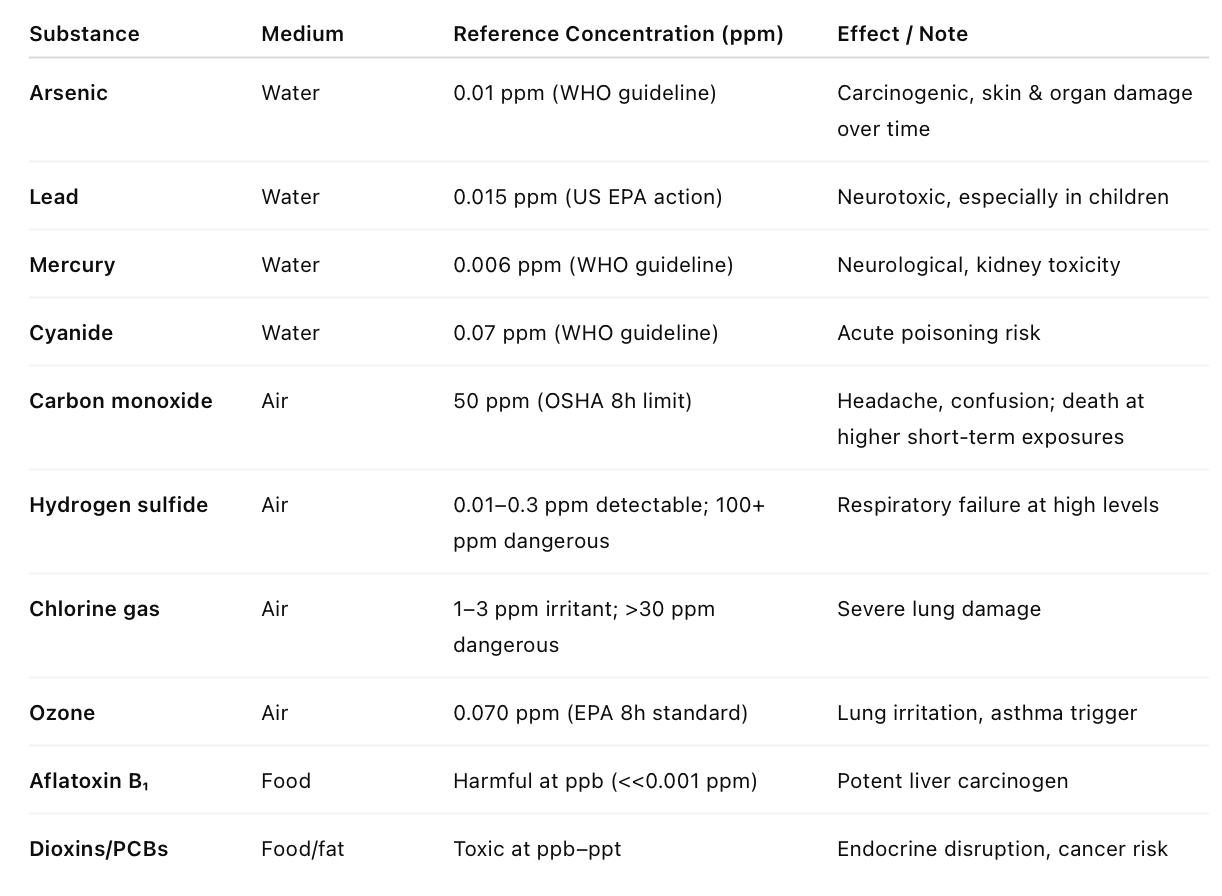
It’s as if it has never occurred to him that this is how poisons and pollutants work: they have strong effects at weak concentrations. Would he be happy with 0.04% arsenic in his tea? Or 0.04% cyanide in his sandwich? Does he know that 0.04% carbon monoxide in the air would be fatal within hours?3
Of course, CO2 is not poisonous (to us) in the same way as these other substances are. But there is little uncertainty about its effect on global warming and it is interesting to consider the reasons. The part which everybody knows well is that CO2 is a greenhouse gas: so like the glass in a greenhouse, CO2 allows the high frequency/short wavelength radiation from the sun to pass through (on the way to Earth’s surface) but does not allow the low frequency/long wavelength radiation which is then re-emitted by the Earth to do the same thing (on the way back out to space). So a portion of the heat trying to escape into space is trapped in the atmosphere, pushing up temperatures over time.
The more interesting question is why? Have you ever thought about this? Why do the other gases in our atmosphere not have a greenhouse effect? It’s pretty lucky for us that they don’t, given the composition of the atmosphere is as follows:
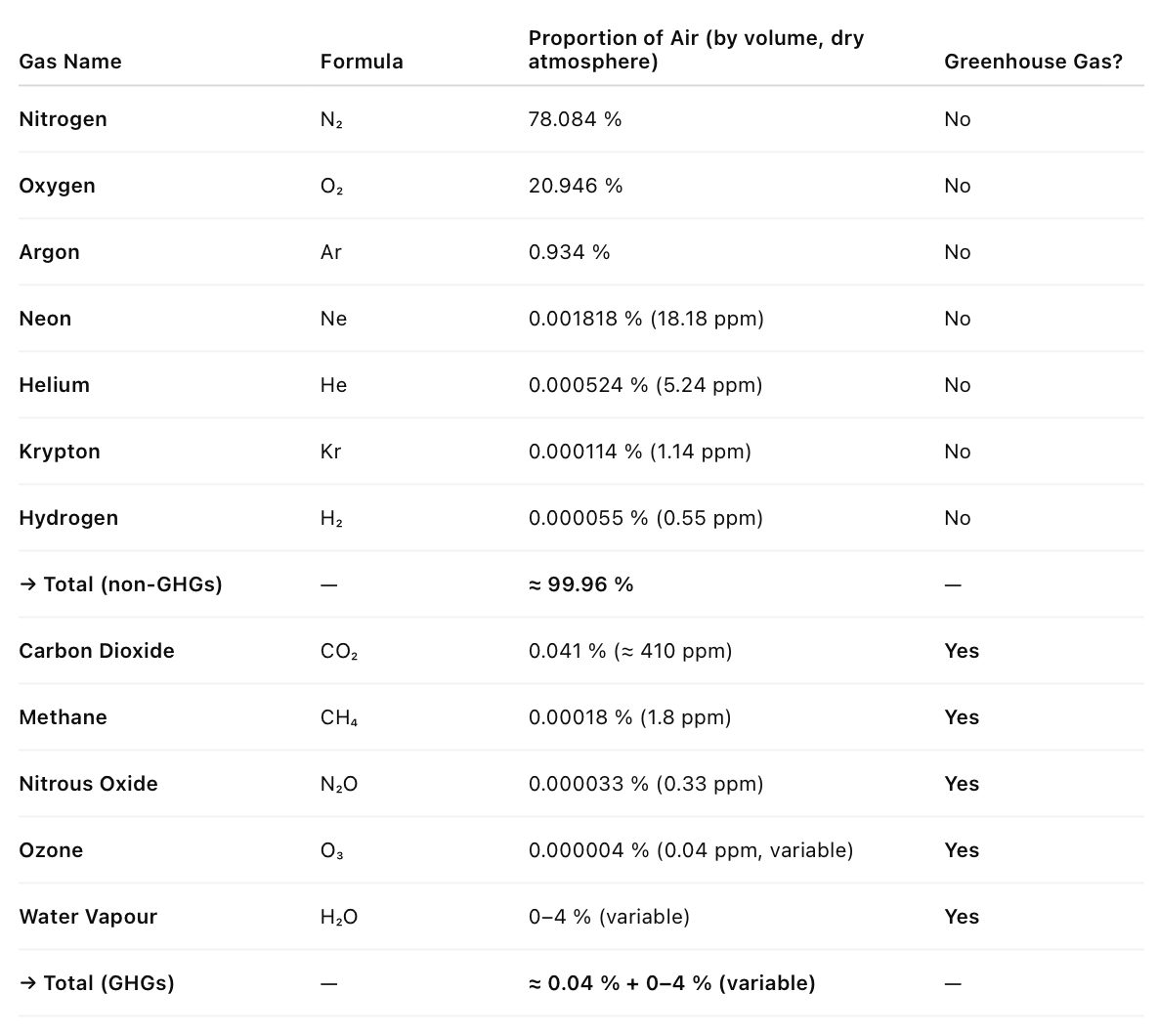
To understand the difference, let’s start with the molecular bonding structure of a CO2 molecule, which looks like this:
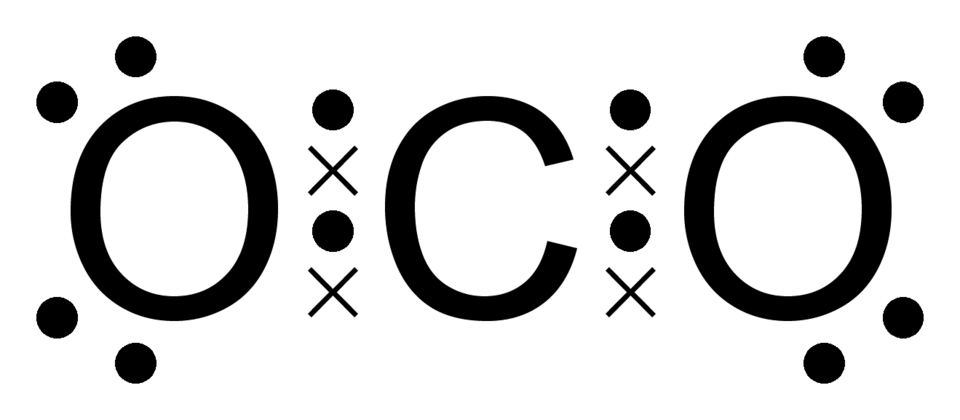
The Lewis Structure simply shows that the carbon atom (C) has 4 electrons in the outer shell, while the oxygen atoms (O) have 6 each. So the solution to satisfy the octet rule is for the carbon atom to share 2 of its electrons with each oxygen atom, and for the oxygen atoms to reciprocate, forming a double covalent bond on each side. The double bonds then repel each other, to 180 degrees, and the result is a linear molecule which we can imagine looks a bit like this:
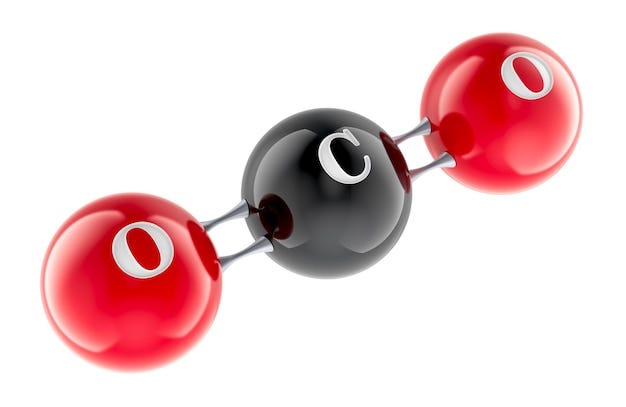
Now, what happens to a molecule with that shape when you bang it with a photon? The answer is that it starts to vibrate. Or more specifically, it might start to vibrate if the incident photon has exactly the right amount of energy to bump the molecule into one of its three quantised, vibrational modes, which look like this: 4
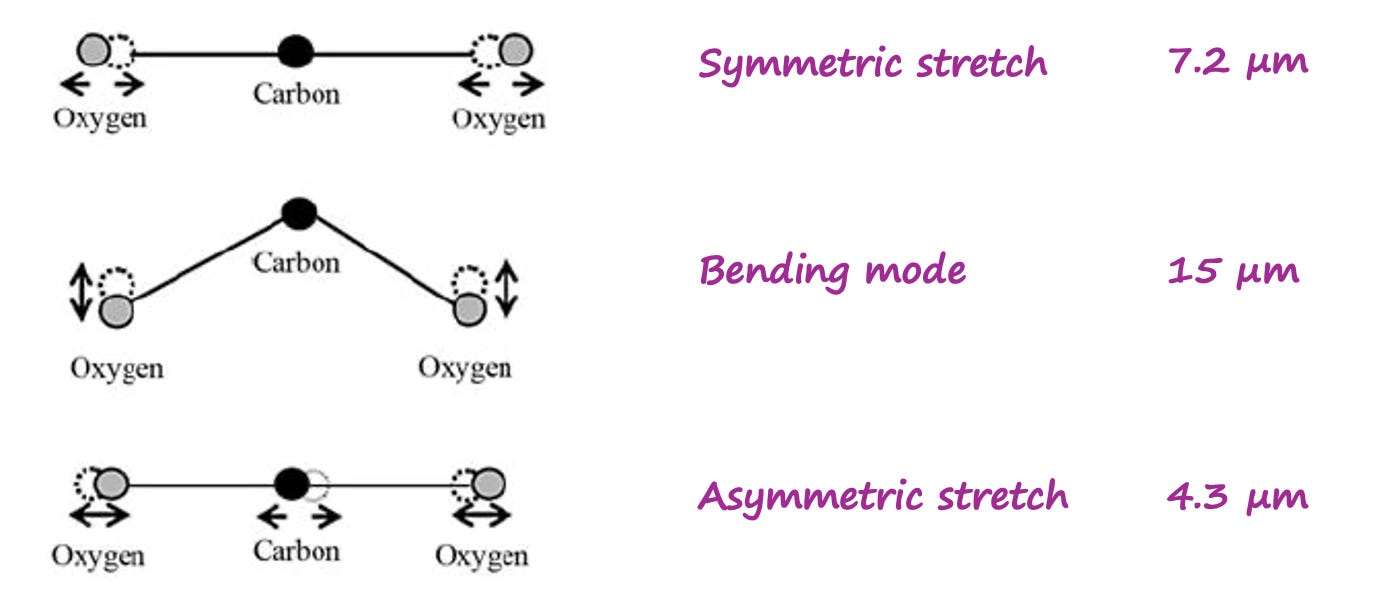
Of the three ways the molecule might vibrate, it turns out the middle one (the bending mode) is the most important, and it takes a photon with a wavelength in the range 13 – 17 µm to bump the CO2 molecule into this mode, from its ground state.
This is a coincidence of truly geological significance, because about 20% of the thermal (infrared) radiation coming from the Earth falls into this range. And whenever a CO2 molecule in the ground state is excited by this type of radiation, it jumps up into the bending mode. Energy is transferred from the electromagnetic wave to the molecule, and then one of two things happens: either the molecule simply spits the energy out again and returns to the ground state (sending out another photon at the same wavelength, but not usually in the same direction), or it collides with other molecules in the air (transferring kinetic energy to them, and then, again, returning to the ground state).
All this happens in a 10 millionth of a second. In a rare case, the incoming photon might be ejected again in the same direction it was originally traveling, and continue its journey towards space. But vastly more often, the photon will be redirected in another direction, or back down to the Earth’s surface, or even more likely the energy will simply be transferred via collisions to other molecules in the air, mostly diatomic nitrogen and oxygen. These molecules are already vibrating and zipping about at very high speeds (e.g. 500 m/s is typical for a nitrogen molecule at room temperature) but the vibration or motion is increased after collision with an excited CO2 molecule. And so we can say that the process has increased the thermal motion of the air, which is another way of saying that the temperature has gone up.
This is the bottom line: what we have just described is how the famous greenhouse effect works at the atomic and molecular level.
But before we draw a conclusion, it’s helpful to understand why the other ways a CO2 molecule can start vibrating – the symmetric and asymmetric stretches shown in the figure above – play no real part in the global warming story. This section is a little more painful, but bear with me, as this short digression underpins the conclusion we want to reach. And the four building blocks we need are as follows:
All this is a long way of saying that for a molecule to be bumped up into an excited state by solar or thermal radiation, the excited state must create a dipole moment (a difference in charge from one end of the molecule to the other) which can oscillate at the same frequency as the incident photon.
This is then exactly what happens when thermal infrared radiation bumps a CO2 molecule into the bending mode. The bending vibrations cause the dipole moment to oscillate and the energy is transferred from the photon to the molecule. But now we know how the mechanism works, we can see why the other vibrational modes of the CO2 molecule (the stretches) are irrelevant.
To summarise this digression then: the molecular driver of the greenhouse effect is thermal radiation from the Earth striking CO2 molecules and bumping them up into a bending mode. The bending mode absorbs energy, delaying the loss of planetary energy into space and warming the surrounding air. But only the bending mode is important, because the symmetrical mode is radiation-inactive (no oscillating dipole moment) and the asymmetrical mode requires radiation at a wavelength which isn’t available – at least not in the lower atmosphere where most of the CO2 is to be found.
Now, with all this under our belt, we have what we need to explain why Nitrogen and Oxygen, which make up 99% of the air around us, are not greenhouse gases. The answer is obvious if we look at their molecular structure:
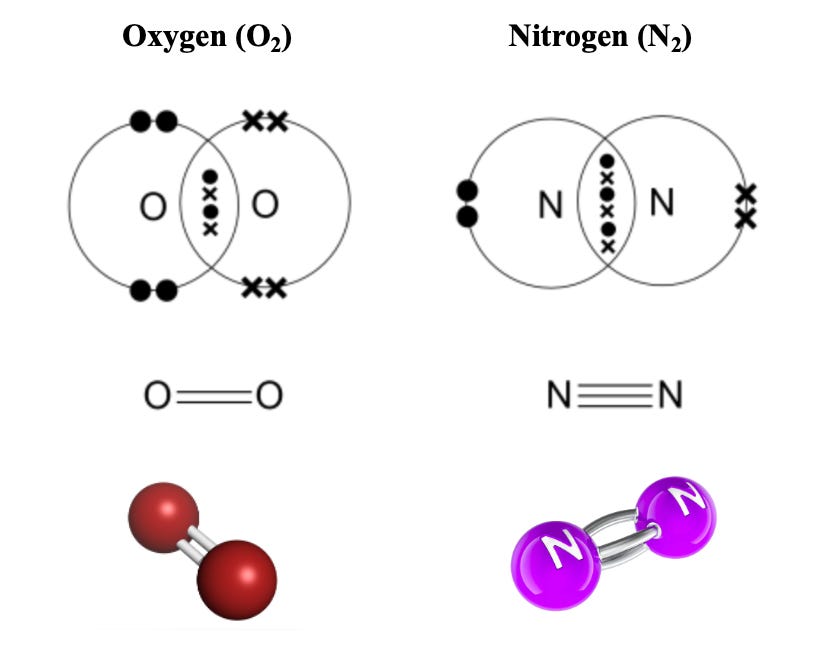
From the pictures, you can see that both gases have what’s called a homonuclear diatomic molecule: in other words the basic molecule is made up of just two identical atoms, strongly bonded together. And because you have atoms of the same element on each end of the bond (that’s the meaning of homonuclear) there is no difference in electronegativity, the bonds are not polar and there is no dipole moment. And because there are only two atoms in the molecule, the shape of it is essentially two-dimensional and so it’s not clear how a dipole moment could oscillate, even if it were there.5
So to cut a long story short, these molecules cannot be bumped into an excited state by incident radiation – either incoming from the sun, or outgoing from the Earth. And thank goodness, or else we would surely live on an intolerably hot and inhospitable planet.
So, to conclude, let’s return to our friend the Congressman who seemed so pleased with himself for discovering that carbon dioxide is a small proportion of our atmosphere, by volume. And let’s start by noting that were this not the case, he surely wouldn’t have been here – and nor would any of us – to comment on that interesting fact.
And worse, what the Congressman doesn’t seem to understand, which hopefully this article has shown, is how CO2 can have such a strong effect on our atmosphere even while being so diluted. The central point is that CO2 molecules (and those of other greenhouse gases) have a property which the rest of the atmosphere does not share. Their molecular structure is such that they can generate an oscillating dipole moment, allowing them to couple with an electromagnetic wave at the same frequency. And this means that the radiation (or photon, or wave, or whatever we call it) can ultimately transfer its energy to the gas.
And then the CO2 molecule does one last thing: it transfers the energy it acquired to the air around it, mostly as kinetic energy which accelerates the thermal motion of the air, raising the temperature of the atmosphere. The CO2 molecule does this almost instantaneously, within a fraction of a second, and as soon as the process is over it falls back into the ground state. And in the ground state, it can acquire energy again from the Earth’s thermal radiation, and repeat the whole process. And of course it does continually repeat the process, because thermal radiation is continually emanating from the planet’s surface.
The best way, I think, to conceptualise this is like a foot pump for an air mattress. Yes, the pump is small compared to the mattress, but it’s a mechanism for capturing energy (from your leg muscles) to fill the mattress with air. In the same way, CO2 is a tiny proportion of the atmosphere, but it acts as a mechanism for capturing energy from radiation and transferring it to the rest of the atmospheric gases – which cannot pull off the same trick. 6
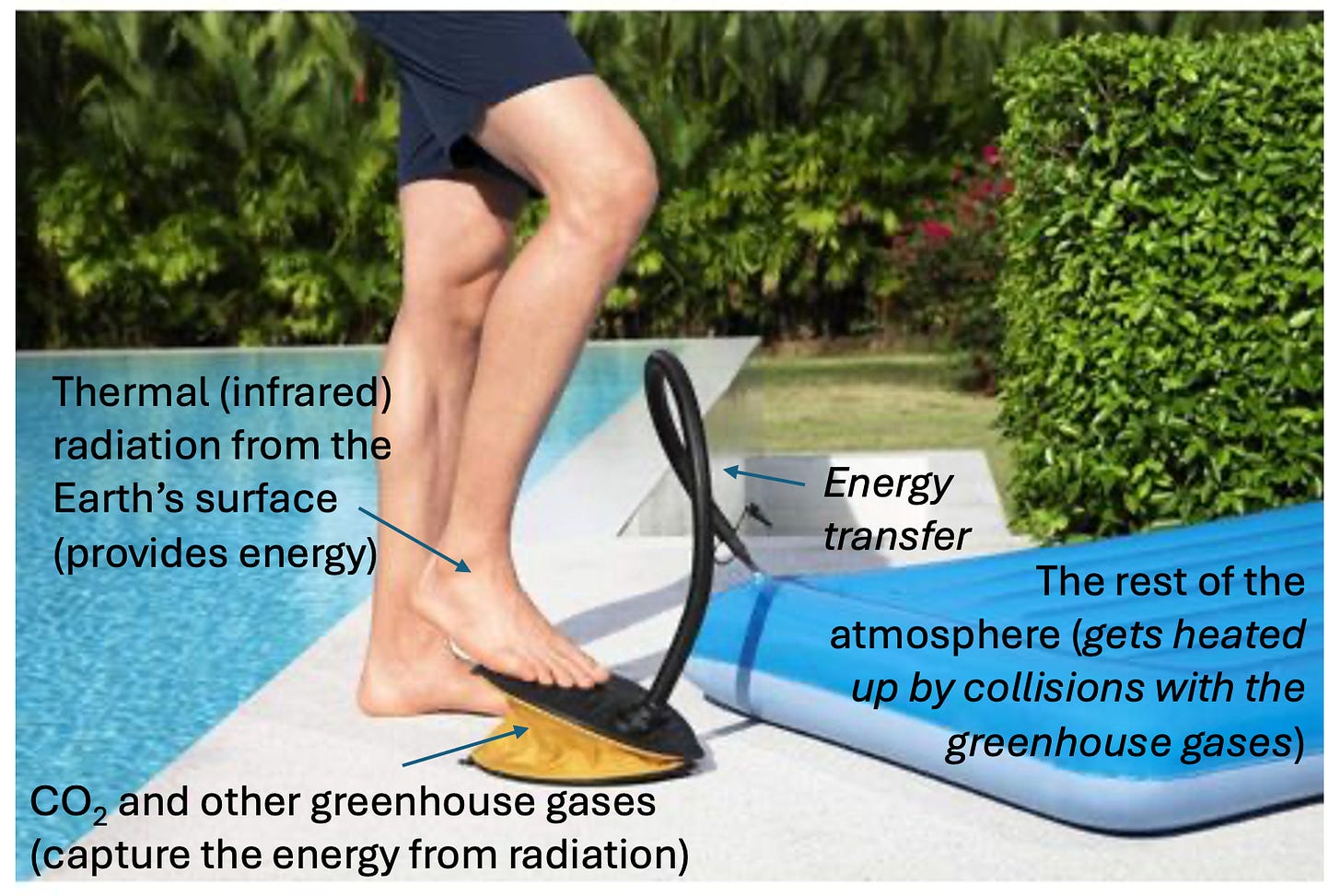
And what this means is that we should not think of CO2 as storing the energy it captures. Instead it is a kind of temperature increase enabler, an energy gateway, or pump. So it doesn’t matter at all that it’s a small proportion of the atmosphere by volume. All that matters is the effect it has on the rest of the gases which surround it.
In conclusion: I’ll admit that I am one of those who think our climate response has taken a bit of a wrong turn of late. So I could potentially be an ally of Congressman LaMalfa in some areas. But whatever the policy changes are that we need, they must be based on sound reasoning and good sense. So the problem I have with the Congressman and his supposed insight is that it was not an insight at all. It was, I am sorry to say, an uninformed assumption which wouldn’t pass a high school science test, and which has apparently been co-opted in support of a nakedly ideological point.
And that, dear readers, is no way at all to proceed.
Actually this is molecular volume, so it means there are 425 moles of CO2 for every million moles of dry air. Adjusting for the higher mass of CO2 (44) relative to air (29), suggests CO2 is more like 0.064% of the atmosphere, by mass. But LaMalfa probably doesn’t care to get into all that, so let’s move on.
I will have more to say on this in future articles, so bear with me. One step at a time.
Here are some more reference concentrations. The source is GPT. I haven’t checked them all.
OK, it was already vibrating slightly. Everything is vibrating slightly. But what I mean is, it starts to vibrate at a higher frequency.
I borrowed this exhibit from an unrelated scientific paper. Diffusion Cooled V-Fold CO2 Laser - Scientific Figure on ResearchGate.
Contrast the CO2 molecule with three atoms and a bending mode (or the methane molecule, CH4, with 5 atoms).


