Literature
The undiscovered 'Easter Egg' in Stegner's masterpiece
It has to do with raw chicken. Let me explain.
Literature
The undiscovered 'Easter Egg' in Stegner's masterpieceIt has to do with raw chicken. Let me explain.
Culture
The power of a pure idea: The Finger-SpaceThe rip-roaring tale of Marc Antoine de Muret, Fragment 31 and the greatest literary scoop of the 16th century
Earth Science
Our brains are not wired to understand geologic timeIf they were, we might reach some very different conclusions about our planet
Drama
Sophocles and the Pink Pony ClubWhat we learn about how a good society works from a survey of world literature
Age of Discovery
Volta do marWe must sometimes risk the perils of the wide open ocean if we are to discover new worlds
Culture
Has intelligence gone out of fashion?It might soon be time for a retro revival
Finance
How financial markets actually workI'm taking a swipe here at a Nobel Prize winner - maybe not a good idea, but if you work in finance you'll understand my motivation
Politics
The end is near for Sir KeirHe seems to have a nasty case of Stanley Baldwin disease
Society
A red traffic light at 3amNot a soul in sight and the town is fast asleep. What do you do?
International Relations
NATO and 1984Will Ukraine be betrayed by doublethink and boiled rabbits?
Markets
Is the AI bubble bursting now?Opinions are divided (but I have taken a view)
Climate
Bill Gates and Point BreakA look at the Gates climate letter through the lens of an iconic, 1990s surf dude film
Politics
The dumbest thing a Congressman saidSo daft, you won't know whether to laugh or cry
Culture
The rip-roaring tale of Marc Antoine de Muret, Fragment 31 and the greatest literary scoop of the 16th century
An article to celebrate the humble finger-space: that short interlude of blank canvas which we have learned to leave between our written words. Without that liberating but invisible innovation, we would be lost in a sea of words – a problem nowhere more elegantly illustrated than in the story of Marc Antoine de Muret and the re-discovery of the long-lost Fragment 31 (the most famous verse fragment to come down to us from Antiquity).
Let me introduce this article with the story of Marc Antoine de Muret, an early Renaissance French scholar and humanist who was born (evidently) in Muret, Limousin, in the year 1526. He is a little known figure today, having left a limited legacy beyond the events I plan to recount here. Yet under his Latin name Muretus he was a celebrated figure in his day and clearly among the leading classical scholars of the 16th century.
Already prodigious in his youth, by the age of 21 Muretus was teaching at the Collège de Guyenne in Bordeaux, where his colleagues included George Buchanan (the leading Scottish intellectual of the sixteenth-century; later to become tutor to King James VI) who was on the lam in the South of France, after pushing his mockery of the Catholic church a little too far.1 Muretus’s own students were also notable, including, from the age of six, a certain Michel de Montaigne (renaissance philosopher and father of the modern essay). And his close friends were Pierre de Ronsard, Joachim du Bellay and Jean-Antoine de Baïf – the senior members of La Pléiade, a famous if somewhat shape-shifting group of poets committed to the revival of the French language in classical forms.
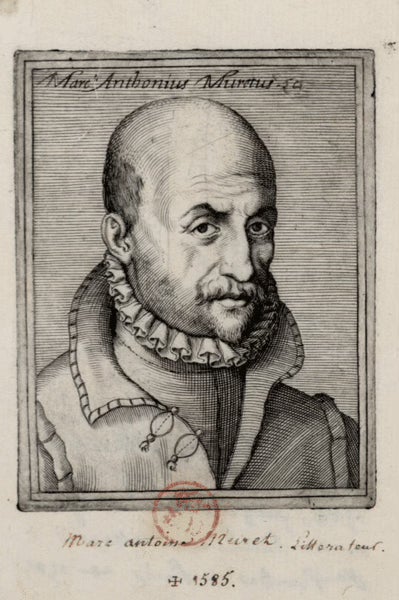
The Bordeaux days were good times for Muretus and he is immortalised in a dedication to a famous Ronsard poem – The Fortunate Isles - which fantasises an escape to intellectual Elysium. But if that moment was the apogee, a dark chapter was to follow soon after when he was “charged with an offence against public morals”, as a biographical source from the 1940s coyly puts it, and forced to flee to Venice while his effigy burned in France. The source continues: “his hasty flight adds weight to the reports of his contemporaries that he had been guilty of the practice of which he had been accused”. I will let you draw your own conclusions, as this is not important to the story at hand, but let us just say in passing: thank goodness times have changed.2
What is much more important for our purposes here is what happened when he arrived in Venice. This is where the story becomes interesting, because Venice is where Muretus makes history with his epic discovery – or to be more accurate, re-discovery3 – of a long lost fragment of Sappho’s most celebrated lyric love poem, according to Emmet Robbins the single most famous poem to come down to us from Antiquity, and known to us now simply as ‘Fragment 31’.
Here it is, the entire fragment of Sappho which Muretus found in Venice (English translation to the right):4
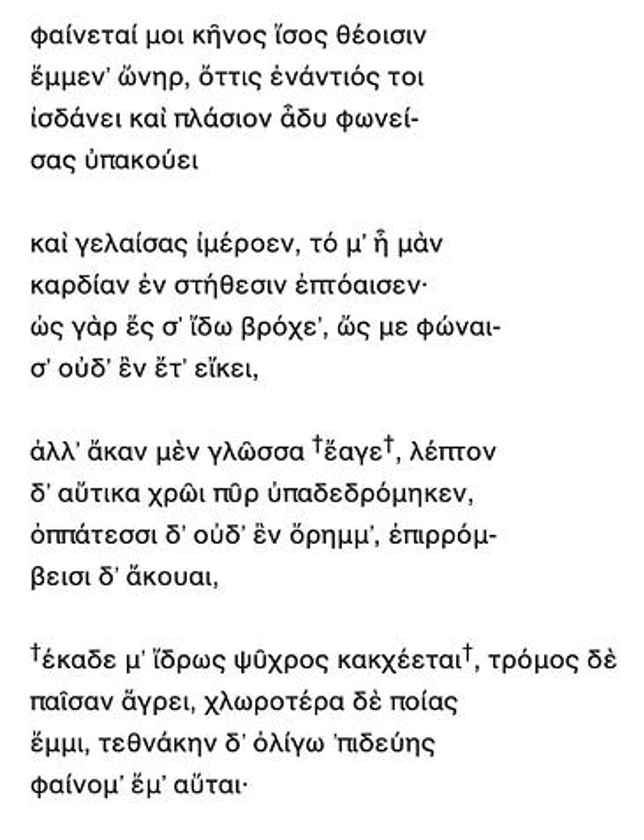

Where then, you may be wondering, was this fantastic fragment found? Hiding, you could say, in plain sight. Muretus was working on a translation into Latin of a Greek text by Longinus (Peri Hypsous, or ‘On the sublime’; an early work of literary aesthetics) when he discovered that to support a certain argument, Longinus had parsed out several verses of the Sappho poem, as quoted above. These verses, and indeed all the rest of the poem - already some 2000 years old by the time Muretus found them - had been lost to Western academics for centuries. But it was at once obvious that these were the correct, original verses, not least because (as suddenly became clear, though of course nobody had known until that moment) Catullus 51 turned out to be a Latin rendition of the same poem, even preserving the metre.
What Muretus discovered was without a doubt the literary scoop of the 16th century: classicists still write and think about it today. And his excitement at the discovery is nowhere clearer than in his new edition of Catullus, where he allowed himself the chance to delight in what he had found. His commentary on poem 51, which also reveals something of his own inimitable style, reads as follows:
Libet autem hoc potissimum loco singularem gratiam inire ab ijs omnibus, qui antiquitatis studio, & delicatorum versuum suauitate capiuntur. Etenim cum Dionysij Longini libellum Περὶ ὕψους, qui nondum à quoquam editus est … cum alia in eo sane plurima deprehendi digna, propter quae liber ipse communi omnium elegantium hominum desiderio expetatur, tum oden suavissimam poetriae Sapphus, quam ijs, qui proxime antecesserunt, versibus maxima ex parte Catullus expressit.
It is a pleasure in this place to earn the particular gratitude of all who are fascinated by the study of Antiquity and the charm of tender and sensuous poetry. For when I had begun to translate Dionsyius Longinus’ work Peri Hypsous, which has never been edited by anyone, into Latin … I not only noted in it many things worthy of discovery, which make the book itself an undisputed desideratum among all men of good taste, but also the most charming lyric of the poetess Sappho, which Catullus has largely translated in the preceding verses.
From Muretus new edition of Catullus (1554), commentary on poem 51, highlighted by WL Jansen in ‘Appropriating Longinus’.5
So it was definitely a scoop. But we have to ask, how was it that nobody had noticed these lines before? The manuscript that Muretus was working on, the Parisinus Graecus 2036, dates from the 10th Century. It was not a new source. It had not been missing or lost. But it seems that for at least several hundreds of years, nobody had realised what a wonderful secret lay hidden within its pages.
Excited by this story, I decided to see if I could manage a look at the famous manuscript myself. Manuscripts in general are hard, but the first part of this project quickly proved simpler than I expected – since the Bibliotheque Nationale de France has painstakingly scanned the codex and provides a digital version of the entire document online. So one day not long ago, I sat down with my laptop to have a look.
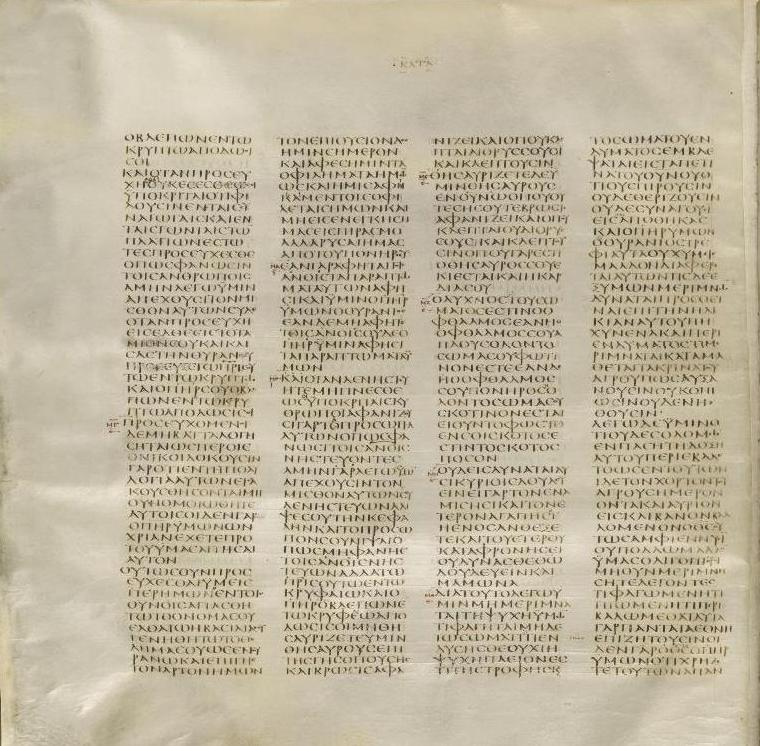
My first thought was this: I’d really like to see those lines of Sappho, and imagine what Muretus felt when he turned the page and found them for the first time. But my second thought was: wait … how on Earth am I going to find those lines? Even with the digital manuscript in front of me, locating the Sappho fragment was a LOT more difficult than I expected. To give you a sense of how painful the exercise turned out to be, here is one of the 442 pages from the codex (which begins, by the way, with the complete text of Aristotle’s Problemata; Longinus is attached as an appendix).
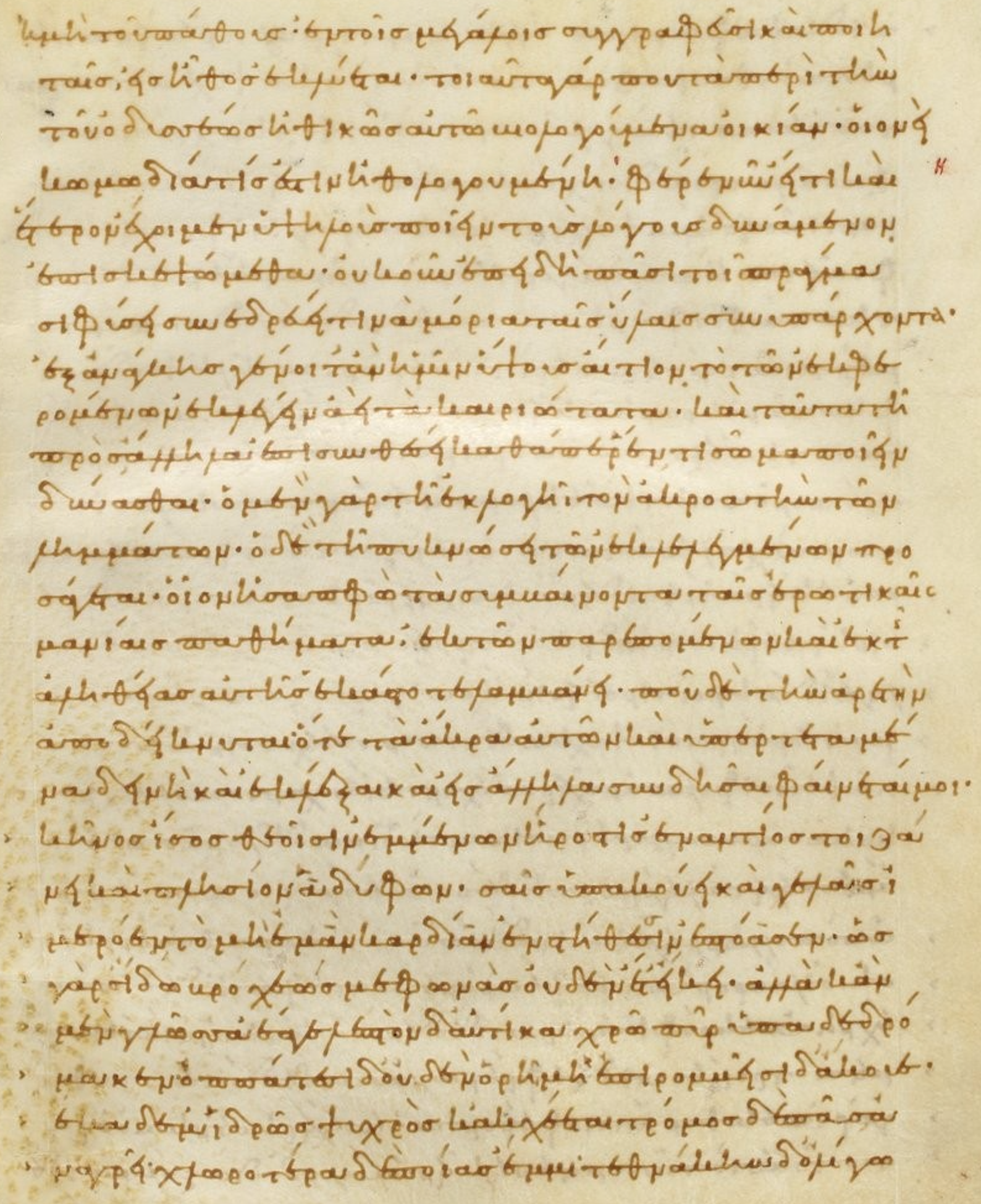
A glance at the above immediately conveys the problem. First of all, there is the fact that manuscripts are generally hard to read, simply because the way letters were written out, by hand, a thousand years ago is very different to how they are printed nowadays in a modern classical text. To transliterate a few problems: an ‘e’ looks like an ‘s’; an ‘n’ looks like an ‘m’; and so on. Never mind that these pages are somehow, indulgently gorgeous to look at, the handwritten text takes an awful lot of getting used to. It is almost impossible to read, even if you know Greek.
But even after that, there is another, and much bigger problem: scriptio continua, or continuous text. There are no line spaces, quotation marks, carriage returns or commas or other punctuation, barely even a finger-space between the words. The page copied above is, actually, the one which contains the immortal Sappho fragment - but you would be forgiven for not seeing it. Tracking down the exact words is like finding the proverbial needle in the haystack. But I got there in the end, and here it is (the lines of the first verse are underlined, and quoted beneath in the modern format):
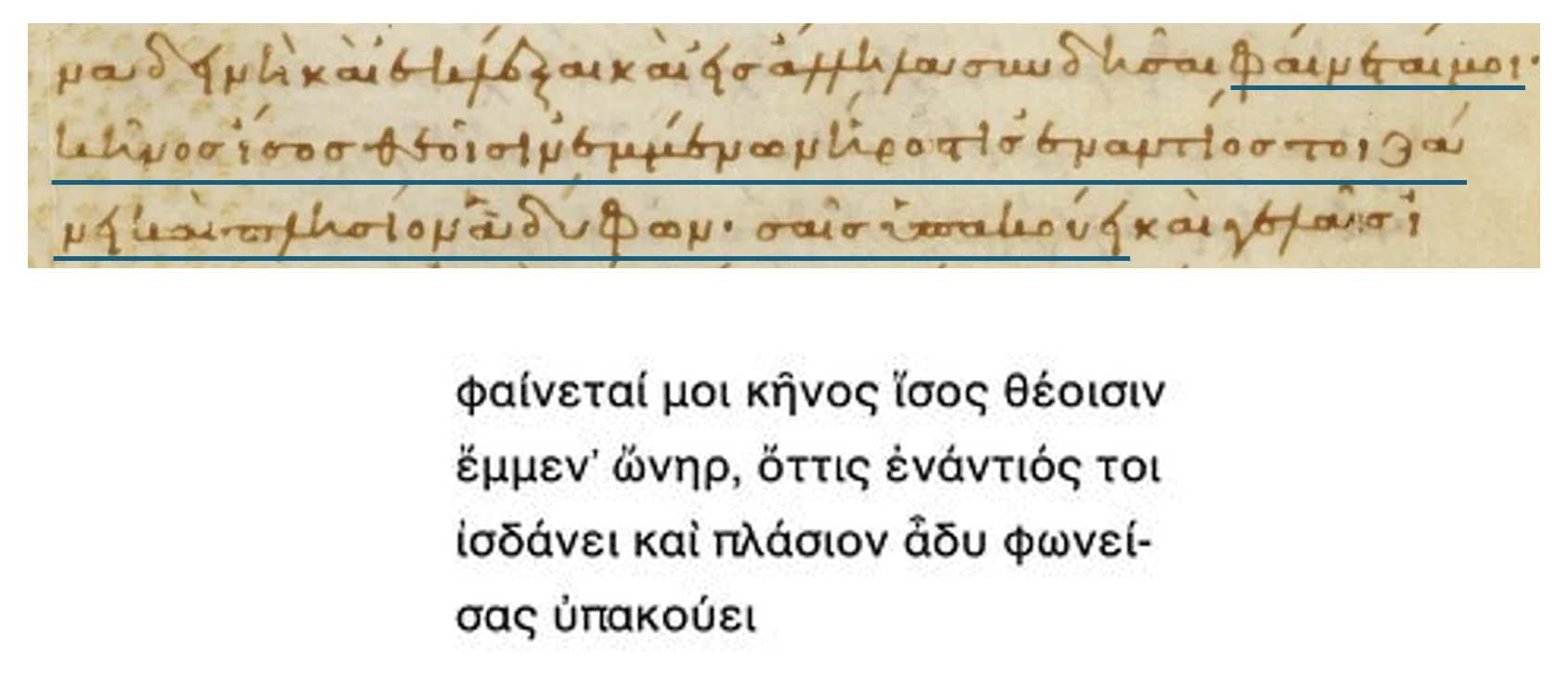
By now, you may see where I am going with all this. Why was it, I wanted to know, that nobody thought to leave at least a space between each word? The benefit is so obvious, and the costs of omission so high - as illustrated firstly by the story of Muretus and the lost fragment (practically impossible to find within the pages of an essentially unreadable manuscript), but also by the practical difficulty of understanding simple statements when written without a break between the words. The ambiguous statement that Godisnowhere gives an entertaining illustration of the problem. Ambiguous readings are par for the course in scriptio continua.6
My first thought was that the reason must have been economic. I assumed that the idea of leaving a ‘finger space’ between words – which we teach to our children these days before they even start school – must have been obvious, but undesirable for some reason. And the most likely reason, I guessed, must have had to do with the cost of writing materials. If the parchment, papyrus or vellum was expensive, I reasoned, perhaps the scribes could not afford to leave any space unused? Perhaps they were under pressure to cram as many words as possible onto the page?
But then a look at some famous manuscripts from the age of scriptio continua quickly dispensed with this idea. A look at the Codex Sinaiticus, for example, one of the oldest biblical manuscripts (dating back to 4th century CE, and the oldest to include a complete copy of the New Testament) shows acres of unused parchment. Look how wide the margins are! From this and other pictures, I have estimated that the scribes left at least 40% of each page blank. Sometimes, an oversimplified economic explanation can be, well, just completely misleading.
With a bit more research, I soon found out that the story is quite different. Scriptio continua dates back to a time when reading was done aloud, the text providing a prompt to the reader of what to say next and the continuous script mimicking the continuous manner in which we speak. We don’t leave gaps between words when we are speaking aloud. So for this purpose, it seems, the finger-space (or other innovations in layout or punctuation) were not really required. Indeed, the classical Latin convention of an interpunct, a floating full stop between each word, largely fell out of use by around 200 CE, seemingly because it wasn’t needed.7
So then there followed a period of some 500 - 1,000 years where manuscripts followed the scriptio continua convention, or what I think of as the unreadable stream of consciousness format. And it was only from around the 7th or 8th Century that scribes in the Irish monasteries, and some in the North of England, began to introduce the finger-space, and the monks started reading in their heads – although it’s perhaps not 100% clear which came first: whether the brilliant innovation of the finger-space unlocked the practice of silent reading, or if silent reading was the brilliant innovation which unlocked the practice of leaving a space between words.
We will surely never know, but my money is on the finger-space as the déclencheur.8 There are some sources which suggest silent reading had been around for a long time before the finger space became standard, including an interesting 4th century story about St Augustine and Ambrose, Bishop of Milan. But for some reason, silent reading never really caught on. Never, that is, until someone came up with the finger-space to make it easy. From that point on, what we can see is that the convention began to spread around the world, so that by around the 12th century or so, scriptio continua had been abandoned almost everywhere and by almost everyone – and the finger-space had won its permanent place in the foundational technologies of human civilisation: writing, and reading.9
What I love about the story of the finger-space is that it does seem to have been the purest of pure ideas. No new materials were needed, no financing, no conferences or copyright applications. It was just an idea, tout court. The scribes just had to see what hadn’t been seen until then: that leaving a space between words could make reading so easy that you could even do it in your head.
Today, we are so used to the space between words that we take it entirely for granted, as indeed we take for granted the idea of silent reading. But we need to pinch ourselves and remember that what may seem to be obvious today, was not always so. Someone had to think of it first, just as they had to think of all these other ideas at the foundation of our modern way of life:
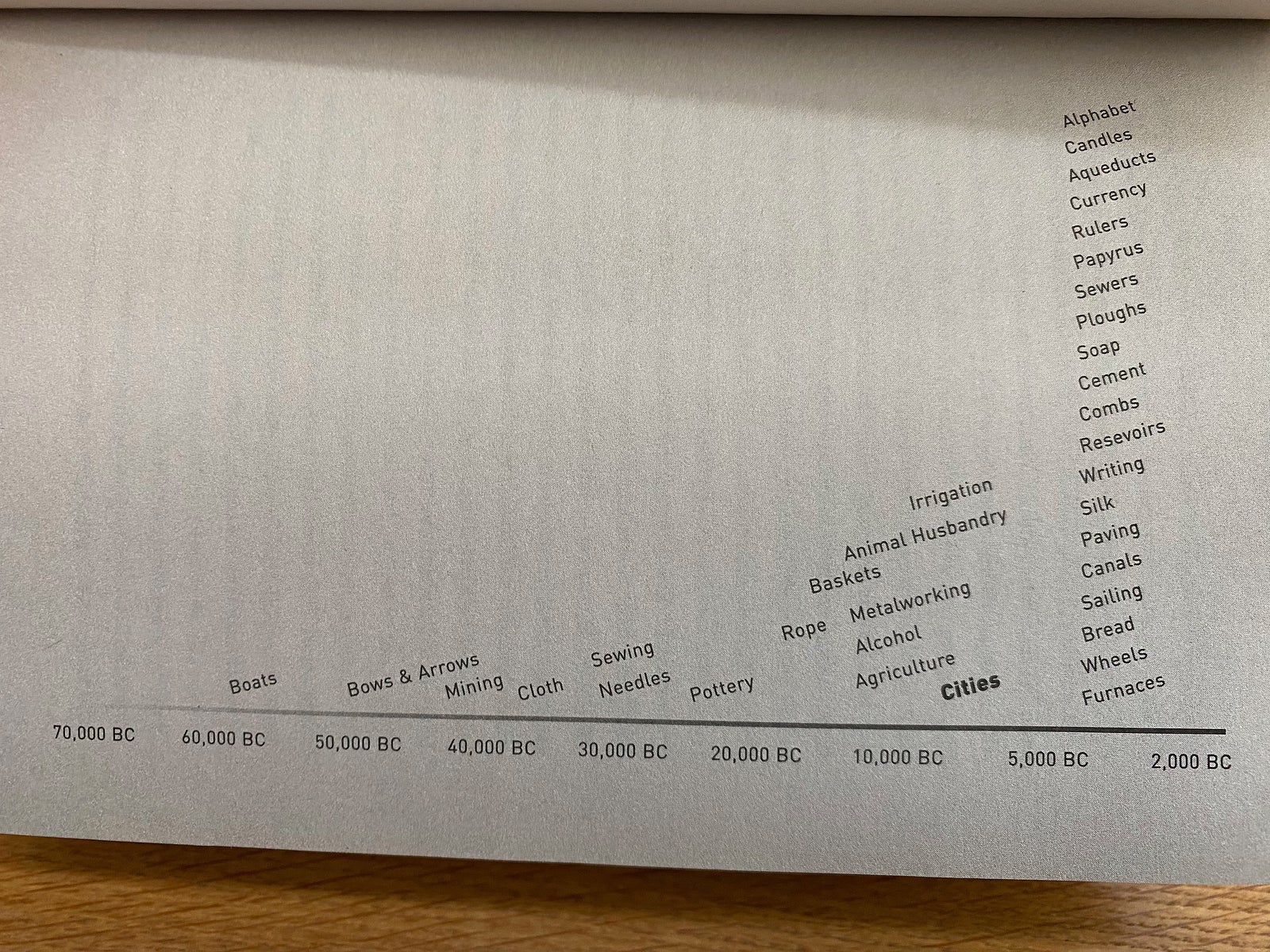
And this is, if you like, the paradox of innovation. The best ideas are so good, that once discovered, they are almost impossible to un-see. They are almost impossible to think of as ideas. Yet once a good idea proves its worth, like the humble finger-space, we use it all the time without even noticing and we struggle to dial back the intellectual clock to a time when the idea in question had not yet dawned on anybody.
But by the same token, we must recognise that we also find it hard to dial forward the intellectual clock, and to imagine the ideas which are yet to come. What is the finger-space of tomorrow? Or next year? Or next century? When it comes, it will change our lives forever, and we will scratch our heads and wonder how the buffoons of 2025 got by without this obvious insight. But until then, can we say what the next idea will be? Of course not – because by definition, nobody has thought of it yet.
His biting poem, Franciscanus et Fratres, reportedly amused King James V (of Scotland) but did not amuse Cardinal Deacon, who followed Buchanan to Paris, hastening his retreat to Bordeaux.
Marc-Antoine Muret: A Sixteenth-Century Classicist and His Work, Henry T. Rowell, The Classical Weekly Vol. 35, No. 23 (May 11, 1942), pp. 268-272, The Johns Hopkins University Press.
Technically, the fragment was not ‘lost’, since it had been preserved in the 10th Century manuscript where Muretus found it. There is some evidence that Michel Psellos, the 11th Century Byzantine historian, was familiar with Peri Hypsous, and perhaps also Angelo Poliziano, in 15th Century Florence. But it is broadly agreed that the Sappho fragment was forgotten, and editions of Catullus prior to Muretus in 1554 made no mention of it, although it was known that other Catullus poems were translations of earlier Greek lyricists, e.g. Alcaeus. So it seems fair to say that Muretus rediscovered Fragment 31, at least for Western scholars.
The translation is from the Wikipedia page on Fragment 31, omitting the last, incomplete line. Wikipedia does not say whose translation this is, so I can’t attribute.
Jansen, W. L. (2019, April 17). Appropriating Peri hypsous : interpretations and creative adaptations of Longinus’ Treatise On the Sublime in Early Modern Dutch Scholarship. Retrieved from https://hdl.handle.net/1887/71553. This is an excellent piece of work.
In case not obvious, you can read this as ‘God is now here’ or ‘God is nowhere’. Up to you.
For completeness, I note that the interpunct did start to serve a role in some Greek manuscripts which was equivalent to the modern comma, and this is visible also in the Parisinus Graecus 2036. But you try reading it - the interpuncts don’t help you much! There is also one in the penultimate word of the first verse (phonesas) which seems to be a shorthand or elision, rather than a comma. If any one can explain, please do! There is a comments section.
Paul Saenger’s 1997 book Space Between Words has more to say on all this.
Well, not quite everywhere. There remain some languages, eg Thai, which are mostly written in scriptio continua, and there is also a weird thing called CamelCase where you omit spaces between words, but capitalise the first letter. Modern day examples are YouTube, PowerPoint, FedEx, etc. It’s weird. But it is a Thing.


