Literature
The undiscovered 'Easter Egg' in Stegner's masterpiece
It has to do with raw chicken. Let me explain.
Literature
The undiscovered 'Easter Egg' in Stegner's masterpieceIt has to do with raw chicken. Let me explain.
Culture
The power of a pure idea: The Finger-SpaceThe rip-roaring tale of Marc Antoine de Muret, Fragment 31 and the greatest literary scoop of the 16th century
Earth Science
Our brains are not wired to understand geologic timeIf they were, we might reach some very different conclusions about our planet
Drama
Sophocles and the Pink Pony ClubWhat we learn about how a good society works from a survey of world literature
Age of Discovery
Volta do marWe must sometimes risk the perils of the wide open ocean if we are to discover new worlds
Culture
Has intelligence gone out of fashion?It might soon be time for a retro revival
Finance
How financial markets actually workI'm taking a swipe here at a Nobel Prize winner - maybe not a good idea, but if you work in finance you'll understand my motivation
Politics
The end is near for Sir KeirHe seems to have a nasty case of Stanley Baldwin disease
Society
A red traffic light at 3amNot a soul in sight and the town is fast asleep. What do you do?
International Relations
NATO and 1984Will Ukraine be betrayed by doublethink and boiled rabbits?
Markets
Is the AI bubble bursting now?Opinions are divided (but I have taken a view)
Climate
Bill Gates and Point BreakA look at the Gates climate letter through the lens of an iconic, 1990s surf dude film
Politics
The dumbest thing a Congressman saidSo daft, you won't know whether to laugh or cry
Finance
I'm taking a swipe here at a Nobel Prize winner - maybe not a good idea, but if you work in finance you'll understand my motivation
In a seminal 1970 paper in the Journal of Finance, Eugene Fama of the University of Chicago, the father of modern finance, set out the case for the Efficient Market Hypothesis. He didn’t entirely invent the hypothesis, some of the groundwork for that had been done by a Frenchman named Louis Bachelier way back in the year 1900, but the concept had returned to academic circles during the 1960s and others (notably Mandelbrot in 1963, and Samuelson in 1965) had begun to do interesting work on it. Fama’s paper, which provided a new synthesis at the end of that decade, soon became the canonical articulation.
So what does the Efficient Market Hypothesis say? In short, that asset prices in an efficient market should reflect the available information set and so it should not be possible to devise a trading strategy that systematically outperforms the market on a risk-adjusted basis. In lay terms, this is very similar to saying that no investor should be able to beat the market consistently. It doesn’t mean that nobody will turn out to make an abnormal return ex post. It just means that if that happens, it may as well just have been luck.
Fama’s paper collated various types of evidence to show that markets are efficient in this way, and his citation on the Nobel Prize website summarised his work as follows: 1
In the 1960s, Eugene Fama demonstrated that stock price movements are impossible to predict in the short-term and that new information affects prices almost immediately, which means that the market is efficient.
Well, I may be a fool, but I beg to differ.
Here goes why.
I’ll start with the observation that apparently, some asset managers do consistently outperform. The graphic below, from a widely used Corporate Finance text book, shows that at least the larger sized asset managers are indeed adding value. They are generating alpha, which means they are realising returns which are better than would be expected based on a simple correlation of their portfolios with the market (beta). 2
(The graphic also shows, by the way, that the fund managers capture all this additional value for themselves, by charging high fees. The net alpha generation for their investors, i.e. after adjusting for their fees, is still negative. But that is perhaps a topic for another day.)
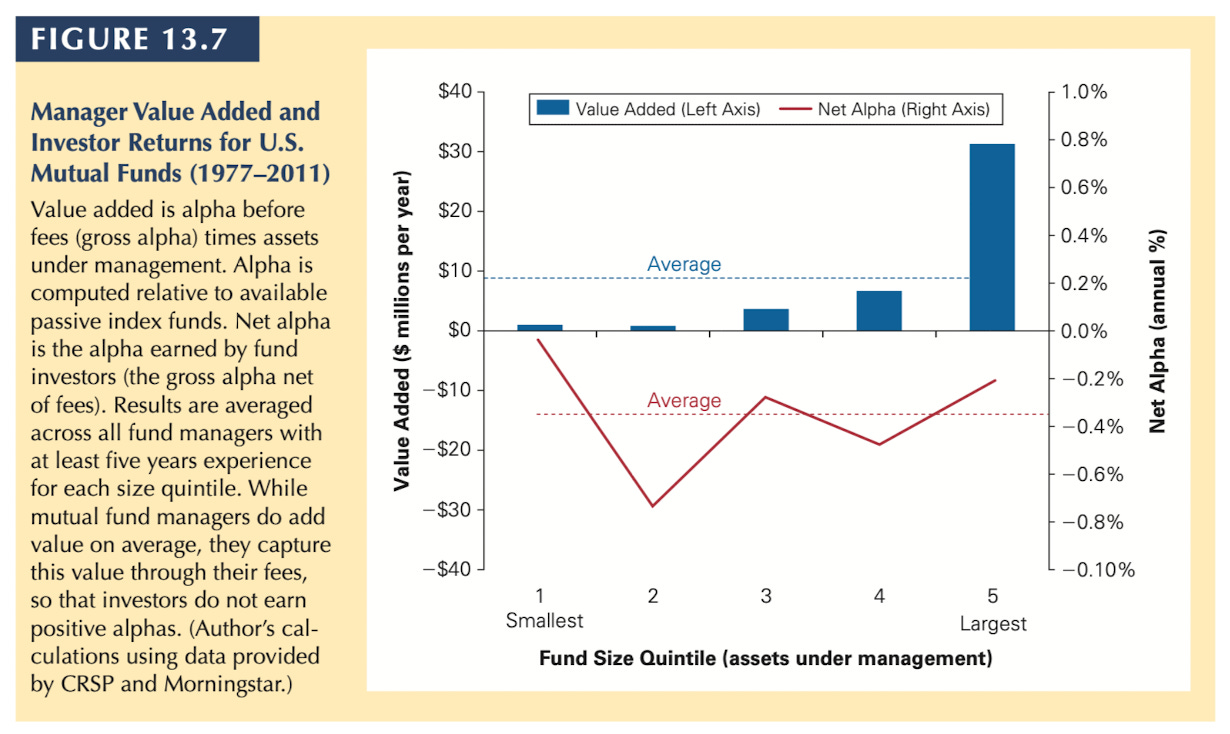
The point is that if at least some asset managers are able to generate alpha consistently, then it seems to follow that there must be at least some level of market inefficiency lurking in the system.
Academic studies look for this inefficiency in various interesting places. They speculate whether some investors have constraints which prevent them from trading exactly as they would want to - perhaps capital constraints, liquidity or risk limits - or if they are subject to various behavioural biases? It has been noted that stock markets perform better on days when the sun shines in the morning, for example.3
There are also questions about the role of retail investors, i.e. individuals rather than firms, who tend to lack access to all the relevant information (as well as diversify insufficiently and trade too much). The idea is that for some investors to outperform the market, others must under-perform it, so the direction this kind of research goes in is to figure out which investors are under-performing and why.
But at the end of the day, this sort of research has something in common with the famous poker aphorism that if you don’t know who the fish is, then you are the fish. It is a search, in other words, for obvious sources of error, and the implication is that those sources of error could, at least in theory, eventually be ironed out.
I don’t object to these studies, and I’m sure they capture something which is relevant. But at the same time, I struggle with the basic way that the problem has been framed, and the mental model it seems to adopt of how financial markets work.
Let me start with what Fama means when he refers to ‘information’.
Early in the famous paper Fama introduces a term, Phit, to denote “whatever set of information is assumed to be ‘fully reflected’ in the price” of an asset at time t.4 But he doesn’t spend time discussing what kind of information he is talking about. The idea seems to be that Phit is an all-encompassing term which captures any public information which is important for prices.5
But if we then look at the examples of ‘information’ which he uses, what are they? They are all very concrete and immediate kinds of information. Here for example is the key passage from his conclusion section:
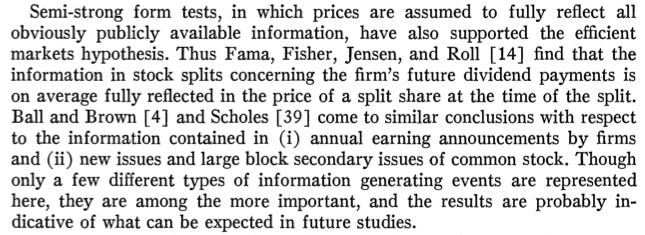
To paraphrase, Fama is concluding here that the ‘semi-strong’ version of the Efficient Market Hypothesis (which is the one we are interested in - see earlier footnotes for the reason why) is supported by the data. And he is going on to explain that the data in question includes his own groundbreaking work on stock splits and dividends (which did indeed precipitate the entire industry of event studies in finance) and also similar work by peers on other kinds of concrete events (annual earnings announcements and new issues and large block secondary issues of common stock).6 He recognises that these are just examples, but goes on to say that the examples he cites are “among the more important” types of information.
And this is where I think the great man has made a misstep.
To explain why this is a misstep, we need to look at how the asset management industry actually does its work.
We can do that by narrowing in - as an illustration - on the standard method for generating a fair value estimate for a company stock. In short, a fund manager needs to take a view on the overall value of the enterprise; identify the claims on that enterprise value from parties other than the shareholders; and finally deduce the equity value by subtracting the latter from the former. A deliberately simplified summary would look something like this:
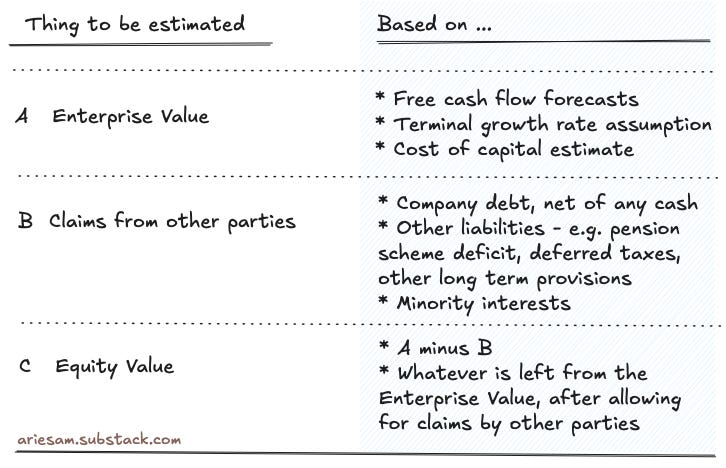
A glance at this table reveals important differences in the kind of information which the analyst is going to use. For (A), the Enterprise Value estimate, the exercise is to make predictions of the future: the fund manager might use analyst consensus estimates, or her own model projections. She might draw on expert opinions such as market size projections or competitor benchmarks. And she might use management guidance as an input (indications from the company about how they expect numbers to shape up). But very little of this is hard or factual data. What is going on is a process of estimation.7
In contrast, for (B), she needs to size the claims from other parties as at the valuation date - which for simplicity is often the last balance sheet date. So this part of the process will be about looking up numbers. The net debt is a published number, so is the pension deficit, so are the deferred taxes, and so on. The list can be quite complicated, and sometimes adjustments and guesswork is needed, but for the most part the numbers you need are facts, and you can look them up.
Together, then, the investor combines facts about the world with estimates and forecasts about the future to produce an output, which is the investor’s fair value estimate for the shares. And in my experience, in the first instance, the fair value estimate will tend to be quite close to wherever the shares are trading. Why so? Because many investors begin by trying to figure out ‘what’s priced in’.
What this means in everyday language is that the investor will begin by using their valuation model to reverse engineer the current share price. This is a valuable thing to do for two reasons: firstly, because it gives you a cross check that your valuation model is working as it should (if you are missing some important input, for example, you won’t be able to reproduce the current market price); and secondly because it allows you to make inferences about what everyone else, collectively, is thinking. Anybody with access to the internet can see the market price of a stock, but to see what information and assumptions that price is based on, you need to build a valuation model.
But this is then where things get interesting. Because once you have built a valuation model which replicates market pricing, yes, you will be able to infer what everybody is thinking about the future. But you will also, at last, be at liberty to ask the most important question any investor ever asks: how will the actual future be different to the expected future which the market is currently pricing?
It is the answer to this question which makes or breaks investment careers. It is the answer to this question which allows a fund manager to take a contrarian view. It is the answer to this question which explains how a fund manager can generate alpha.
Now we know what investors actually do, we can think about the types of information which will be relevant to market prices. It doesn’t take long to come up with a classification, as follows:
Now, if we consider these three information types as sub-categories of public information as Fama defined it, we can suggest a better analysis of when we would expect markets to be efficient. The first part of the answer is that markets should be hyper efficient in the processing of first order information. After all, that stuff is factual and usually quantified already. I don’t see any reason why markets would not be very good at identifying and factoring in this kind of information - the only exception would be mistakes, and while mistakes are never eliminated, you can imagine that systematic mistake-makers would drop out of the market over time.
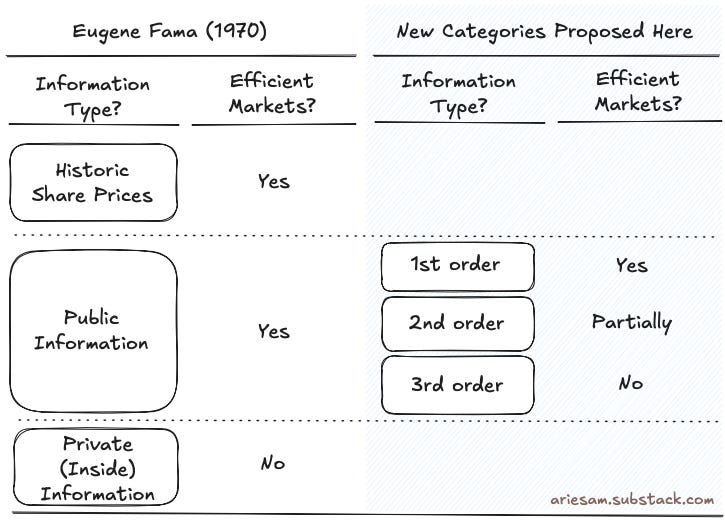
What’s interesting however is that 1st order information is only a subset of Fama’s public information (‘whatever set of information is assumed be fully reflected in the price of an asset at time t’). Asset pricing also reflects 2nd and 3rd order information, which informs our estimates of the future, and our estimates of how our estimates will change.
It’s perhaps not immediately obvious how you would test the efficiency of the market in converting 2nd and 3rd order information into prices, but the existence of systematic alpha at scale (as indicated above) does seem to support the conclusion that markets are not fully efficient. The alternative, under Fama, would be to assume that large fund managers generating systematic alpha are all trading on inside information, which - as a characterisation of how modern finance works - seems a lot more extreme than the picture I have drawn .8
In summary, Gene Fama is a giant. He produced groundbreaking work which shaped how several generations have thought about financial markets. But at least in his original and most canonical paper, he seemed to imagine ‘information’, and the process of market price formation, in a highly stylised way. He made claims about the ‘information set’ using a very broad definition of what that set could include, but supported those claims with empirical studies which looked at a much narrower subset of information types. He essentially only supported the efficient market hypothesis with reference to what I am now calling “first order” information. And he even seemed to say that this was the most important type of information for prices.
These days, over 50 years later, we have a better understanding of how financial markets work and of what asset managers are doing every day. We can see that what they most want to lay their hands on is not first but second order information (allowing them to develop forecasts and estimates about the future) and third order information (allowing them to anticipate how the basis of today’s forecasts and estimates is likely to change, and therefore to adopt contrarian positioning). We can see that they are engaged in a process of making bets about how second order information will crystallise into first order information over time, and - even more powerfully - about how third order information will crystallise in the same way into second order information.
And once you have the three tier model of information types in mind, it doesn’t seem controversial at all to suggest that some asset managers might find ways to identify and process the second and third order information systematically more effectively than peers. Because while the first order information is concrete and cheaply available, the second order information is not concrete, and the third order information is neither concrete nor cheap.
As a result, the capabilities needed to identify and process the higher order information can take many years to develop, for individuals and for firms. The systems and practices used to do so are complex and proprietary and in that sense, not dissimilar conceptually to ‘private’ information as Fama defined it. Which explains why such capabilities may not scale at pace to the wider market, and why systematic alpha may persist in some cases.
A final feature of this way of looking at how financial markets actually work is that it puts the focus on positive capabilities, which you might generically call skill or expertise. Market inefficiency, under this view, arises when some parties are able to develop unique and proprietary insight which cannot be instantly scaled and emulated by everybody else. And that feels more realistic as a driver of competitive advantage than the view we started with, that market inefficiency arises because some people in the market are fish, even if that is also true.
None of this, I don’t think, will seem controversial to practitioners - but there is clearly a gap between theory and practice, and my argument here is that the gap can be closed by thinking more carefully about the three different types of information in play. By thinking more carefully, that is, about how financial markets actually work.
The paper famously made a distinction between three forms of information you might be referring to when you articulate the hypothesis. The weak form refers to the information contained in historic prices, and was said to be well supported by the data. The semi-strong form refers to all publicly available data, and was also said to be supported by the data. The strong form refers to all available, including private or insider data, where the evidence was more mixed. For simplicity in this article, when I refer to the ‘Efficient Market Hypothesis’ I’m just referring to the ‘semi-strong’ form.
For simplicity, I have skipped over the joint hypothesis problem. This says that you can’t really say if markets are doing what they are supposed to do if you don’t have an objective model of what markets are supposed to do. And if you do have one, and somebody outperforms, then you can’t tell if the market is inefficient or if the model of what the market is supposed to do was wrong. But this is all a bit complex, and not key to what I’m trying to say here.
“Good Day Sunshine: Stock Returns and the Weather” (Hirshleifer & Shumway, 2003/2005): Published in the Journal of Finance, this study analyzed data from 26 international stock exchanges between 1982 and 1997 and found that morning sunshine in the city of a country’s leading stock exchange is strongly and significantly correlated with daily market index returns. The study noted that annualised returns in New York were much higher on sunny days (24.8%) compared to overcast days (8.7%).
If you want to see the source, here it is - a splendid instance of saying something simple in the most complicated possible way.
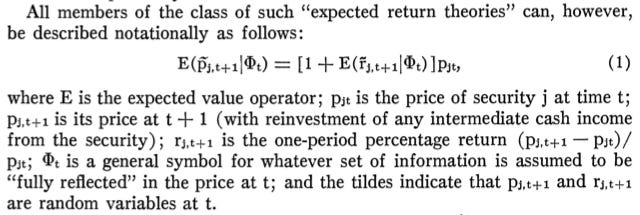
Again, for simplicity, I’m ignoring here the three part distinction mentioned in the first footnote, and instead just focusing on the information set referenced in the semi-strong version of the hypothesis - which is the one everyone cares about in practice.
A ‘new issue’ is when a company issues new equity to the market, and a ‘large block secondary issue’ is the sale of a substantial number of already-issued shares by existing shareholders (not the company) into the public market, typically executed in a single transaction or short time window, and which is often large enough to affect liquidity, price, or ownership structure.
The distinction is not black and white between the sections I have laid out. For example, the fund manager might use hard data to estimate the cost of capital, which is an input to (A), the Enterprise Value estimate. And she may use a modelled estimate of fair value for the minority interests, which is an input to (B), the sizing of claims from other parties. But generally speaking (A) will be based on estimates, and (B) will be based on facts you can look up.
I suppose somebody might say, you can’t rule out that thesis. But it seems more far fetched than my model of how markets work.


